Energy Transition, Electric Power, Coal, Water, Natural Gas, Renewables
October 29, 2026
FACTBOX: Affordability, energy transition on ballot in US state elections

By Staff
Editor:
HIGHLIGHTS
Utility costs, grid reliability drive gubernatorial races
States weigh who covers grid expansion costs
Gubernatorial and utility commission races in the US midterm elections Nov. 3 could reshape how states meet growing electricity demand and who pays for the necessary infrastructure, with implications for power supplies, utility investment and customer bills.
Data center development raises the stakes, putting pressure on states to expand generation and grid infrastructure while protecting existing customers from the costs of serving large electricity users.
Governors influence energy development through legislation, permitting policy and regulatory appointments, while utility commissions decide rates, infrastructure spending and power supply plans. Those decisions shape which projects advance, how costs are recovered and who bears the investment risk.
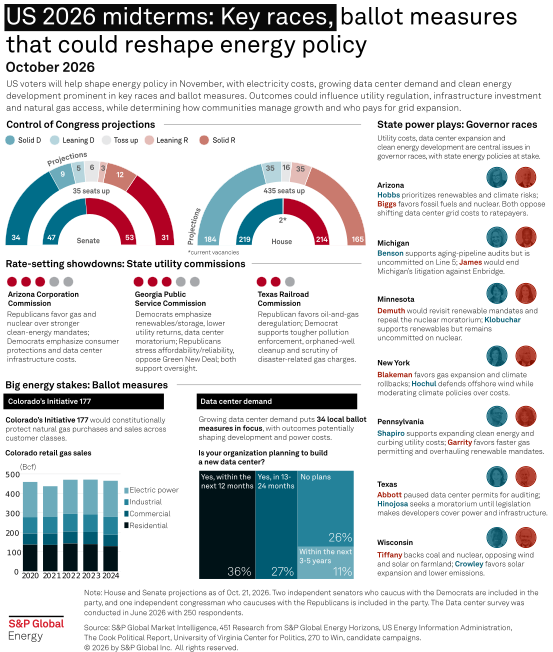
The following highlights key gubernatorial and utility commission races and their energy implications:
Gubernatorial races
Arizona
Overview: Governor Katie Hobbs (Democrat) is seeking a second term against US Representative Andy Biggs (Republican).
Energy impact: Hobbs favors renewable energy to lower costs and address climate risks. Biggs backs fossil fuels and nuclear power. Both support ending data center tax incentives and protecting ratepayers from grid-connection costs, but neither has backed calls for a moratorium.
Florida
Overview: US Representative Byron Donalds (Republican) faces David Jolly (Democrat) in to race to succeed Governor Ron DeSantis.
Energy impact: Donalds wants data centers to cover their electricity and water costs, and he wants utilities to harden infrastructure against major hurricanes. Jolly supports utility-scale clean energy, a cap on utility returns and reduced reliance on imported natural gas.
Michigan
Overview: Jocelyn Benson (Democrat) and John James (Republican) are running to succeed term-limited Governor Gretchen Whitmer (Democrat).
Energy impact: The race could shape the future of Enbridge's disputed Line 5 oil pipeline replacement project. Benson has not taken a position but supports audits of aging pipelines, including Line 5. James says he would end the state's litigation against Enbridge.
Minnesota
Overview: State House member Lisa Demuth (Republican) faces US Senator Amy Klobuchar (Democrat) as voters also decide control of the closely divided legislature.
Energy impact: Demuth said she would reconsider renewable energy mandates and repeal the state's nuclear moratorium. Klobuchar supports renewable energy but has not committed to nuclear power. Her Democratic-Farmer-Labor party hopes to cement legislative control by expanding its narrow 34-33 majority in the state Senate and 67-66 majority in the state House.
New York
Overview: Governor Kathy Hochul (Democrat) is seeking another term. Her opponent is Nassau County Executive Bruce Blakeman (Republican).
Energy impact: Blakeman would roll back state climate and renewable-energy policies, oppose offshore wind energy and support new natural gas pipelines and extraction. He has been critical of the state's moratorium on data centers. Hochul has moderated parts of the state's climate agenda over ratepayer costs while defending offshore wind, allowing some gas infrastructure and pausing construction of large data centers pending new regulations. The outcome could reshape renewable development, gas investment, utility planning and costs for large power users and ratepayers.
Pennsylvania
Overview: Governor Josh Shapiro (Democrat) is seeking another term against state Treasurer Stacy Garrity (Republican).
Energy impact: Shapiro has pursued an "all of the above" strategy that includes expanding clean energy, challenging utility rate increases and pressing PJM Interconnection to rein in capacity costs. Garrity would lift restrictions on new drilling, fast-track permits for gas production and power infrastructure, and pause or overhaul renewable energy and efficiency mandates. She also proposes cutting taxes and fees on electric bills, increasing bill transparency, and pausing data center development while prioritizing brownfields and giving local communities final approval. Both candidates say data centers should supply their own power. Pennsylvania's legislature is divided, with Republicans controlling the Senate and Democrats holding a narrow House majority. Voters will decide 25 Senate seats and all 203 House seats on Nov. 3. A Garrity victory, coupled with Republican control of both chambers, could shift state energy policy toward greater support for fossil fuels.
Texas
Overview: Governor Greg Abbott (Republican) is seeking a fourth term. His opponent is Democrat Gina Hinojosa.
Energy impact: Abbott is considering ending property tax exemptions for data centers and has paused permits pending an audit of large-load interconnection requests, after initially championing data center expansion. Hinojosa supports a moratorium until the legislature passes a law requiring large loads to pay for the power and infrastructure they require.
Wisconsin
Overview: Milwaukee County Executive David Crowley (Democrat) faces US Representative Tom Tiffany (Republican) to succeed Governor Tony Evers (Democrat).
Energy impact: Both oppose shifting data center costs to ratepayers, support ending tax credits for data centers, and favor greater local control of their development. Tiffany backs coal and nuclear power and opposes wind and solar on farmland. Crowley favors more solar and lower emissions.
State utility commissions
Arizona Corporation Commission
Overview: Two of five seats are open on the all-Republican commission. Republicans Kevin Thompson, an incumbent commissioner, and Ralph Heap, a state legislator, are facing Democratic running mates Jonathon Hill, an engineer and geologist, and Clara Pratte, a former federal and Navajo Nation official focused on tribal policy and clean energy.
Energy impact: Thompson and Heap oppose stronger clean energy mandates and favor greater reliance on natural gas and nuclear power. Thompson also says large energy users should cover the grid costs needed to serve them, while Heap emphasizes competition and scrutiny of utility rates. Hill and Pratte support stronger consumer protections, scrutiny of utility rate increases and requiring data centers to cover their infrastructure costs. They also back transparent cost-of-service reviews and water-use and conservation standards for large load users. The results could shift commission policy on rates and clean energy.
Georgia Public Service Commission
Overview: Democrats Peter Hubbard and Sheila Edwards face Republicans Fitz Johnson and Josh Tolbert, respectively, for two commission seats. Republicans need at least one to retain control.
Energy impact: Hubbard, an incumbent, supports renewables, storage, lower utility returns and a temporary data center moratorium. Johnson emphasizes affordability, reliability and opposition to Green New Deal policies. Edwards and Tolbert both say data centers should cover their grid costs and support greater utility oversight and transparency.
Texas Railroad Commission
Overview: Republican Bo French and Democrat Jon Rosenthal are competing for a seat on the three-member commission, which regulates oil and gas, pipeline safety and natural gas rates.
Energy impact: French favors further oil and gas deregulation. Rosenthal supports stronger pollution enforcement, orphaned-well cleanup and scrutiny of disaster-related gas utility pass-through rates. The seat will not change commission control, but a Rosenthal win could force a public debate on routine regulatory matters that have historically passed with industry-friendly consensus.
