Energy Transition, Metals & Mining, Electric Power, Natural Gas, LNG, Crude Oil, Renewables, Emissions
October 22, 2026
FACTBOX: US midterms to shape energy policy, oversight and investment outlook

By Staff
Editor:
HIGHLIGHTS
Republicans push fossil fuel expansion
Democrats eye energy oversight probes
The US midterm elections on Nov. 3 will determine control of Congress and could reshape the federal policy outlook for energy producers, utilities and project developers during the final two years of President Donald Trump's term.
A continued Republican majority would give the administration more room to pursue expanded domestic production, faster permitting and environmental deregulation, though narrow margins could limit major legislation.
Democratic control of either chamber would bring tougher oversight of agency decisions, project approvals and federal spending while increasing leverage over appropriations and, in the Senate, cabinet and court nominees. Either outcome could affect the durability of permits, tax incentives and other policies underpinning long-term energy investments.
The following is a snapshot of potential impacts and vulnerabilities across commodities under both congressional scenarios on the ballot: Republicans maintain full control of Congress, or Democrats reclaim at least one chamber.
Power markets and utilities
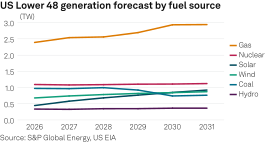
Republican scenario: Republicans could support continued rollbacks of US Department of Energy energy-efficiency standards and Environmental Protection Agency regulations on power plant greenhouse gas emissions. They could also use budget reconciliation to advance tax and spending measures favoring fossil fuel generation and grid expansion, including requirements that large loads pay their share of related costs.
Democratic scenario: Democrats could challenge or investigate agency actions that impede renewable energy resources or weaken GHG regulations. They could effectively block Republicans from using budget reconciliation to advance power-market priorities. Scrutiny of the Federal Energy Regulatory Commission could increase as the term of Commissioner David Rosner, a Democrat who has drawn Republican support, expires in June 2027.
Offshore wind and renewable energy
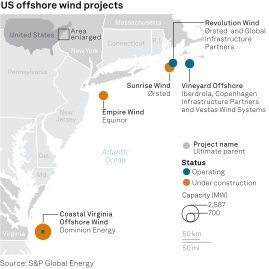
Republican: The administration would have more room to continue its offshore wind policies, delay permits for wind and solar projects and resist efforts to restore clean energy programs.
Democrat: An investigation into the US Department of the Interior's multibillion-dollar buyout of offshore wind leases is a near certainty. Democrats assert the refunded lease payments are illegal and violate congressional intent. Representative Jared Huffman of California could lead that effort as House Natural Resources Committee chairman, while Senate Democrats, including Chuck Schumer of New York and Martin Heinrich of New Mexico, have opened a parallel probe. Heinrich has also introduced legislation that would penalize improper delays or blocks on clean energy projects.
Nuclear energy and fusion
Republican: The Trump administration would face fewer obstacles in pursuing its nuclear energy agenda, including its civil nuclear agreement with Saudi Arabia. Bipartisan support for fusion commercialization could leave room for action on the American Fusion Leadership Act, a $10 billion proposal to accelerate the technology's development.
Democrat: Lawmakers are likely to demand stricter oversight of the Trump administration's nuclear policies. A Democratic Senate could complicate the civil nuclear agreement with Saudi Arabia, which has drawn proliferation concerns and was submitted for a 90-day congressional review in late August. The American Fusion Leadership Act could advance as part of a broader effort to revive clean energy programs and investment.
Cybersecurity
Republican: Bipartisan utility cybersecurity measures could continue to advance. The Quantum-GUARD Act, led by Republican Senator Mike Rounds of South Dakota, would codify parts of Trump's June 22 executive order addressing quantum-computing threats to utility encryption and help electric utilities adopt post-quantum cryptography standards developed by the National Institute of Standards and Technology in 2024.
Democrat: Cybersecurity is still likely to remain a bipartisan priority. Divided government, particularly a Democratic House and Republican Senate, could preserve momentum for legislation addressing quantum-computing threats to utility systems.
Natural gas and LNG
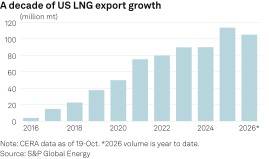
Republican: Prospects could improve for a bipartisan permitting reform package that natural gas industry participants view as the best opportunity in years to overhaul federal project reviews. The Trump administration would also retain broad latitude to ease LNG permitting and promote US LNG in trade negotiations. Republicans could also continue to try to enact a national prohibition on state and local gas bans.
Democrat: This could complicate permitting reform and intensify oversight of the gas and LNG sectors. Charlie Riedl, executive director of the Center for LNG, said a Democratic House would have to decide whether to advance legislation that could hand the Trump administration a policy win. With committee and subpoena power, Democrats could expand investigations into industry profits, energy prices, campaign finance ties and gas projects championed by the Trump administration, while blocking a federal prohibition on gas bans.
Oil
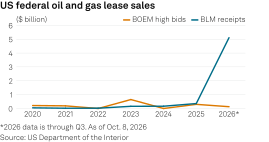
Republican: The Trump administration would have more room to continue expanding federal oil and gas leasing, including in the National Petroleum Reserve-Alaska and the environmentally sensitive, less-developed Arctic National Wildlife Refuge. Continued Republican control could also support the administration's deregulatory priorities, while a bipartisan permitting bill could provide near-term benefits for fossil fuel projects through changes to the National Environmental Policy Act.
Democrat: There are few direct tools to reverse the administration's leasing expansion, but there would likely be a wave of investigations into the oil industry's dealings with the White House. Democrats have already said they would examine energy companies' communications with the administration and whether Trump donors received preferential treatment in leasing. Increased investigations and policy proposals could divert agency resources from deregulation. If Democrats win both chambers, control of appropriations could give them greater leverage to force policy compromises, including potential limits on military spending related to the Iran war. Gridlock between the White House and Congress could also prompt the administration to rely more heavily on foreign policy and geopolitics, which could increase oil prices and spur more oil production.
Metals and mining
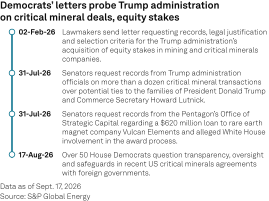
Republican: The Trump administration's minerals strategy, including its growing use of government equity stakes in mining companies, critical minerals agreements, federal incentives and faster permitting for mining projects, would continue to advance. Republicans have broadly supported critical minerals partnerships, although some lawmakers have argued that Congress should play a more active role in shaping and evaluating minerals agreements.
Democrat: Lawmakers are prepared to intensify scrutiny of government investments in mining companies and critical minerals agreements. Hearings, document requests and subpoena power would be used to examine potential conflicts of interest, the legal basis and transparency of transactions, and whether taxpayer funds were adequately protected. Democrats have already questioned administration officials and mining companies about the financial terms of federal equity and financing deals.