Metals & Mining, Electric Power, Non-Ferrous
October 15, 2026
US finds solar imports from India, Indonesia, Laos threaten domestic factories

Editor:
HIGHLIGHTS
ITC issues final determination in AD/CVD case
Import surges from other countries are being monitored
The US International Trade Commission determined that domestic solar manufacturers are harmed by an influx of low-priced imports from India, Indonesia and Laos, bringing the trade case to a close.
The International Trade Commission (ITC) on Oct. 14 issued a final affirmative injury determination in the antidumping and countervailing duty (AD/CVD) investigation into crystalline-silicon photovoltaic cells and panels from those three countries.
The trade agency found that the domestic industry is materially injured by these imports, which are dumped, or sold in the US at less than fair value, and subsidized by the governments of India, Indonesia and Laos.
Tim Brightbill, partner and co-chair of the International Trade Practice at Wiley Rein and lead counsel to the petitioners, applauded the outcome.
"We're very pleased with these results, which will support American solar manufacturing, new jobs, new factories, billions of dollars of investment that has been made in the last few years all across the country ... and also research and development to develop even better solar technology here in the United States," Brightbill told reporters during an Oct. 14 call.
The US Department of Commerce issued final duty rates in September. It set AD rates of 123.04% for India, 94.36% for Indonesia and 65.43% for Laos. It set CVD rates of 126.09% for India, 73.2% to 173.7% for Indonesia, and 82.03% to 153.67% for Laos.
The next step is for Commerce to issue AD/CVD orders to US Customs and Border Protection to enforce duties on imports from these countries.
The Alliance for American Solar Manufacturing and Trade, which includes Hanwha Q Cells USA Corp., First Solar Inc. and Mission Solar Energy LLC, filed the petition in July 2025 following a surge of imports from these countries. The petition came after the conclusion of another AD/CVD case on imports from Cambodia, Malaysia, Thailand and Vietnam.
'New import surges'
There are also other pending trade cases, including an anti-circumvention case on imports from Ethiopia filed by a similar group of US manufacturers.
"Importers should be aware that if circumvention is found by these companies, duties will apply retroactively and likely on a countrywide basis back to the date when Commerce first initiated the investigation," Brightbill said. "So, anything coming in today would be potentially subject to those circumvention duties."
There is another anti-circumvention case on imports from South Korea, filed by a different group of manufacturers.
Brightbill said that the petitioners continue to monitor imports from other countries, including the Philippines, which he said had imports surge 3,000% over the past 12 months. The alliance is also looking at Kenya and other countries. Although the US produces solar modules, it is still reliant on imports, particularly for solar cells.
"If we have evidence of new import surges that are injuring the US industry, our domestic alliance will not hesitate to take action," Brightbill said.
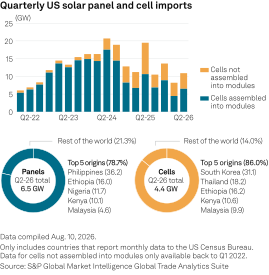
The determination comes as the solar industry continues to adapt to a series of recent policy changes, including President Donald Trump's Section 232 proclamation on polysilicon issued in August and anti-stockpiling rules issued in September. Brightbill noted that dozens of importers have been barred because of surging imports.
"We appreciate the efforts of Commerce and Customs and Border Protection to aggressively enforce and stop companies from gaming the system," Brightbill said.
The Section 232 proclamation, which takes effect Dec. 4, applies to foreign polysilicon and derivative goods, including silicon wafers and ingots as well as solar cells and modules. These AD/CVD duties would stack on top of minimum import prices and a 15% tariff set in the Section 232 proclamation.
"We are hopeful that these Section 232 actions can help address the whack-a-mole problem, but I don't think we'll know for some time to come if we continue to see unfair trade practices that might need to be addressed," Brightbill said.
Others in the industry agreed it was too soon to tell, but that pricing would be an indicator.
"Where the rubber meets the road on these kinds of trade actions is what market price it yields in our market for those imported panels," Michael Carr, executive director of the Solar Energy Manufacturers for America Coalition, said during the press call.
The industry is also awaiting additional guidance on foreign entity of concern restrictions on tax credits, following initial guidance in February.
