Electric Power, Refined Products, Diesel-Gasoil
October 08, 2026
Utility arrearages add to voter anxiety ahead of 2026 US midterm elections

Editor:
HIGHLIGHTS
Campaigns seize on rising energy bills
States scrutinize utility collection practices
Rising energy costs and utility bill arrearages are emerging as a campaign issue in the 2026 US midterm elections, giving challengers an opening to attack incumbents over household expenses and prompting officeholders to point to efforts to limit the burden.
The issue is difficult to translate into a prediction about election results. State consumer advocates in interviews declined to forecast whether utility affordability would determine any race. Nearly all, however, said higher energy costs were appearing in campaign advertising, either as criticism of incumbents or as evidence that officeholders were responding.
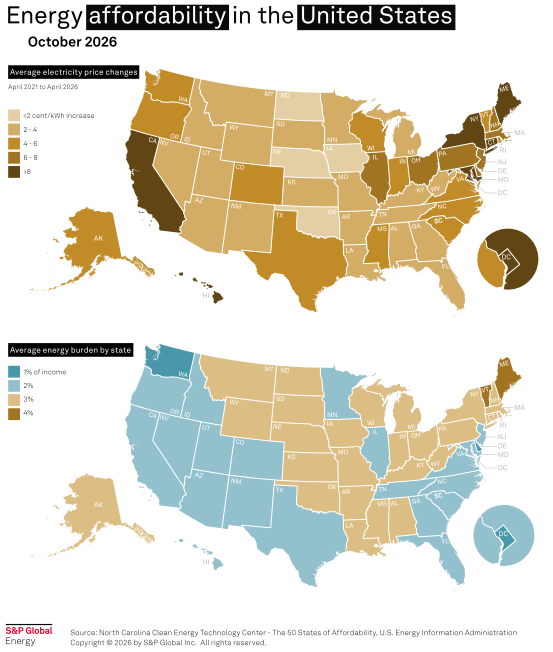
The political attention comes as state action on energy affordability accelerates. Since June, 42 states have taken more than 300 legislative and regulatory actions, many focused on allocating costs among utility customers and strengthening oversight and cost-recovery reviews, according to a Sept. 30 report from the North Carolina Clean Energy Technology Center at North Carolina State University. The mid-Atlantic, Upper Midwest and West were the most active regions during that period, the report said.
State lawmakers "are mandating changes to utility business models and profit-making while regulators are voluntarily opening investigations into utility finances and affordability practices, all increasing scrutiny on how utilities make money and pass on costs to consumers," said Nick Montoni, a senior program director at the center.
"It's the political season, and politicians like quick fixes," said David Springe, executive director of the National Association of State Utility Consumer Advocates. But utility affordability "is not something we solve quickly," he added, because charges appearing on bills today often reflect spending approved years earlier. Even so, Springe said, utilities regulators face increasing political pressure to act on the costs they can control.
| Summary of affordability actions since June 2026 | |||
| Action type | type (%) | # of actions | # of states |
| Customer cost allocation | 40 | 135 | 41 |
| Utility oversight, cost recovery | 16 | 54 | 20 |
| Consumer savings programs | 12 | 41 | 22 |
| Planning and procurement | 12 | 39 | 16 |
| Utility business model | 11 | 37 | 24 |
| Studies, investigations | 8 | 28 | 19 |
| Total | 100 | 334 | 44* |
| Note: The # of states includes District of Columbia and Puerto Rico on some actions. *The total of states is not the sum because some states have multiple actions. Percentages are rounded. | |||
| Source: North Carolina Clean Energy Technology Center - The 50 States of Energy Affordability | |||
Maine races spotlight energy costs
Maine offers one of the clearest examples of utility affordability intersecting with competitive 2026 campaigns.
Its US Senate contest between Republican incumbent Susan Collins and Democrat Troy Jackson was rated a toss-up by the Cook Political Report, while public polling in late September showed Democratic gubernatorial candidate Hannah Pingree leading Republican Bobby Charles and Independent Rick Bennett.
Energy costs feature prominently in political advertising in the state, said Heather Sanborn, the Maine public advocate, who was appointed by Democratic Governor Janet Mills. Mills cannot seek reelection because of term limits. The public advocate represents interests of Maine utility customers in regulatory and court proceedings.
The Maine Public Utilities Commission is developing a metric to assess the burden of electric bills on residents. It is also conducting a comprehensive review of each component of electric utility rates and publishing data on credit and collection activity involving customers who are behind on payments. The work was required by legislation enacted in March, Sanborn said in a Sept. 28 interview.
The issue is especially acute in Maine, where more than half of households use heating oil and electric utilities are barred from disconnecting customers during the winter. "We are very worried about this winter" and "what the arrearages will look like next spring," Sanborn said, noting the annual utility disconnection moratorium ends on April 15, 2027.
Other competitive Senate races broaden the potential political reach of the issue. As of late September, the Cook report also rated contests in Alaska, Iowa, Ohio and Texas, all now held by Republicans, and Michigan and New Hampshire, now held by Democrats, as toss-ups.
The available reporting does not establish that utility affordability is influencing each of those races, but the ratings show how a modest movement among cost-conscious voters could matter in determining control of the Senate.
Arrearages widen political pressure
A clear national picture of electric utility customers who are behind on payments or face disconnection remains difficult to assemble because many states provide limited data, Springe said. The US Energy Information Administration published state-by-state data for 2024 in an April report, he noted.
"Anecdotally, we're hearing arrearages are increasing and disconnections are increasing as the summer disconnection moratoriums roll off in many states," Springe said in an Oct. 1 interview.
Rising energy costs are placing the greatest strain on lower-income households, said Jenifer Bosco, managing director of energy advocacy at the National Consumer Law Center. Citing an early 2026 report from the National Energy Assistance Directors Association, Bosco said low-income households spend 8.6% of their income on energy, nearly three times the share for other households, and about 21.5 million households are behind on utility payments.
But affordability challenges are "creeping up the income ladder," Bosco said, with utilities seeing more customers falling behind. In some states, late-payment fees, reconnection deposits and limits on deferred-payment plans deepen the burden, she said.
Those trends give campaigns a tangible way to connect broad concerns about the cost of living with household bills. They also create a vulnerability for incumbents, even when the costs on current bills stem from utility investments or regulatory decisions made years earlier.
Policies become campaign evidence
In a Sept. 10 policy report, the National Consumer Law Center said utility debt-collection practices are often opaque and recommended steps states could take to reduce household energy costs. Bosco and Sanborn said Illinois, Maine, Maryland and Virginia are among states that have enacted laws to improve transparency on arrearages and make more information about disconnections and deferred-payment plans public.
"Instead of churning families through a cycle of disconnection and reconnection, utility companies should focus on helping customers stay current on their bills," Bosco said in a statement accompanying the report.
Investor-owned utilities, meanwhile, are offering bill-payment assistance, energy-efficiency programs and other affordability measures, the Edison Electric Institute said in a Sept. 30 report. The report profiles several member utilities that provide bill credits, deferred-payment options and other forms of financial relief.
"We know these efforts don't erase the pressure many families feel — but they make a real and measurable difference, and we're expanding them," Drew Maloney, EEI's president and CEO, said in the report's opening statement.
For candidates, those state and utility programs provide evidence of action but not necessarily immediate relief. The electoral effect of affordability and arrearages will depend on whether voters blame incumbents for higher bills, credit them for mitigation efforts or give greater weight to other issues.
