Electric Power, Natural Gas
October 06, 2026
Utilities feeling election season heat as data center opposition mounts
By Allison Good and Darren Sweeney
Editor:
HIGHLIGHTS
Governors pressure regulators on rate hikes
Data center backlash reshapes utility strategy
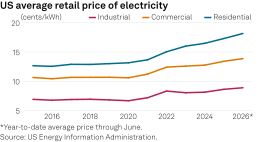
With surging residential electricity bills under the spotlight ahead of US federal, state and local elections in November, utilities are adjusting to a nationwide backlash to data center development as candidates campaign on affordability messaging.
Keeping pace with the changing political landscape is proving challenging for the industry, even as utility management teams say they are working to improve stakeholder engagement and protect customers from the costs of generation, transmission and distribution additions to serve large loads.
"I've been doing politics for a long time, and this issue has probably shifted more quickly than almost any issue I think I've ever seen," Drew Maloney, president and CEO of investor-owned utility trade group the Edison Electric Institute (EEI), said in an interview about the intersection of data centers and affordability. "These companies can't engage communities early enough."
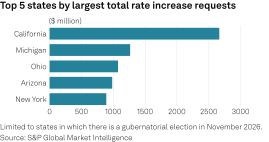
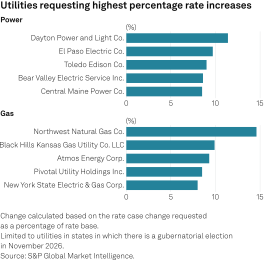
Of the 36 states electing governors this fall, California has the largest total dollar value of gas and electric rate increase requests pending with state regulators, at $2.67 billion, followed by Michigan, Ohio, Arizona and New York, according to S&P Global Market Intelligence data. Utilities regulators are appointed by the governor and confirmed by the Senate in all of those states but Arizona, where members of the state Corporation Commission are elected statewide.
Raising elections stakes
Gubernatorial involvement in particular has caught some utilities and their management teams off guard, analysts said. This trend makes the outcome of upcoming US midterm elections all the more salient for utilities.
"Growing political pressure from governors' offices on utility commissions in several states is raising concerns about their ability to act impartially, which is central to the regulatory framework our member companies operate under," EEI Vice President of State Engagement Kristine Telford said in an interview.
The National Association of Regulatory Utility Commissioners did not respond to requests for comment about this issue.
Virginia Governor Abigail Spanberger (Democrat) formally intervened in the State Corporation Commission's review of Dominion Energy Inc.'s proposed $67.4 billion acquisition by NextEra Energy Inc. The companies in September increased their offer of customer bill credits in Virginia in an effort to help complete the transaction.
In June, Indiana Governor Mike Braun (Republican) demoted state Utility Regulatory Commission Chairman Andy Zay after the commission approved a $71 million base rate increase for AES Corp. subsidiary AES Indiana that the governor staunchly opposed. Braun then fired Zay, who sued, claiming wrongful termination. In August, Zay settled with the state, receiving $625,000 to cover legal fees and his salary for the remainder of his term on the commission.
Governor-level pressure "is not a new concept," NiSource Inc. Executive Vice President and CFO Shawn Anderson told Platts, part of S&P Global Energy.
"We always want to hear stakeholder consideration, and all of that influences the rate actions we take and the filings that we make," Anderson said.
Nor does that pressure make Exelon Corp. hesitant to file rate cases or more likely to adjust revenue requests, Jeanne Jones, the company's executive vice president of finance and strategy, said in an interview.
"The most important thing that we can do is make sure that every dollar that we're entrusted with goes as far as possible," Jones said. "That's part of why we pulled the rate case in Pennsylvania, is telling the story and making sure regulators understand the value of investments."
"We know we can do a better job of that," she added.
Data center pushback
With many utility companies projecting long-term earnings growth driven by data center contracts, executives are also adjusting how they talk about those prospects.
"What you've seen is more companies ... talking about a rate base trajectory, rather than an earnings trajectory," Paul Zimbardo, managing director at Jefferies, said in an interview. "You've seen a very clear shift in the industry of management teams internalizing the political sensitivity and trying to be less promotional around their growth prospects."
In July, President Donald Trump broadened the Ratepayer Protection Pledge, an initiative to shield customers from data center-related bill increases, by including commitments from public and investor-owned electric utilities accounting for about 80% of all power delivered nationwide.
Gubernatorial candidates running for reelection this year have been vocal about aiming to shield ratepayers from data center cost impacts.
Texas Governor Greg Abbott (Republican) in mid-September ordered state environmental regulators to pause issuing data center-related project permits until an audit of grid interconnection applications is complete.
"The top question I get now [from investors] is, 'Why can't XYZ state become the new Texas?'" Zimbardo said, referring to the opportunity for other states to step in and court data centers as Texas grows increasingly cautious about the AI buildout.
Pennsylvania Governor Josh Shapiro (Democrat), who is also seeking another term as governor, signed an executive order restricting data center fast-track permitting and requiring developers to fund their own electricity.
And New York Governor Kathy Hochul (Democrat) earlier this year signed the country's first statewide data center construction moratorium as she runs for another term.
Cost accountability
Political finger-pointing over rising prices can obscure the factors driving those costs, which often differ across regions and market constructs.
Many utilities building power plants and transmission lines to serve data center demand have proposed large-load tariffs to state regulators to protect residential ratepayers from costs involved in developing that infrastructure.
American Electric Power Co. Inc., one of the first utilities to advance such tariff structures, also filed a rate reduction proposal with Indiana regulators in August to freeze subsidiary Indiana Michigan Power Co.'s residential rates for three years, AEP spokesperson Tammy Ridout said in an email.
Wires-only utility companies such as Exelon, Consolidated Edison Inc. and Eversource Energy, as well as integrated utilities that operate in states that have not restructured their utilities sectors, are better able to protect ratepayers because "you can barely separate those transmission and distribution costs" from what residential customers are paying, CreditSights senior analyst Andrew DeVries said in an interview.
"Our regulators need to understand that 50% of the bill is our investments. The other 50% of the bill, which is driving up 75% of the increase, is supply costs," Exelon's Jones said.
With that in mind, Exelon has advocated for legislation throughout its multistate service territory, including Illinois, Maryland and Pennsylvania, that supports allowing regulated utilities to build, own and operate generation or storage capacity, which Jones said is the long-term key to slashing residential rates.
Delaware, Maryland and New Jersey have been most receptive to Exelon's proposals, according to a company spokesperson.
Exelon and other regulated utilities that operate in the PJM Interconnection region have been critical of the grid operator's capacity market and its impact on those costs.
The clearing price in PJM's 2028/2029 capacity market auction in July reached the federally approved cap of $325/megawatt-day, but procured capacity fell 6,831 megawatts short of the grid operator's reliability requirement.
For utilities operating in states that do allow them to own generation, CreditSights' DeVries said ring-fencing power plants to keep them out of retail customers' bills, like NiSource has done in Indiana with NIPSCO Generation, should be the industry "blueprint" for affordability.
NIPSCO Generation estimated it will create approximately $1.4 billion of customer savings over the 15-year terms of its contracts with Amazon.com Inc. and Alphabet Inc., the parent company of Google LLC, to supply power to data centers.
"Our focus is on growing that mechanism and making that credit even larger to the extent possible," Anderson said, adding that NiSource believes the model is scalable and useful for peer utilities.
