Electric Power, Energy Transition, Renewables
September 30, 2026
US Midwest, Southwest lead clean power purchasing in 2026

By Nushin Huq
Editor:
HIGHLIGHTS
Corporate buyers sign 31.2 GW through August
Solar dominates Southwest contract activity
Rising US power demand continues to drive momentum for clean energy offtake agreements in 2026, especially in the Midwest and Southwest.
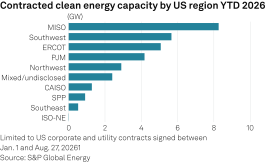
Utilities, hyperscale cloud-computing giants and other corporations signed about 31.2 gigawatts of clean power contracts from January through August, according to S&P Global Energy CERA data.
"The big takeaway from us is momentum isn't slowing," said Tony Lenoir, associate director at 451 Research by S&P Global. "There were questions around that last year because of the new administration, the [One Big Beautiful Bill Act], and the acceleration of the tax credit phase-out and so forth, but it's not slowing down at all."
The Midcontinent Independent System Operator region had the most clean energy dealmaking this year, with 23 contracts signed through August, totaling almost 8.3 GW. About half of the contracts were corporate deals, including a 1.9-GW contract between Google LLC and Xcel Energy Inc. in Minnesota for a mix of solar, wind and battery storage, and a nearly 1.5-GW agreement between Google and Cypress Creek Renewables LLC for a portion of a large-scale solar-plus-storage project in Arkansas.
"Every time I talk to a developer, usually the first thing that they're trying to do is find offtake for a MISO project," Owen Glubiak, vice-president of markets at Resurety, told Platts, part of S&P Global Energy.
Resurety provides advisory and consulting services to offttakers. It also has a regulated trading platform for virtual power purchase agreements. S&P Global Energy partners with Resurety for certain environmental and renewable energy price assessments in North American markets, including power purchase agreements.
Clean energy developers remain active in the Electric Reliability Council of Texas region, though solar buyers have begun to shy away from the ERCOT market.
"It's not to say that the big four hyperscalers have," Glubiak said. "I know they are still buying in ERCOT, but the rest of the corporate buyers candidly have started to look elsewhere."
By volume, the non-ISO Southwest followed MISO with nearly 5.7 GW of utility and corporate contracts signed through August, according to CERA data. The total was led by a 3-GW solar development agreement between Salt River Project and NextEra Energy Resources LLC, the competitive generation arm of NextEra Energy Inc.
In total, nine PPAs and tolling contracts were signed in the non-ISO Southwest through August, including four with utilities and five with corporate offtakers.
Much of the non-ISO activity is centered around digital infrastructure and energy resources, Adam Wilson, senior principal research analyst at S&P Global Energy, told Platts.
"It's relatively close to areas of operation where data center locations are, but it's also a function of, particularly in the West, [being] resource-driven," Wilson said. "Solar is very attractive in those markets because they produce a ton of power and they're highly efficient, and that helps the power purchase agreement contracts be much more financially viable than [in] other areas."
From January through August, solar and storage deals accounted for the bulk of contracts in the Southwest. There was also one onshore wind deal between Salt River Project and Pattern Energy Group LLC for 600 megawatts from the Sunzia Wind Project.
In ERCOT and the PJM Interconnection, corporate buyers accounted for the majority of signed contracts.
"There's just a lot in [ERCOT] that makes sense for corporate buyers in terms of the regulatory structure ... and just the sheer abundance of projects to pick from and the relatively approachable cost they can get with those PPAs," Wilson said.
The strongest markets for corporate contracts are also the ones with the most data center growth, Paul Eory, director of utilities and corporates at Ascend Analytics, told Platts.
"You're seeing ERCOT, the load growth, the asks are way beyond what is reasonably feasible," Eory said. "PJM has always been a hotbed and MISO is growing as well."
Interest in PJM is more location-driven, with companies looking to procure energy in close proximity to major areas of operation, such as Northern Virginia and Ohio, Wilson said, pointing to nuclear power opportunities.
From 2024 through August 2026, corporate buyers signed deals for over 7 GW of new and existing nuclear capacity in PJM, according to CERA data, including three Meta Platforms Inc. offtake agreements signed this year for a total of 3.8 GW of capacity.
