Electric Power, Coal, Energy Transition, LNG, Natural Gas, Carbon, Renewables
September 30, 2026
European gas, power markets enter Q4 under cloud of high prices, supply concerns
Editor:
HIGHLIGHTS
Gas demand core uncertainty amid lagging storage
El Nino could be key to gas, power demand in Q4
Gas-carbon link tightens as ETS reform risk looms
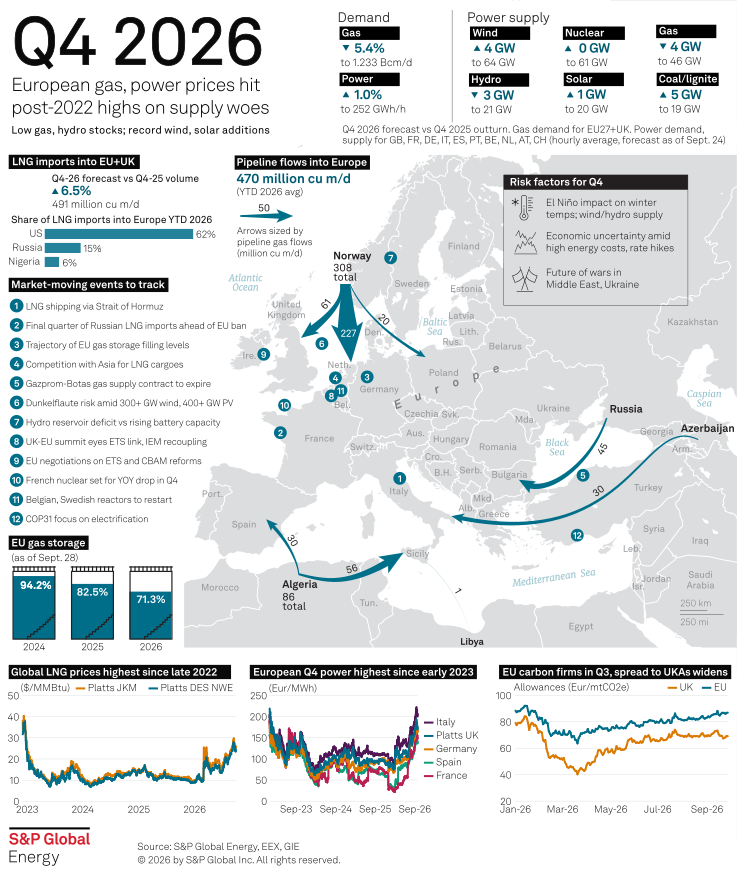
European energy prices have risen to highs not seen since 2022, with the fourth quarter set to test markets amid low gas storage and continued LNG supply disruptions due to the war in the Middle East.
For much of 2026, Europe has grappled with a tighter global LNG market; seven months into the Middle East conflict, those pressures are growing as winter looms.
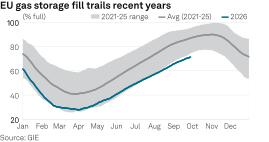
High prices and persistently backwardated forward curves have hampered gas stocking in many parts of the continent throughout the filling campaign.
Analysts at S&P Global Energy CERA now project the EU will enter the coming heating season with storage just 74% full on Nov. 1. This would be the lowest fill level at that point in records dating back to 2011, according to data from Gas Infrastructure Europe.
The storage shortfall is linked to lagging EU LNG imports, which are trailing 2025 levels in the year to date, per CERA figures. However, CERA analysts forecast a pivot, with fourth-quarter European LNG imports projected to come in some 6.5% higher than those across Q4 2025, at roughly 491 million cubic meters/day. That would be among the highest levels in recent years, amid heightened competition with Asia for scarcer cargoes, they said.
EU gas experts have repeatedly assessed that the continent's gas supply remains secure, most recently at a meeting on Sept. 24.
Even if molecules are available, though, elevated prices remain a growing concern, with gas demand a core uncertainty in the months ahead.
"The re-escalation of conflict in the Middle East and the resulting disruption to LNG tanker movements through the Strait of Hormuz have embedded a substantial risk premium across the European gas curve, while Europe's increasingly precarious storage position has reinforced concerns over winter supply adequacy," the CERA analysts said.
Demand-side shifts could offer headroom. Indeed, the European Commission pushed in late September for member states to take measures to reduce gas and power demand, while also urging caution around moves targeting prices. Market watchers will be vigilant for any further policy interventions as temperatures decline.
CERA analysts see gas demand across the EU and UK in the fourth quarter sliding 5.4% year over year to 1.233 billion cubic meters/day.
The analysts highlighted a host of factors driving the expected decline in gas demand, including demand destruction amid elevated wholesale prices and a drop in gas-for-power usage on an annual basis over the coming quarter as increased renewables output and high costs temper Northwest Europe's gas dispatch.
While a resolution to the war in the Middle East could exert rapid downward pressure on prices from the supply side, such a bearish shift is far from certain.
"The balance of risks remains firmly skewed to the upside," the CERA analysts said.
Focus on wind, nuclear, hydro
For Europe's main power markets, CERA forecasts a 1% year-over-year increase in Q4 demand, assuming average temperatures.
Demand so far this year is up about 3% as the hot summer and cold winter boosted consumption, but underlying structural demand only gained about 1%.
"If 2026 has had echoes of 2022, it is worth remembering that forward power prices went into Winter-22 with a huge risk premium that dissipated at outturn, largely due to benign weather conditions and price-driven demand destruction. But as we have noted before, 2026 is not 2022," said Glenn Rickson, head of near-term power analytics at CERA, noting limited potential for demand destruction.
On the supply side, wind and nuclear are set to lead the European winter mix.
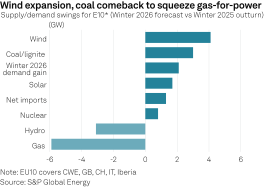
Assuming average wind speeds, Q4 wind output is forecast to rise 4 gigawatts year over year across the 10 major markets closely covered by CERA.
Daily swings in wind supply are set to cause more volatility in spot markets, with more than 300 GW of wind now installed across the EU27 and the UK, but that can't negate the risk of Dunkelflaute episodes.
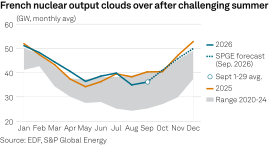
Nuclear output is forecast to be unchanged year over year, just behind wind, with improved availability in Switzerland, Spain and the UK, balanced by reduced French reactor availability, with the new 1.6 GW Flamanville-3 reactor set to be offline until September 2027 for maintenance work and repairs.
Belgium's last two 1-GW reactors are to resume operations from Nov. 2.
Overall, French nuclear output is forecast to average about 45.5 GW in the fourth quarter, down just 1 GW year over year, according to CERA.
The summer rally in gas prices lifted winter power prices to levels not seen in over three years, with Italian Q4 peaking above €200/megawatt-hour.
Gas generation could see the largest year-over-year declines, despite limited potential for gas-to-coal/lignite switching following plant closures.
Hydropower is also seen sharply lower in the core region, as well as across the Nordics and the Balkans.
CERA analysts see "greater downside risk to demand in Q1 2027, balanced by El Niño risk of milder and possibly windier conditions weighted to Q4."
Another uncertainty is the risk of market intervention and the impact of existing policy measures. Asked whether governments should intervene with more regulation, Marco Saalfrank, head of Merchant Trading at Axpo, made it clear that the market should be left to correct itself.
"Regulation can potentially help, but only if it provides a clear overarching framework that still allows the market to function as a market," he said.
ETS talks intensify
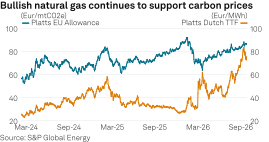
Meanwhile, European carbon prices rallied through the third quarter, carried higher by surging gas prices and robust compliance demand. With the correlation between gas and carbon tightening, EU Allowances are increasingly trading in step with the broader energy complex, a dynamic that looks set to persist as the market enters a politically charged final quarter.
Analysts at CERA expect EUAs to range between €82 and €86/metric tons of CO2 equivalent in the fourth quarter, with upside risk from "persistent high gas prices, colder low-wind weather and firm investor length" and downside risk from "a looser ETS reform outcome, easing geopolitical energy pressure" and "greater renewable output."
Heading into the fourth quarter, EU Emissions Trading System trilogue negotiations have emerged as the dominant policy flashpoint for the carbon market, with sharply diverging institutional positions and intense industry lobbying set to drive allowance price volatility through year-end.
The Alliance of Energy Intensive Industries demanded Parliament strip out conditionality entirely, warning it "causes new asymmetries" and undermines the financial capacity to decarbonize.
Parliament rapporteur Peter Liese is pushing in the opposite direction, calling for stricter conditions than the Commission proposed and for 75% of ETS revenues to be reinvested in ETS sectors. Member state positions add further complexity: Poland called conditionality "illogical and counterproductive," Italy warned the timetable was unworkable, and France called for simplicity.
A parallel dispute over the Market Stability Reserve — where the Council wants an 800 million allowance cancellation threshold from 2031 against Parliament's 650 million from 2027 — will shape future auction supply volumes. European leaders have committed to completing ETS reform by the first quarter of 2027.
"More free allocation could reduce near-term industrial auction buying; tighter investment conditions could change plant decisions; MSR rules could alter future auction supply and market liquidity," CERA analysts said in a recent note.