Electric Power, Natural Gas, Water, Energy Transition, Renewables
September 11, 2026
Where states stand on data center sales tax exemptions ahead of US midterms
HIGHLIGHTS
Energy and water concerns drive opposition
Political pressure mounts before elections
Having previously competed to lure data center development with a variety of tax incentives, states across the US are increasingly reconsidering the costs of these exemptions ahead of the US midterm elections.
Eight states have moved to pause or repeal sales tax exemptions for data centers over May through August, according to an analysis by S&P Global Market Intelligence.
Five states — Arizona, Illinois, Massachusetts, New Jersey and Ohio — paused sales tax exemptions or benefit programs, while three states — Maine, Minnesota and Nebraska — repealed them. A number of others — including Pennsylvania and Delaware — tightened regulations by adding stipulations around investment levels, power generation or job creation.
The changes come amid rising opposition to data center development among constituents calling on both state and local lawmakers to address concerns about energy and water usage, among other factors.
At the same time, those who support tax incentives note the economic impact of data centers can extend beyond state tax revenue.
"Governors, or local political leaders of whatever size, are using whatever tool they have in their toolbox to slow down data center development — perhaps to appease voters' concerns that there are too many developments or that they're happening too quickly, or because people don't understand exactly what they might bring to the community," said Ammad Waheed, a real estate and corporate transactions partner at Norton Rose Fulbright LLP who advises hyperscalers, developers and landowners on data center leasing, land acquisition, development, zoning, financing and related transactions.
States reconsider exemptions
The recent tax incentive shifts come as dozens of elected officials face constituent scrutiny and concerns over high energy prices heading into the midterms.
"We have 36 gubernatorial elections in November. We have like 88% of state policymakers up for election this year," said Morgan Scarboro, a vice president and economist at MultiState, who leads the teams monitoring data center legislation. "There is a really big tension right now for policymakers between: There is a lot of public attention on this issue; at the same time, it's driving a lot of the economic growth. So how do you sort of marry those two things?"
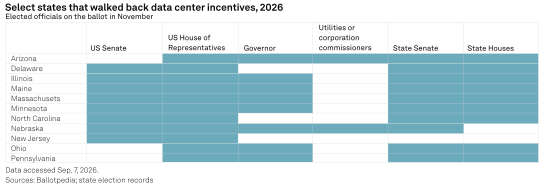
In August, Pennsylvania Gov. Josh Shapiro (Democrat), who previously supported data center development in the state, signed an executive order restricting the sales and use tax exemption to data center operators that comply with the Governor's Responsible Infrastructure Development (GRID) Requirements, which cover power, sustainability, labor and community engagement concerns. Shapiro is up for reelection this cycle.
That same month, Delaware Gov. Matt Meyer signed a package of energy consumer protection bills requiring data centers and other large energy users to pay for their own infrastructure costs. The legislation creates a separate utility rate class for large energy-use facilities, enforces a "bring your own generation" requirement, and prohibits them from qualifying for job-creation business tax credits.
North Carolina legislators repealed the state's sales tax exemption on data center energy usage, making electricity purchases by data centers subject to the combined 7% state and local sales and use tax rate.
The move followed a report from the state Department of Commerce that estimated existing data center operators in North Carolina receive $20 million per year in electricity-related sales tax exemptions. Elected officials in both branches of the state's legislature are up for reconsideration in the midterm elections.
Gov. Josh Stein (Democrat) has called for the full repeal of North Carolina's data center tax exemptions at the end of 2032.
Earlier in the year, Illinois Gov. J.B. Pritzker (Democrat), Massachusetts Gov. Maura Healey (Democrat), and Ohio Gov. Mike DeWine (Republican) indefinitely paused the acceptance of new data center sales tax exemption applications. And in Arizona, Gov. Katie Hobbs (Democrat) approved a state budget that includes a three-year moratorium on the state's data center sales tax exemption.
All four states have gubernatorial elections in November.
As for New Jersey, the state paused a $500 million tax credit program for AI data centers that was set to launch this year, with many now expecting the program to be eliminated.
But calculations about how much sales tax revenue states might collect without incentives do not tell the whole story, according to Dan Diorio, executive vice president of state policy and government affairs for the Data Center Coalition trade association.
"When you see $1 billion or something like that, it makes headlines, and it's easy to harp on and say, 'Well, we're missing out on $1 billion of revenue,'" Diorio said in an interview.
Those estimates, Diorio said, overlook a very real possibility that a data center project might not have been built in the state absent tax exemptions and other incentives.
Effects on development
The states that have seen the most data center growth — including Virginia, Texas and Pennsylvania — have sales tax exemptions, Diorio said.
By contrast, he pointed to his home state of Colorado, which does not offer any sales tax exemptions.
"It would seem that Colorado would be ripe for development, but it really hasn't been," Diorio said.
The Colorado state legislature considered a bill in 2026 that included a 100% sales and use tax exemption for data center development as well as a less stringent set of renewable energy requirements, but the measure failed to advance.
Even the possibility of tempered incentives can have an effect.
In Georgia, the General Assembly introduced multiple bills that would have eliminated the state's existing statutory sales tax exemption. Though the bills did not pass, they still had an impact, according to 451 Research Director Dan Thompson, who leads the Data Center Services & Infrastructure team.
A number of companies building for two of the hyperscalers are "dragging their feet on developments" as they wait to see whether the bills would pass, he said.
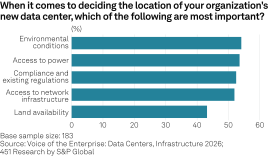
That said, 451 Research's "Voice of the Enterprise: Data Centers, Infrastructure 2026" survey found that when asked to select the most important considerations for choosing the location of a new data center, compliance and existing regulation came in slightly behind environmental conditions and access to power, but slightly ahead of access to network infrastructure.
Scale of impact
Shifting the tax environment could have material implications both for tax revenue and for data centers' broader impacts, such as on power demand.
The four major hyperscalers — Meta Platforms Inc., Alphabet Inc., Amazon.com Inc. and Microsoft Corp. — are expected to spend a collective $1.5 trillion in capex between 2026 and 2027 as the companies race to expand their infrastructure, according to the Visible Alpha AI Monitor as of August. Developments are also being planned by smaller enterprises.
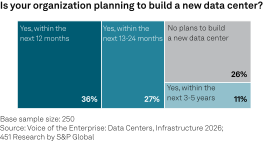
451's VotE survey of IT and line-of-business decision-makers found that 73.6% of respondents said their organization planned to build a new data center, including 35.6% who expect to build within the next 12 months.
At the same time, local opposition has led to a growing number of projects being canceled or delayed.
As of June, 47 projects that had been contested, delayed or canceled, according to 451 Research by S&P Global, representing a significant uptick from the 53 projects counted in full-year 2025.
"Previously, these things would be just quietly built and no one paid much attention," 451's Thompson said of data centers. "Now there is seemingly a spotlight being shown on every single development."
While 451 noted that the reasons for public pushback are myriad, the two most common concerns involve power and water use.
US data center power demand was estimated at about 195 terawatt-hours in 2023, according to 451 Research. For 2026, that demand is expected to more than double to 411 TWh before reaching close to 1,000 TWh in 2030.
In part, that is because AI data centers consume more power, but it also reflects the sheer number of data centers expected to be built over the coming years.
And though new generations of data center technology are becoming more efficient in terms of water usage, indirect water usage for power generation remains significant, especially for nuclear power.
