Electric Power, Natural Gas, Energy Transition, Renewables
August 24, 2026
Rise of negatively priced hours points to reshaping of Europe's power markets

By Maxim Grama
Editor:
HIGHLIGHTS
Negative prices drag on solar profitability, give strong signal for battery rollout
Energy portfolios with batteries can deliver robust structure for PPAs
Industry converging toward supply and demand hourly matching
The increasing number of negatively priced hours across European power markets highlights a growing need for battery storage systems that can help maintain renewables' profitability during peak solar generation.
Negative prices, once largely viewed as an occasional signal of system stress, have become a recurring feature in spring and summer periods, when strong solar output coincides with moderate demand, wind generation and limited grid flexibility. Negatively priced hours have also emerged during high-wind periods, underscoring periods of oversupply or subdued demand, and the need for additional battery storage capacity to store excess generation or "load shift" for periods when there is an uptick in power demand.
"The expansion of solar capacity at a faster rate than the market's ability to absorb it has led to an increased number of negative and low-priced hours during the solar peak," said Glenn Rickson, Associate Director at S&P Global Energy CERA. "Conversely, we have also seen increased instances of price spikes in summer evenings as flexible plants such as gas need to turn up quickly to offset the steep decline in solar generation at the end of the day."
In the EU5, including Great Britain, for the first half of 2026, negatively priced hours were around 2% above the record levels seen in H1 2025. The total number of negatively priced hours in 2025 was more than 13 times higher than in 2022.
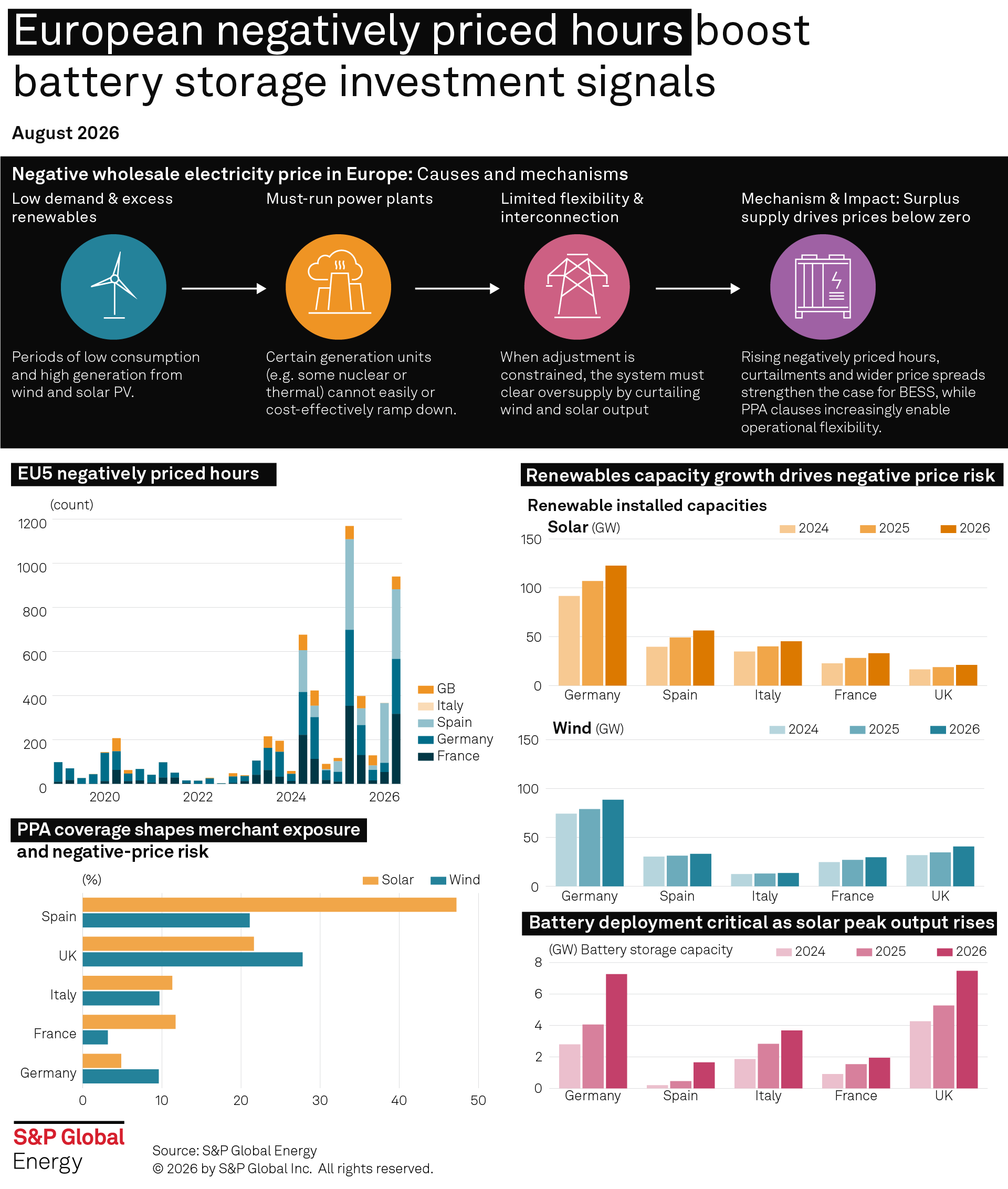
France has registered the highest amount of negatively priced hours, as its multi-year high nuclear output this year has weighed on prices across the region, while higher gas prices in Germany supported prices during the summer. Italy has registered no negatively priced hours due to its higher share of gas-fired generation.
But the trend of negatively settled power prices is visible across most European markets, where solar-heavy midday hours are increasingly trading at a discount to evening peak demand periods. This is widening intraday spreads, eroding solar-weighted realized prices and changing the economics for merchant renewables projects, while creating new opportunities for battery capacities.
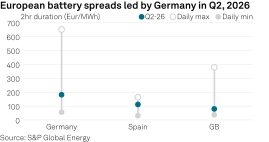
Wholesale battery spreads in Germany have reached a daily maximum above €650/MWh, while averaging almost €200/MWh in Q2 2026, above Spain and Great Britain, data from Platts, part of S&P Global Energy, shows.
"Europe's power markets remain highly exposed to gas prices, and we have seen this summer that a combination of cooling demand, low water levels impacting hydro generation and thermal plant operation, and occasional times of low wind can at times increase summer power prices' sensitivity to gas to levels equivalent to those in winter," Rickson noted.
In solar-predominant regions, such as Spain, the market dynamics over the last few years have strengthened investment opportunities for grid-scale battery storage, as the development of negative pricing indicates that the energy system is more inflexible solar generation increases.
The shift is leading to a fundamental reshaping of merchant solar revenues amid higher tail risks. Currently around 10-15% of the European solar capacity is exposed to merchant risks, as over 61 GW is contracted under power purchase agreements (PPAs). In comparison, in Germany, only about 9% of the total installed capacity is market-exposed.
The issue is not that solar is uneconomic as a technology, but rather when "unshaped" solar output becomes less valuable during its peak generation, with corporates and utility offtakers changing how solar PPAs are valued. "Unshaped" solar output means the electricity is delivered to the offtaker based on the actual (as-produced) solar generation profile, rather than being converted into a fixed, predetermined hourly delivery shape.
Traditional pay-as-produced PPAs were built around a relatively simple structure, where the buyer pays a fixed or indexed price for renewable output as generated. That model worked when solar output was broadly valuable and negative prices were rare.
In today's market, pay-as-produced solar carries significantly higher profile risk. The buyer receives electricity when the plant generates, not necessarily when it needs the power or when the market values it. If the project produces heavily during low or negative-price hours, the buyer can be exposed to an unfavorable shape.
"The decline in stand-alone solar contracting shows that negative pricing is becoming a structural PPA design issue, not just a merchant-market concern," said Bruno Brunetti, Head of Renewable Revenue Streams at S&P Global Energy Horizons. "Pay-as-produced solar PPAs were built for a simpler market, where renewable output was typically valuable when generated and profile risk was easier for offtakers to absorb."
"That is no longer the case in markets with high solar penetration. Across Europe, stand-alone solar PV represented more than 55% of total reported PPA transactions in 2025, but its share has dropped to about one-third in the first half of 2026, with less than 3 GW contracted. Buyers still want renewable energy, but they are increasingly looking for contract structures that manage timing, capture price and negative-hour exposure more explicitly," Brunetti explained.
The oversupply risk during peak solar hours is increasingly difficult to manage without a broader portfolio or battery storage, as a stand-alone solar project has limited ability to reshape output. A portfolio combining wind, solar, batteries and flexible trading capability does provide a robust structure for PPA buyers requiring a delivered baseload product.
This results in the PPA market transitioning toward aggregation, as buyers want simplicity and firming while sellers need flexibility to provide it, with the industry converging toward supply and demand hourly matching.
"Hourly certificates represent the next step in corporate clean energy procurement. The focus is shifting from simply buying more renewable energy to matching clean electricity with consumption patterns," Brunetti said.
He noted also that a review underway of the global standard for corporate electricity emissions accounting, the GHG Protocol Scope 2, is exploring ways to align market-based claims with when electricity is actually used.
"By reflecting the temporal value of renewable generation, hourly matching frameworks and granular certificates are aligning with electricity market needs, strengthening investment signals not only for wind and solar, but also for storage, flexible hydro and other resources needed to meet demand during scarce hours," he said.
The PPA market is shifting from simple renewable procurement toward structured energy management product, with the value no longer being in only producing renewable megawatt-hours, but in delivering them when they are needed.
