Electric Power, LNG, Natural Gas
August 21, 2026
Germany will respond if gas supply security deteriorates: ministry

By Matt Hoisch
Editor:
HIGHLIGHTS
Preparing ‘targeted’ action if needed
No winter gas shortage expected, though storage fill lags
Stresses government intervention also carries risks
Germany's energy ministry said Aug. 21 it was preparing to respond if the country faces a significant hit to its natural gas supply security amid lagging storage levels, even while underscoring that it does not expect a gas shortage throughout the winter.
"We are preparing the necessary courses of action in such a way that they can be deployed quickly and in a targeted manner if the situation deteriorates," the ministry said in a statement on the social media website X. "If central risk factors for supply security deteriorate significantly, the state can and will respond."
The ministry added that it does not expect a gas shortage this winter. Still, the comments signal a potential shift from the government, which has repeatedly maintained that gas storage filling is a responsibility for market players and downplayed the possibility of government intervention.
Even as it suggested it could act if supplies become severely strained, the ministry stressed it continues to see risks associated with such a move.
"A hasty government intervention is not a risk-free instrument: Government gas purchases can drive up prices and weaken the market's precautionary measures," it said Aug. 21. "An intervention must therefore be carefully weighed. Winter stockpiling remains, for the time being, the task of the market."
The ministry did not offer further details on the sort of response it would undertake if required.
The Chairwoman of the Executive Board for Germany's Federal Association of Energy and Water Industries, or BDWE, pushed this week for incentives to boost storage usage, such as lowering levies.
In the longer-term, the German government plans to develop a 24 terawatt-hour (2.3 billion cubic meter) strategic gas reserve to safeguard supply security in the event of acute disruptions. The volume would cover about 10% of Germany's gas storage capacity. But the government has said it does not expect to start stocking those volumes until summer 2027.
Largest EU gas storage capacity
German gas storage sites were filled to 50.2% as of Aug. 19, according to the latest data from Gas Infrastructure Europe. At the same time in 2025 and 2024, facilities were filled to 67.4% and 93.4%, respectively.
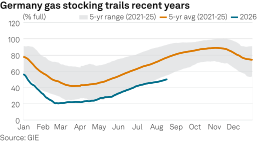
National storage rules adopted in April 2025 stipulate that total German storage must be filled to an average of 70% by Nov. 1. However, Germany's gas grid operator group FNB Gas warned in a statement earlier this week that the current levels have left the domestic target "hardly achievable."
Germany boasts the largest storage capacity in the EU, with sites capable of holding some 246.5 TWh of gas, according to GIE. This is about 22% of total EU gas storage capacity.
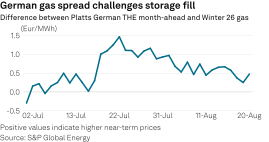
Like much of Europe, German market players have faced persistently backwardated forward curves that have sapped the financial incentive to stock gas in warmer months to sell for a profit in colder ones.
Platts, part of S&P Global Energy, assessed the German THE month-ahead gas price at €66.045 /megawatt-hour on Aug. 20, at a premium of 48 euro cent/MWh against the Winter 2026 assessment.
The month-ahead index is at its highest point since January 2023 as Europe continues to manage the loss of Persian Gulf LNG exports linked to sustained fighting in the Middle East.
LNG trends
The German energy ministry has consistently argued, including in its Aug. 21 remarks, that a broad array of gas system components gives the German market greater resilience in the face of lower storage levels than would have been the case earlier this decade. In particular, it has highlighted the benefits of the dramatic expansion in LNG import capacity in the years since Russia's 2022 invasion of Ukraine.
Market players have countered, though, that storage still matters, even with more LNG facilities.
"LNG cannot replace the role of storage facilities in winter," FNB Gas said in its statement this week, adding that LNG terminals can supply fuel to meet a little less than 10% of daily power needs in winter. "Sufficiently filled storage facilities are therefore indispensable for security of supply."
German LNG imports have actually risen on the year, according to data from S&P Global Energy CERA. So far in 2026, Germany has brought in about 5.7 million metric tons of the super-chilled fuel, equal to roughly 7.9 Bcm of gas, CERA figures showed. This is up about 37% compared to the same period in 2025.
Germany brings in LNG via four floating storage and regasification units. A fifth is due to begin operations in September at the port of Stade.
