Electric Power, Energy Transition, Coal, Natural Gas, Renewables
August 20, 2026
Clean energy politics get boost from affordability debate in midterm campaigns
By John Siciliano and Nushin Huq
Editor:
HIGHLIGHTS
Clean energy central to Democrats' messaging
Renewables feature in key House races
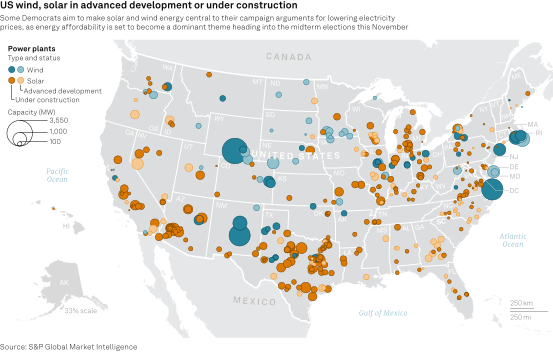
Democrats are positioning solar and wind energy as key solutions to rising electricity costs as they approach November's midterm elections, seeking to capitalize on voter concerns about energy affordability amid surging demand from data centers and artificial intelligence facilities.
The strategy marks a shift in how renewable energy advocates frame their arguments, moving away from climate benefits to focus squarely on pocketbook issues that affect household budgets.
Both Republican and Democratic voters have expressed a desire for greater control over their energy use to shield themselves from market volatility and reduce costs. Solar panels have gained popularity among both parties for this reason, though rolling back tax credits would increase the cost of solar installations.
Polling conducted earlier this year for the Solar Energy Industries Association, the country's largest solar trade group, demonstrated that despite a rhetorical partisan divide in Washington, DC, support for solar among Republicans has grown, as they see the resource as a way to reduce costs while also creating jobs and enhancing energy security.
A poll from Fabrizio, Lee & Associates, a polling firm used by President Donald Trump during his presidential campaigns, found that 68% of Republican voters agreed that solar is necessary to lower electricity costs, while 70% said they support utility-scale solar when projects use American-made materials.
Additional polling from former Trump communications strategist Kellyanne Conway and KA Consulting showed that 75% of Trump voters in Arizona, Florida, Indiana, Ohio and Texas believe solar energy should be used to bolster the US energy supply.
Democratic messaging strategy
For Democrats, renewable energy represents an issue that could attract a broader base of voters, particularly when combined with messaging about affordability, jobs and national security.
"We are talking about affordability ... at every opportunity," Representative Jared Huffman of California, the top Democrat on the House Natural Resources Committee, said in an interview with Platts, part of S&P Global Energy.
Huffman is running for reelection in his Northern California district, where he reports that voters have responded positively to affordability messaging.
"[Voters] are looking at their electricity bills, they are looking at all these data centers coming online, and they see Donald Trump paying renewable energy developers to walk away from huge projects that could provide the cheapest clean energy available in large amounts," Huffman said.
Policy contrasts
Democrats are contrasting their renewable energy stance against Trump administration actions, which include the US Department of the Interior's buyout of offshore wind leases, the US Department of Defense's delays to onshore wind siting, the cancellation of billions of dollars in federal Solar For All grants, and the US Department of Energy's multiple orders to keep older coal plants operating.
Democrats are touting solar and wind energy for their ability to add power to the grid quickly, while the Trump administration maintains that renewable energy resources cost more than other forms of electricity generation and blames wind and solar for rising electricity costs.
White House spokesperson Taylor Rogers contended that Democratic policies stifled production of more affordable energy from fossil fuels, "causing prices to skyrocket more than 30% under [President Joe] Biden's failed leadership."
"The Democrats caused the grid crisis; President Trump is fixing it," Rogers said in an email.
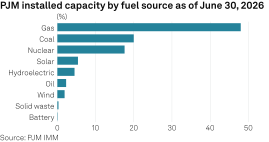
Rogers said coal and natural gas performed like "champions" during heat waves this summer while wind and solar "did close to nothing," and cited data from the DOE that showed the breakdown of energy resources in the mid-Atlantic grid operated by the PJM Interconnection.
However, the limited contribution of renewables during peak summer heat reflects known operational characteristics rather than system failure. PJM's capacity accreditation methodology assigns low summer capacity credits to these resources because their availability during peak demand hours is constrained. Wind and solar together accounted for 6% of PJM's 2025 generation and are projected to reach 16% by 2035.
Huffman pointed to the war in the Middle East as a factor causing higher energy prices, but also highlighted benefits of renewable energy resources. He argued that the Middle East conflict has shown how solar and wind resources can reduce the US' dependence on fuel imports from foreign sources and other factors that elevate energy prices.
Industry perspective on electoral opportunities
Jeff Danielson, vice president for advocacy at the Clean Grid Alliance, a renewable energy industry group, said voters' focus on costs creates opportunities for renewable energy messaging in the midterm elections.
"Yes, President Trump has made it clear that he doesn't want any new wind farms built and is encouraging the federal departments to delay or deny those permits, but that really isn't the salience for the voters," Danielson said in an interview with Platts. "Good news is that energy and electricity and the prices consumers pay is actually a salient issue in this election."
The increasing demand for electricity is outpacing established supply, and the renewables industry has a role to play in addressing this imbalance, Danielson said.
"We believe that if voters are concerned about affordability around energy and electricity prices, then homegrown clean energy is a solution," he said. "It's the quickest to market, which means it can be added to the supply ... and it's also the most price-competitive."
Polling by environmental advocacy group the Natural Resources Defense Council (NRDC) shows voters oppose policies that reduce energy generation options, according to Jed Ober, director of the NRDC Action Fund, the group's political arm. Even Republican voters have warmed to solar energy, though they remain hesitant about wind, Ober said.
"I think you're going to see it come up all over the map," Ober added. "Every candidate who's running out there is going to poll on energy costs. And when they poll on energy costs, they're going to see what we see."
The NRDC Action Fund is monitoring numerous races nationwide and endorsing candidates, both Republicans and Democrats, whose energy policies align with efforts to reverse the Trump administration's policies, Ober said.
Battleground races
The NRDC endorsed Representative Brian Fitzpatrick (Republican-Pennsylvania), who introduced legislation to restore renewable energy incentives removed by Trump's One Big Beautiful Bill Act. Fitzpatrick was one of two House Republicans who voted against the president's legislation when it passed in 2025. The other, Thomas Massie of Kentucky, lost in a Republican primary election in May.
Among the races renewables advocates are watching closely are Colorado's 8th District, where Republican Representative Gabe Evans was elected in 2024 by a margin of less than 1 percentage point, and Iowa's 1st District, where Republican Representative Mariannette Miller-Meeks also won in 2024 by less than 1 percentage point.
Miller-Meeks faces particular pressure as high fuel prices affect farmers heading into Iowa's fall harvest season. Iowa in 2024 generated 63% of its electricity from wind resources, the highest percentage in the nation, according to the US Energy Information Administration.
The fact that Miller-Meeks voted in favor of ending wind subsidies — by supporting the One Big Beautiful Bill Act — in a state that leads in wind energy gives her Democratic opponent an advantage in this year's congressional race, said Matt Mohrfeld, former mayor of Fort Madison, Iowa, where Siemens Gamesa Renewable Energy SA operates a wind blade manufacturing plant.
Mohrfield noted the slim margin by which Miller-Meeks won in 2024. "If it's 500 votes, we have 500 people working at Siemens Gamesa. I think the math is simple; she just lost," said Mohrfeld, who is running as a Democrat to represent District 100 in the Iowa House of Representatives on a platform focused on protecting the state's green industries.
Miller-Meeks' campaign office did not respond to requests for comment. She faces a challenge from Democrat Christina Bohannan, an environmental engineer and lawyer. Polling conducted over the past year by the House Majority PAC, a Democratic group, showed Miller-Meeks trailing Bohannan by 4 points in the 2026 race.
In Florida, Democratic Representative Kathy Castor's race is attracting attention from clean energy advocates after Castor reintroduced a ratepayer protection bill in July aimed at easing constraints on clean energy development.
Castor serves as ranking Democrat on the House Energy and Commerce Committee's energy subcommittee. She was unopposed in a primary, but her district, historically held by Democrats, was redrawn this year and is likely to be more favorable toward Republicans.
