Energy Transition, Electric Power, Renewables, Emissions
August 13, 2026
EU PV, storage inverter funding ban could reflect shift toward clean energy
By Lena Dias Martins and Eklavya Gupte
Editor:
HIGHLIGHTS
Industry warns rapid rollout may slow solar growth
Guidance part of broader cybersecurity push
US follows with similar restrictions on foreign power inverters
European clean technology companies are exploring alternative sourcing options outside China after the European Commission removed EU funding eligibility for certain Chinese-made solar photovoltaic and battery storage inverters, a move that could mark a broader shift toward diversified clean energy supply chains.
Under interim guidance adopted in April 2026, the Commission barred EU-funded clean energy projects from using solar PV and battery storage power conversion systems from countries classified as "high-risk," with requirements taking effect this November for grid-connected projects and next April for off-grid installations.
The policy directly challenges Europe's dependence on Chinese manufacturers, which supply the vast majority of the continent's solar inverters and battery storage PCS.
A European Commission spokesperson told Platts, part of S&P Global Energy, the work on this policy is "ongoing" as it aims to "better align EU funding with the bloc's economic security objectives," part of a broader strategic effort to address mounting cybersecurity threats across critical infrastructure.
Solar and wind infrastructure has become a cybersecurity priority for Brussels because inverters control electricity flow and connect directly to grid, creating vulnerabilities that could allow production manipulation, data breaches or remote blackouts.
Rollout concerns
Members of the solar industry have expressed concern about the speed at which the guidance is being implemented and about how its impact might vary across countries.
"We fully understand why this is happening. It's rather the how and when that we have a current problem with," Jan Krčmář, executive director at the Czech Solar Association, told Platts.
Speaking on S&P Global's Energy Evolution podcast, Krčmář explained: "There are countries that use very little EU funding, where European inverter manufacturers are already present with local offices, local distribution networks, service centers, and countries where this is not the case."
In Czechia, where solar growth is slowing down, Krčmář said developers might need to switch supply chains, technologies and project designs, potentially slowing growth in the short to medium term.
Analysts at S&P Global Energy Horizons estimate that more than 80% of solar inverters in Europe originate from Chinese suppliers, while China accounts for more than 50% of Europe's energy storage inverters.
"Based on historical funding, we estimate around 20% of projects [will be impacted by the ban], and most of them steered towards utility scale," Cormac Gilligan, director of clean technologies at Horizons, said on the same podcast.
Krčmář added that the debate should not be framed simply as "Europe against China," but as a question of how Europe can decarbonize quickly, cost-effectively and without deepening dependence on specific countries.
Speaking on what the association would like to see, Krčmář said that, as well as a member-state level analysis, he believes implementing the ban in phases would be beneficial.
Sourcing outside China
In light of the new guidance, Krčmář noted that members of the market had begun exploring sourcing opportunities outside China for their inverter supply.
"It's early days," Krčmář said, "but what we are seeing is the wholesale market looking for alternatives."
Gilligan noted that Europe currently has around 60 gigawatts-ac of inverter demand as of 2026, compared with about 100 GW-ac of inverter manufacturing capacity in Europe.
He estimated that more than 50 GW-ac of European capacity could serve European demand, as some output is already directed to markets such as the US and Australia.
Gilligan also cited a further 100 GW-ac of potential international capacity, including in the US, the Middle East and India, that could supply the European market.
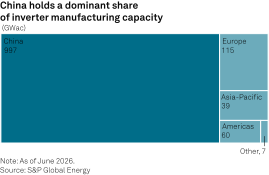
However, non-Chinese clean technologies are likely to carry a premium because China-made renewable products benefit from earlier scaling of manufacturing capacity.
Platts assessed TOPCon utility-scale solar modules shipped from China on an FOB basis at 10.8 cents/W on Aug. 12 for lower volumes, compared with 26.5 cents/W for TOPCon modules shipped from India.
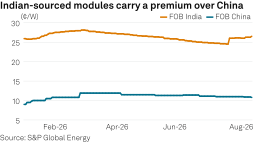
The inverter pricing for supply from European manufacturers might typically increase in the range of maybe 10%-20%, Gilligan said.
Even so, Gilligan said inverters account for a relatively small share of total project capital expenditure, meaning any price rise should not create a significant overall cost burden.
Global shift underway
The US has also tightened policy around imported clean technology products, citing national security concerns. Despite existing import tariffs on several markets, including China, Washington issued restrictions on foreign-made inverters effective July 28.
The restrictions apply to all new model inverters produced abroad unless they receive conditional approval from the Department of Homeland Security or the Department of Defense.
"I would say this is just a continuous activity that I expect that a lot of governments and jurisdictions are going to do across the world," Gilligan said.
"The reason why inverters are under the spotlight a bit is because they are part of the interface, they're part of the brains of controlling the flow of electricity," Gilligan said, noting the growing role of renewables in power mixes worldwide.
What began as an EU funding restriction could crystallize into a coordinated global effort to reshape clean energy supply chains around security as much as cost.
