Electric Power, Energy Transition, Renewables
August 10, 2026
Europe's solar supply diversification faces cost hurdles as China's PV dominance persists

Editor:
HIGHLIGHTS
Chinese supply chain dominance challenges NZIA resilience requirements
FOB Turkey solar modules may have low risk, but double the cost: supplier
German solar capture rate lower on year as generation rises
Europe's drive to boost its solar manufacturing capacity under the Net-Zero Industry Act (NZIA) is sharpening procurement scrutiny across the solar supply chain, prompting market participants to consider alternatives outside the Chinese market despite its competitive prices and lower supply chain costs, analysts, renewable energy developers, and suppliers told Platts, part of S&P Global Energy.
Policies aimed at boosting European clean tech manufacturing capacity have emerged, including the NZIA, which requires that net-zero manufacturing capacity meet at least 40% of the EU's annual deployment by 2030, according to the European Commission.
The NZIA also includes a resilience requirement, which notes that "not more than 50% of the value of the net-zero technology final product should originate from the dominant source of supply."
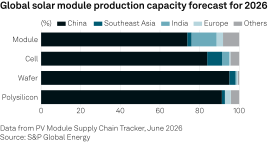
China has held solar manufacturing dominance for at least 15 years, according to S&P Global Energy's PV Supply Chain Tracker. In 2026, S&P Global Energy CERA expects Chinato hold over 90% of polysilicon and wafer production capacity and 84% of cell manufacturing capacity.
Other initiatives can also inadvertently act as a driver toward sourcing clean technologies from outside of China. In April 2026, the European Commission released guidance stating that EU funding would be banned for renewable projects using inverters from countries deemed "high-risk," including China.
"At some point, the [ban] will impact us, because we need financing from banks. The financing from banks could even have a small portion of EU funds in it," a renewables developer said.
"I think we need to be ready to follow these guidelines – it's not only for the inverters in PV plants, but also the [power conversion system] in battery systems," the developer added.
The source also said that procuring certain types of inverters outside of China is more difficult than for others, adding that centralized inverters were easier to source outside China than string-type inverters. While pointing to Germany and Taiwan as markets with string inverter manufacturing, the developer said it would be difficult to find high-volume manufacturing in Europe.
"EU manufacturing is slowly deployed and still cannot meet its local demand. It's less competitive in the global market, much higher cost, but lacking supporting policies," said Jessica Jin, clean technologies and supply chains principal analyst at CERA.
"Upstream segments such as wafer and cell manufacturing are limited by insufficient scale and higher costs, reducing their competitiveness. While Europe can deploy solar at scale, true manufacturing sovereignty remains elusive, likely achievable only through partial regionalization rather than full reshoring," according to CERA's Cleantech manufacturing series: Europe, published May 26.
Clean technologies outside of China
Outside of China, the Indian and Southeast Asian markets hold some of the largest capacities for cell, wafer, and module manufacturing in 2026, according to the PV Supply Chain Tracker.
Some Indian market participants have looked towards European markets as a potential destination for exports. The removal of the US as a viable export country has led some Indian market players to explore other markets, including European ones.
The US was a key importer of India's utility-scale modules; however, antidumping and countervailing duties imposed on India have made it extremely difficult for India to continue exporting to the US at previous scales.
Some market participants said utility-scale modules sold into Europe may need to be priced more competitively in a market saturated with lower-cost modules from China. Throughout 2026, the Platts assessment for TOPCon utility-scale solar modules shipped out of India on an FOB basis has maintained a premium of at least 14 cents/watt over the FOB China equivalent.
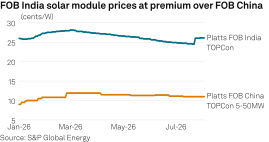
Even when FOB China TOPCon solar module prices for 5-50 MW units reached their highest level this year, at 11.90 cents/W, FOB India prices were still more than twice as high.
The EC considers Turkey a potential export market for Europe due to the lower risks associated with the Turkish market, as it does not hold a majority share of the module market or supply chain.
However, like India, higher module costs from Turkey could still deter interest in it as an alternative to the Chinese market.
AEurope-based supplier said utility-scale modules delivered from Turkey on an FOB basis could cost up to 24.50 cents/W, well-above prices for Chinese-made modules, which were assessed at 10.90 cents/W Aug. 7.
Solar market participants may face greater challenges absorbing higher module costs in a market where overall solar power costs are declining.
The value of solar power can be measured using solar capture rates, which compare solar capture prices – indices that represent the market value of solar electricity generation – to the overall wholesale spot market average price and can show how much solar generators can earn from the wholesale market.
Solar capture rates in Germany – one of Europe's largest solar module markets – fell over a tenth below the previous year's levels in July to 63%, indicating a year-over-year decline in levels of solar penetration into Germany's electric grid.
While capture rates fell, solar generation in Germany reached 16.2 gigawatts in July, up 33% from the previous year's levels, Platts data showed, indicating increasing levels of solar penetration into Germany's electric grid on a year-over-year basis.
Energy security amid volatile power market
The increased efforts to boost Europe's renewable manufacturing fleet come amid a volatile energy market landscape and geopolitical instability after the start of the US-Iran war in late-February.
Germany – a fuel-linked power market – saw front-month prices average €92.73/megawatt-hour in March following the start of the conflict, 18% higher than the same period in 2025, EEX data showed.
Month-ahead power prices have tracked the volatile swings seen in European gas markets. The Dutch TTF front-month product was trading at €25-31/MWh prior to the start of the conflict, but has since seen a surge in volatility, with prices in the range of €39-63/MWh between the beginning of March and July, data from the Intercontinental Exchange showed.
