Electric Power, Natural Gas, LNG
August 04, 2026
Data center loads drive gas turbine orders to highest level since 2000: experts

Editor:
HIGHLIGHTS
Gas turbine orders reach 51 GW in 2025
Electricity prices expected to escalate
Surging data center loads across the Lower 48 drove natural gas turbine orders in 2025 to their highest level since 2000, and 2026 orders may be higher, which will likely strengthen natural gas and power prices, especially in areas where demand growth exceeds supply additions, experts said Aug. 4.
A webinar about "the race to power data centers," conducted by a team of S&P Global Energy CERA analysts, showed that a February 2024 survey of utility forecasts in independent system operators/regional transmission organizations indicated that non-cryptocurrency load was expected to approach a peak of about 400 terawatt-hours by the year 2035.
In contrast, a March 2026 survey of utility forecasts showed data center load likely to approach 1,350 TWh by 2035. "Data centers account for over half of US demand growth through 2035," the presentation states. The largest data center numbers are in the following markets:
- PJM: about 235 TWh
- Midcontinent Independent System Operator: about 115 TWh
- SERC, formerly known as the Southeast Electric Reliability Council: about 85 TWh
- The non-ISO West: about 65 TWh
- The Electric Reliability Council of Texas: about 60 TWh
CERA data shows gas turbine orders hit 51 gigawatts in 2025 and 18 GW in the first quarter of 2026. The largest annual total in recent years was 66 GW in 2000, but numbers hovered between zero and 11 GW through 2023.
'Cost escalation' likely
Doug Giuffre, CERA executive director and head of Americas power and renewables research, said his "personal view" is that the US is "in for an extended period of cost escalation on electricity prices."
"On the gas side, we have a lot of demand coming from LNG plus data centers," Giuffre said. Many of the data centers providing their own power plan to use natural gas, he said. "So we're likely to see increased demand for natural gas, which could push up prices, particularly in some regions."
Catherine Chang, CERA Americas gas and power analyst, said, "We expect a record-breaking year for resources coming online ... with over 90 GW that are under construction."
"This build-out is dominated by solar, wind and batteries," Chang said. "In addition, we also start to see an uptick in gas, and we expect the trend to continue."
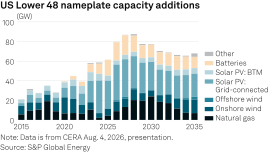
Solar, gas and batteries are likely to dominate resource installations through 2035, Chang said.
"Through 2030, over 400 GW of capacity is expected to be added, over 80% of which will be added across these three resources," Chang said. "Gas additions rise quickly to meet the data center-driven demand growth. Through 2030, we expect roughly 80 GW will be added. At the regional level, the Southeast will lead gas addition over the next five years, followed by MISO, ERCOT and PJM."
Political uncertainty at issue
Giuffre noted that federal, state and local leaders have expressed interest in slowing data center development to ensure affordability for ordinary citizens.
Giuffre noted that Texas Governor Greg Abbott on Aug. 3 ordered the Public Utility Commission of Texas and ERCOT to audit data center projects for issues related to public subsidies, water use and community impact before those projects are connected to the ERCOT grid, with the goal that data center projects are not cross-subsidized by existing electricity customers.
Such steps create uncertainty, Giuffre noted, which may temper CERA's forecast for data center demand growth.
S&P Global Energy's "integrated house view" for data center demand growth is for it to rise from current levels around 100 TWh to about 700 TWh by 2035, according to the webinar presentation. But if demand explodes as utilities have projected, that total could exceed 1,000 TWh by 2035. In contrast, if demand slows, CERA projects data center growth may only rise to about 400 TWh by 2035.
Regarding the impact on retail electricity bills, Giuffre said, "I live in Ohio, and we're living it in real time here and seeing the cost escalation in our retail electricity bills."
Monitoring Analytics, PJM's independent market monitor, "attributes a lot of that to data centers," Giuffre said.
"PJM auctions were in a period of pause, and when they were conducting capacity auctions again, suddenly, we're in a new paradigm, and we just haven't been able to catch up," Giuffre said. "And so we've had very expensive capacity auctions that are flowing through to retail customers."
