Electric Power, Energy Transition, Renewables
July 31, 2026
INTERVIEW: Domestic solar cell mandate extension sufficient to address project construction backlog
By Hardik Verma and Aditya Saroha
Editor:
HIGHLIGHTS
Stuck projects, manufacturers drive ALMM-II deadline extension
Wafer, ingot production entirely import-dependent, posing key hurdle to self-reliance
Domestic market remains primary anchor as US duties weigh on exports
The government's decision to extend the deadline for using solar cells outside the Approved List of Models and Manufacturers framework should ease industry concerns and give the sector enough runway to work through its backlog of project construction and module manufacturing, according to Vinay Rustagi, chief business officer at Premier Energies.
"I expect about 15-20 GW of new cell capacity to be commissioned by the end of December, which will provide much more volume in the market and meet consumer demand," Rustagi said in an interview with Platts, part of S&P Global Energy.
The ALMM-II policy, effective June 1, 2026, mandates that only listed cell manufacturers can participate in key government and related projects. The Indian government subsequently granted a deadline extension for net metering and open-access renewable energy projects, allowing developers until Dec. 31, 2026, to procure solar photovoltaic cells outside the ALMM-II framework.
Rustagi said many projects are in advanced stages of construction, with modules ordered or delivered but not yet commissioned, while manufacturers of non-DCR modules are similarly stalled. These factors, along with insufficient cell supply, were key drivers behind the extension.
According to government data, India's solar module manufacturing capacity stood at about 172 GW as of March 31, while solar cell manufacturing capacity was about 24 GW as of Dec. 29, 2025. Market participants, however, put current cell capacity closer to 30 GW.
As module manufacturers race to build their own cell lines, Rustagi said cells and modules should essentially be viewed as one and the same when assessing demand. Premier's module manufacturing capacity stands at 11.1 GW and cell capacity at 3.6 GW.
Premier Energies has broadly maintained a 50-50 split between cells used internally and those sold to external manufacturers, a ratio set to shift.
"Very broadly, what we have said in the past is that we are trying to keep the ratio at about 50-50. But over a period of time, as ALMM-II gets implemented, the ratio of external sales is going to come down because we will be supplying more DCR modules."
Appetite for DCR cells and modules remains strong, he said. While the non-DCR segment had been somewhat slow due to delays in commissioning utility-scale projects, the extended deadline is expected to support activity in this space over the next six months.
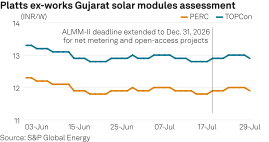
Prices for non-DCR modules made from imported cells had been declining ahead of the announcement, then rose after the July 18 extension. Platts assessed TOPCon modules made from imported cells at 12.90 rupees/W and PERC modules at 11.90 rupees/W on July 31. Prices initially rose on stronger sentiment, but largely remained rangebound as higher non-DCR inventories with suppliers capped gains.
Challenges to being self-reliant
The preference for non-DCR modules is largely cost-driven, with prices sharply lower than DCR counterparts — largely because Chinese cells are priced at roughly one-quarter to one-third of domestic levels.
Rustagi said Chinese companies have significant overcapacity, that most major Chinese cell and module makers are making losses, and that they receive substantial subsidies. Indian manufacturers face additional costs such as import duties on glass and backsheet, higher freight, and the need to maintain 60-90 days of buffer stock. Stripping out these inefficiencies and assuming equal margins, he said, the true cost gap between Indian and Chinese manufacturers narrows to around 15%.
Rustagi noted that ingots and wafers are currently entirely import-dependent. Wafer manufacturing is uncharted territory for Indian players — a technically demanding business requiring significant operational expertise — and the domestic ecosystem remains largely undeveloped, meaning raw materials, consumables, machinery and technical knowledge will all need to be sourced from China.
"It is going to be quite a formidable task, I acknowledge, but we have been working actively after the government's policy announcement, and most of us have already detailed out our investment plans in terms of capacities, timetables, funding, etc. Now it is all about execution," Rustagi said. India expanded its ALMM framework by adding a new List-III for ingots and wafers, set to come into force from June 1, 2028, mandating domestic sourcing for government-backed projects.
Technological complexity and capital intensity increase materially the further upstream one moves, Rustagi said. Cell manufacturing capex alone runs at roughly 3-3.5 times that of a module line, with ingot and wafer production demanding comparable investments, and polysilicon requiring a similar outlay.
Capital requirements extend across ancillary materials, including glass, backsheet, aluminum frames, adhesive and silver paste. Premier Energies' glass capacity is expected to quadruple or quintuple over the next three years, while the company is setting up its own aluminum frames plant and actively looking to diversify procurement options.
Domestic market remains primary anchor
The imposition of preliminary countervailing and antidumping duties on Indian solar cells by the US has significantly curtailed exports to that market. Investigations were also launched on solar cell imports from Indonesia, Cambodia, Laos and Ethiopia, alongside similar preliminary duties.
As far as Premier is concerned, Rustagi said, Premier is not exporting modules, and the share of exports in the order book is zero. India's expanding roster of foreign trade agreements — including deals with the US, Europe, the UK and New Zealand — could gradually open new export avenues as more nations seek to reduce dependence on Chinese supply.
For now, the Indian market is the primary anchor for the business and its foundation going forward, he said.
"Export, in the current context, unless things change dramatically, remains only a cherry on the cake. That is how we are looking at the export market right now, but maybe over a period of two to three years, the export market will become much more attractive," Rustagi said.
