Electric Power, Natural Gas
July 23, 2026
Triple-digit high temperatures boost Texas power grid to new peakload records

Editor:
HIGHLIGHTS
Solar growth keeps prices low despite heat
Data centers and population drive load growth
Widespread triple-digit high temperatures across the Electric Reliability Council of Texas caused it to set a new peakload record on July 21 and another on July 22 before the heat wave broke. Still, energy prices remained subdued, which industry analysts on July 23 attributed partly to massive solar resource growth.
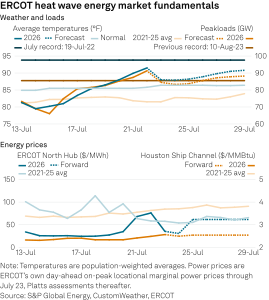
ERCOT had last set a record of 85.5 gigawatts on Aug. 10, 2023, but this week's heat caused load to peak at 87.4 GW on July 21, 2026, and 91.3 GW on July 22, ERCOT data shows. The 2021-2025 averages for those dates are 73.6 GW and 73 GW, respectively.
CustomWeather calculated the population-weighted average temperatures across ERCOT to have been 89.9 degrees Fahrenheit on July 21 and 91.5 F on July 22, well above the long-term averages for those dates of 85.5 F and 85.8 F, but below the record of 93.8 F set on July 19, 2022.
Michael Pickens, S&P Global Energy associate director and principal analyst for North American power, said the apparent disconnect between record peakloads and record temperatures "highlights the significant transformation in the power grid since August 2023."
"While electricity demand has been broad-based across the system, western Texas continues to see the strongest growth, driven by new data centers and the oil & gas sector," Pickens said July 23.
"Texas has seen a confluence of load post-COVID due to the Permian, data centers and just good old-fashioned population growth that has and will continue to test records over the coming years," Faulkner said. "ERCOT's planning has also contributed to fewer tight hours this summer due to their fleet maintenance outage planning process, as well as real-time co-optimization smoothing unit availability. Moving storage into the energy stack and away from pure ancillary service arbitrage has been a net benefit to help keep real-time prices lower."
Energy markets subdued
Despite the high temperatures, power prices at the ERCOT North Hub, the independent system operator's most liquid price point, did not spike. Day-ahead on-peak locational marginal prices averaged just $68/megawatt-hour on July 21 and $75.98/MWh July 22, compared with the 2021-25 average of $69.52/MWh. The overall high for 2021-25 was $656.25/MWh set on July 11, 2022.
Natural gas prices were even more subdued. Platts, part of S&P Global Energy, assessed Houston Ship Channel spot gas at $2.415/million British thermal units on July 21 and $2.485/MMBtu for July 22, compared with those dates' 2021-25 averages of $3.549/MMBtu and $3.629/MMBtu, respectively.
"Gas prices have been low due to the flood of gas from places like the western Haynesville and sufficiently high crude oil prices to keep associated dry gas coming on via shale crude completions," Faulkner said. "LNG offtake has helped keep gas from being sub $2.00, but there is just a large amount of gas available in Texas in particular right now."
S&P Global Energy's Pickens attributed the lack of power price spikes to "new supply ... outpacing electricity demand growth this summer."
"Solar generation reached nearly 29 GW over the peak hour this week, up from nearly 10 GW during the August 2023 peak," Pickens said. "Notably, battery energy storage systems were charging over the peak hour since the grid had plenty of operating reserves. All these factors put downward pressure on power prices with ERCOT North real-time power prices staying below $30/MWh over the peak hour, down from nearly $2,400/MWh during the August 2023 peak."
As of the end of June, ERCOT had 39.8 GW of solar capacity operational, compared with 37.4 GW at the end of 2025 and 10 GW at the end of 2021.
ERCOT's operational battery storage capacity totaled almost 21.2 GW at the end of June, up from less than 16.7 GW at the end of 2025 and just 1.3 GW at the end of 2021.
"With all the solar on the system, peak prices are divorced from peak demand in ERCOT," Joshua Rhodes, a research scientist at The University of Texas Energy Institute, said. "There was so much power available that, even when the grid hit an all-time peak, batteries were still, on net, charging."
Houston faces heat, storm
Houston-based CenterPoint Energy on July 23 said temperatures peaked between 103 and 104 F July 22, followed by severe thunderstorms and wind gusts between 42 and 67 miles per hour in the late afternoon and evening, causing about 11,000 customers to lose power, of which about 5,000 remained without service as of 11 am CT July 23.
Meanwhile, CenterPoint expected the remains of Tropical Storm Bertha to arrive in Houston July 23, for which the Houston utility mobilized more than 1,000 front-line workers to restore service as necessary.
"While we do not expect significant impacts as the system makes landfall later today, our Emergency Operations Center remains activated, and we continue to monitor evolving weather conditions," said Nathan Brownell, CenterPoint Energy's vice president for resilience and capital delivery and incident commander.
Elsewhere in Texas, the National Oceanic and Atmospheric Administration reported the following highs for July 21-22:
- Austin: 101 F on July 21, 104 F on July 22
- Dallas-Fort Worth: 106 F both days
- San Antonio: 98 F July 21, 100 F July 22
Pickens said the ERCOT grid "is likely to face another test in August as temperatures continue to rise."
"The system is expected to hold up unless there is an extended period of extreme heat or power plant outages this summer," Pickens said. "It's also worth noting that ERCOT declared an Energy Emergency Alert on a non-peak demand day during summer 2023. High demand and low wind generation led to an EEA 2 on Sept. 6, 2023."
As of July 22, the Platts M2MS Power Forward Curves had ERCOT North Hub August on-peak power at $63.95/MWh, up from August 2025 day-ahead on-peak LMPs averaging $42.73/MWh.
