Electric Power
July 22, 2026
Despite tropical storm weighs on Gulf Coast loads, energy prices stay strong
Editor:
HIGHLIGHTS
Bertha weakens along Louisiana Gulf Coast
CenterPoint mobilizes 2,150 workers for outages
Tropical Storm Bertha weakened as it approached Louisiana's Gulf Coast July 22, and the peakload was forecast to drop 5.4% on July 23. Still, the Platts M2MS Power Forward Curve on July 21 had MISO Louisiana Hub on-peak power up more than 43% for July 23-24 delivery.
In its 1 pm CT update of the storm, the National Hurricane Center said the center of the storm was about 60 miles east of New Orleans. It had maximum sustained winds of 45 miles per hour, and it was moving northwest at 7 mph. In a 4 pm CT briefing, Houston-based CenterPoint Energy Chief Meteorologist Lena Jakowski said the storm made landfall about 2 pm CT in St. Bernard Parish, Louisiana.
The NHC's 1 pm CT public advisory said, "On the forecast track, the center of Bertha will move near or along the Louisiana and upper Texas coasts through July 23, and then move farther inland into Texas on Friday."
Wind shear a factor
During an 11 am webcast, Jamie Rhome, the National Hurricane Center's deputy director, said a continuing north-south wind shear should keep most of Bertha's heaviest rains offshore as the center tracks along the Gulf Coast of Louisiana.
"Strong northerly winds in the upper levels of the atmosphere [are] pushing that deep shower and thunderstorm activity away from the center," Rhome said. "Bertha has commenced the slow weakening that we have been forecasting over the last several days, and that weakening is going to continue."
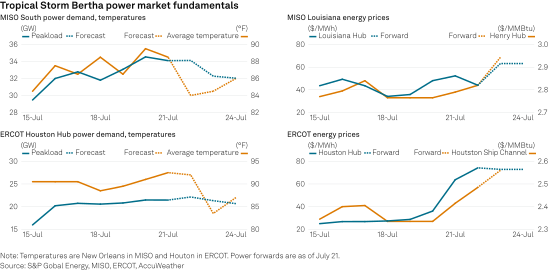
Almost all of Louisiana is in the Midcontinent Independent System Operator, and Entergy Louisiana serves most of the state. MISO forecast the peakload in the MISO South Region, which also includes parts of Arkansas, Mississippi and Texas, to fall to about 1.8 gigawatts, or 5.4%, on July 23 to about 32.3 GW and edge down even further to 32 GW on July 24.
AccuWeather forecast average temperatures (midpoint of highs and lows) in the New Orleans metro area to fall about 4.5 degrees F to 84 F on July 22 but edge up to 84.5 F on July 23 and 86 F on July 24.
Power prices up
On July 22, the Intercontinental Exchange had no trading on Louisiana Hub on-peak power for July 23 delivery. Still, the Platts power forwards on July 21 had on-peak power valued about $63.15/megawatt-hour for the remainder of July, up about $19.10, or 43.4%, from July 22's day-ahead on-peak locational marginal price of $44.04/MWh.
Based on July 22 trading, Platts assessed Henry Hub spot natural gas at $2.943/million British thermal units for July 23 delivery, up 12.3 cents, or 4.4%, from July 22's spot index of $2.32/MMBtu.
Entergy issued no update July 22 for its July 20 Tropical Storm Bertha news release that advised customers to prepare an emergency kit for the possibility of service interruptions and said it was "preparing for severe weather."
Houston preparing
Amid what CenterPoint Energy described as the most extreme heat of the summer so far in the Houston area and in expectation of a July 23-24 arrival of Bertha in the Houston area, the company on July 22 conducted a briefing about its emergency preparation.
CenterPoint said it has done the following:
- Activated its Emergency Operations Center
- Mobilized 1,050 front-line workers
- Contracted with another 1,100 workers, if needed
- Conducted outreach with critical care customers
"With temperatures reaching as high as 104 F today in the Greater Houston area and an estimated heat indices of up to 115 degrees, the National Weather Service has issued an Extreme Heat Warning for the region," CenterPoint said in its July 22 news release. "Isolated thunderstorms are also possible this evening between 4-9 pm."
The Electric Reliability Council of Texas forecast its Houston Load Zone would have a decrease of 812 megawatts, or 3.7%, in peakload on July 23, down to 21.3 GW. AccuWeather forecast the Houston metro area's average temperature to fall 8.5 degrees, or 9.2%, to 83.5 F on July 23 before rising to 87 F July 24.
ICE had no trading of ERCOT Houston Hub on-peak power for July 23, but Platts on July 21 had ERCOT Hub on-peak power valued about $72.85/MWh for the balance of the month starting July 23, down $1.35, or 1.8%, from July 22's day-ahead on-peak LMP of $74.21/MWh.
In contrast, Platts assessed Houston Ship Channel gas on July 22 about $2.56/MMBtu for July 23 delivery, up 7.5 cents or 3%, from July 22's index of $2.485/MMBtu.
