Crude Oil
December 29, 2025
COMMODITIES 2026: Asian refiners drawn to US crude imports for economic and diplomatic gains
HIGHLIGHTS
South Korea still Asia’s top US buyer, Thailand imports up 30%
Weak EFS, WTI discount to Murban make US crude appealing
US crude purchases strengthen relations via trade deals
This is part of the COMMODITIES 2026 series, where our reporters bring to you key themes that will drive commodities markets in 2026.
Major East Asian refiners are expected to continue purchasing light sweet US crude in 2026 as they seek to diversify feedstock suppliers to mitigate geopolitical risks and improve margins, while maintaining strong diplomatic relations with Washington.
Most East Asian refiners rely primarily on sour crude supplies. However, by purchasing light sweet US crude grades, such as WTI Midland and West Texas Light, they seek to enhance energy security and stabilize supply chains, according to feedstock and inventory managers at state-run and major private-sector refiners in South Korea, Japan, Thailand and Taiwan, including PTT and ENEOS.
Sweet and sour crude traders at major East Asian refiners' trading offices in Singapore also confirmed this trend. The market sources spoke on condition of anonymity to discuss commercial matters.
In Japan, the refining sector has historically relied heavily on sour crude suppliers, which have accounted for over 90% of the country's total crude imports.
Recognizing the need to enhance energy security and minimize geopolitical risks, Japanese refiners are increasingly turning to light sweet US crude as an ideal alternative feedstock, reflecting efforts to establish a more balanced and resilient crude supply portfolio, a senior market analyst at Japan's major integrated trading house Mitsui and a feedstock manager at the country's top refiner ENEOS told Platts, part of S&P Global Energy.
Japan, Asia's fourth-largest crude importer, received 106,321 b/d of WTI Midland and WTL crudes from the US in October, up more than 26-fold from 4,029 b/d imported a year earlier and almost triple the 36,183 b/d purchased in September, according to the Ministry of Economy, Trade and Industry.
Refiners in Thailand, South Korea, and Taiwan are also increasingly recognizing the importance of embracing US crude as a strategic measure to lower their reliance on sour crude suppliers.
"By integrating light sweet US crude, it not only helps mitigate the volatility associated with sour crude imports but also aligns with company efforts to diversify supply sources and improve overall refining margins," said a feedstock manager at a major South Korean refiner based in Ulsan.
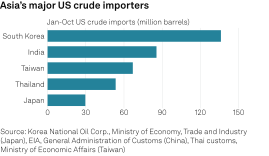
In 2025, South Korea is expected to remain Asia's biggest US crude customer, having purchased 136.11 million barrels, according to data from state-run Korea National Oil Corp.
For Taiwan, the US was the biggest crude supplier as shipments over January-October rose 0.2% year over year to 66.93 million barrels, data from the Ministry of Economic Affairs' Energy Administration showed.
Thailand was Southeast Asia's largest US crude buyer, with WTI Midland crude arrivals in the first 10 months rising 31% year over year to 148,535 b/d, according to customs data.
Feedstock economics
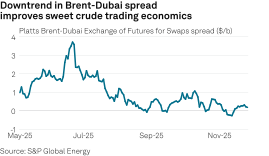
Refining margins and trading economics increasingly favor the intake of light sweet US crude, as the Brent-Dubai price spread has narrowed significantly and WTI Midland is priced lower than key sour crude grades. This is significant, given the superior quality, higher middle distillate yields, and longer delivery distances of US crude grades, according to refinery feedstock managers across East Asia and traders based in Singapore.
Platts has assessed the Brent-Dubai crude exchange of futures for swaps (EFS) spread at an average of 72 cents/b so far in the second half of 2025, compared with the H1 average of $1.12/b. A weaker EFS makes various sweet crudes from the US, North Sea, and the Mediterranean, which are linked to the European benchmark, more economical compared with Dubai-linked Middle Eastern grades.
"WTI Midland is increasingly appealing, as it is viewed as a more cost-effective option compared to various light and medium sour crude grades," said a feedstock manager at a major South Korean refiner based in Ulsan.
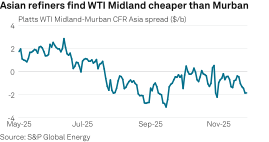
Platts assessed the spread between WTI Midland and Murban crude on a CFR North Asia basis at an average of minus 46 cents/b so far in the fourth quarter.
When asked about the sweet and sour crude import balance next year, an investor relations official at state-run Thai refiner PTT told Platts that sour crude makes up 60% to 70% of the refinery feedstock mix, but light sweet US crude significantly enhances flexibility.
In addition, WTI Midland is highly popular in times of healthy Asian gasoil and jet fuel crack spreads as the light sweet grade is coveted for its high yield of light and middle distillates, feedstock managers at Japanese, South Korean, and Taiwanese refiners, including CPC and ENEOS, told Platts.
"The simple fact that higher-quality WTI Midland, with a higher middle distillate yield, is available at a discount to some light and sour Middle Eastern grades on a delivered basis makes US crude very popular in Asia," said a senior trading analyst at Mitsui.
Diplomatic tool
Increasing imports of US crude serve both economic and diplomatic purposes. By bolstering their purchases of light sweet US crude, countries like Japan, South Korea, and Thailand can strengthen bilateral relations with Washington.
"By committing to purchase more US crude, Thailand not only enhances its energy security but also leverages these imports as a diplomatic tool to strengthen ties with the US," said a feedstock procurement strategist at PTT.
Thailand committed to purchasing US energy products under a framework for a bilateral trade agreement announced Oct. 26.
As for South Korea, its $100 billion US energy purchase agreement was a key component of a broader trade deal with Washington aimed at lowering the reciprocal tariffs from 25% to 15% and enhancing economic cooperation between the two nations.
In Japan, although major refiners purchasing US crude are private-sector companies and are importing WTI Midland and WTL primarily for strategic feedstock economics and refining margins, the uptrend in US crude imports could support state-level diplomatic efforts, according to feedstock managers at refiners including ENEOS, Taiyo Oil and Cosmo Oil.
The US and Japan signed a comprehensive trade and investment agreement on Oct. 28 to implement previous commitments, including Japan's pledged $550 billion investment in US sectors such as energy infrastructure, LNG, advanced fuels, grid modernization, and critical minerals mining, processing and refining.
