Crude Oil, Maritime & Shipping
July 09, 2025
Asian refiners cheer OPEC+ hike but non-Middle East crude diversification in focus
HIGHLIGHTS
Refiners welcome OPEC+ decision for energy security.
Freight costs, geopolitical risks influence diversification decisions
WTI Midland becomes most preferred non-Middle East crude
Asian refiners welcomed the OPEC+ decision to sharply raise August crude output, but regional crude buyers are looking to avoid over-reliance on Middle Eastern supplies as they focus on diversification to maximize refining margins and minimize logistical risks.
The Asian refining industry fully supports the OPEC+ alliance's decision to increase production, as major Middle Eastern producers play a crucial role in Asia's energy security, according to feedstock managers and crude slate strategists from refiners in Japan, South Korea, Thailand, China and Taiwan.
However, the fluid geopolitics in the Persian Gulf serve as a stark reminder for Asian crude buyers of the critical importance of supply source diversification, as feedstock and logistical economics often favor non-Middle Eastern crude grades, said refinery feedstock managers.
On July 5, the eight members of the OPEC+ alliance implementing voluntary crude output cuts agreed to increase their production quotas by 548,000 b/d for August. This group includes Saudi Arabia, Russia, the UAE, Kazakhstan, Oman, Kuwait, Iraq, and Algeria.
Saudi Arabia and the UAE together account for over 80% of Japan's crude oil purchases. While the OPEC+ production hike bolsters Japan's energy security, the recent Israel-Iran conflict serves as a significant warning that refiners must be prepared for worst-case scenarios, according to feedstock managers from two major Japanese refiners, including ENEOS.

"Middle Eastern sour crude grades are staple feedstocks for Japanese refiners, making it prudent and economical to secure adequate term supply contracts....for spot purchases though, flexibility and diversity are essential, and it is crucial to expand non-Persian Gulf supply sources like the US and Canada," a feedstock inventory manager at ENEOS told Platts, part of S&P Global Energy.
In South Korea, refiners and analysts from the Korea Petroleum Association noted that the OPEC+ output hike may not lead to increased intake of Middle Eastern sour crude, as Asia's third-largest crude importer could boost purchases from American suppliers by 5-10 million barrels per month with relative ease.
Hyundai Oilbank, the country's third-largest refiner, has recently reduced the share of Middle Eastern sour crudes in its overall slate to around 40%. Other major South Korean refiners have also found WTI Midland and certain Latin American grades more attractive due to high Persian Gulf-Asia freight and maritime insurance costs.
Elsewhere, a Sinopec refinery in southern China, previously reliant on Middle Eastern crudes, has been encouraged by its head office to consider West African grades, according to a refining source cited by Platts.
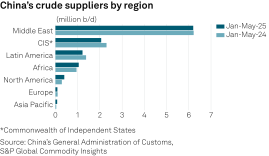
Thailand's top refiner, Thai Oil, has depended on Middle Eastern sour crude for over 90% of its feedstock mix, but refinery officials and feedstock managers believe it is prudent to reassess their crude slate despite the OPEC+ output hike.
US crude popularity
Most refiners in East Asia prefer US crude, particularly WTI Midland, as their primary non-Middle Eastern supply option due to safe logistics and the ample availability of VLCCs for the USGC-Asia delivery route, along with the high quality and economics of this light sweet grade.
Although the USGC-Asia route is long, there are always plenty of VLCCs available to deliver WTI Midland. This grade is ideal for maximizing jet fuel and gasoil refining yields and does not require heating during winter deliveries, according to a feedstock manager at a major Japanese refiner.
In May, Japan imported 189,403 b/d of US crude, nearly tripling from 67,515 b/d a year earlier, according to the Ministry of Economy, Trade and Industry.
Given the recent rise in Middle Eastern crude official selling prices and high Persian Gulf-Asia freight costs, WTI Midland is becoming increasingly attractive. Additionally, South Korean refiners benefit from a government freight incentive program for crude oil imports from non-Middle Eastern regions, allowing for cost savings of approximately $2/b, according to feedstock managers at two major South Korean refiners.
Platts assessed the spread between WTI Midland and Murban on a CFR North Asian basis at minus 4 cents/b on June 30, sharply lower since touching the year-to-date peak of $2.51/b on June 4. The spread was last assessed at 88 cents/b on July 8.

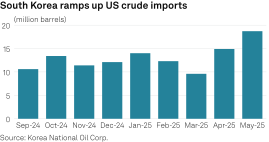
South Korea, Asia's largest US crude buyer, imported 18.7 million barrels in May, making it the country's second-highest monthly intake of US crude, following a record 20.07 million barrels in July 2024, according to data from the state-run Korea National Oil Corp.
Among recent spot trades, GS Caltex purchased a VLCC of US crude scheduled for October arrival, comprising of 1.4 million barrels of WTI Midland and 700,000 barrels of West Texas Light from ATC at a premium in the mid $5s/b to front-month Platts Dubai, according to Singapore-based trade sources with close knowledge of the deal.
Meanwhile, Taiwan's US crude imports constituted 30.7% of total refinery feedstock intake in the first five months, up from 29.9% in the same period last year, according to the island's Energy Administration. Additionally, the market share of Persian Gulf suppliers declined to 66.5% from 69% a year earlier.
