Chemicals, Refined Products, Crude Oil, Aromatics, Gasoline
December 12, 2025
Nigeria's Dangote refinery begins turnaround to stabilize operations: executive
By Kelly Norways and Matthew Tracey-Cook
HIGHLIGHTS
Main gasoline unit to stay offline until late January
Short CDU turnaround will boost capacity to 700 kbd
Further expansion to include second CDU, potential VDU
Nigeria's Dangote refinery has begun a planned turnaround that will pause its main gasoline unit, the residue fluid catalytic cracker, and briefly halt all crude processing in early 2026, according to company Vice President Devakumar Edwin.
In comments to Platts, part of S&P Global Energy, Edwin said that maintenance on RFCC began last week and will end in late January. Contrary to previous comments on the scope of the works, the executive confirmed plans to suspend the site's crude distillation unit, but said the process would only last "a few days" in January.
The turnaround will take the size of the CDU -- already the world's largest -- from 650,000 b/d to 700,000 b/d. The expansion will also see Dangote surpass the capacity of South Korea's Onsan refinery, making it the eighth-largest compex on the international stage.
Work on the RFCC follows growing international focus on the key gasoline unit after a year of intermittent operations. In an interview with Platts in October, company founder Aliko Dangote said the company was still working to resolve problems with the unit, which it hopes to address with the upcoming work.
According to figures published by Nigeria's downstream regulator, the NMDPRA, on Nov. 30, the Dangote refinery supplied the market with an average of 18 million liters of gasoline per day (around 113,000 b/d) through 2025, below a planned 35 million liters/ day (220,000 b/d) and equivalent to roughly 36% of domestic demand
In August and September, when the RFCC was mostly out of service, Nigeria's entire refining sector produced 110,000 b/d of gasoline, according to NMDPRA figures. Dangote accounts for the majority of the output, although three small modular refineries, Edo, Waltermith and Aradel, with a combined capacity of 28,000 b/d, also contributed, the regulator said.
Related interview: Insight Conversation: Aliko Dangote, Dangote Group
RFCC ramp-up challenge
Stabilizing the RFCC has been a key objective for Dangote since it began operating in 2024, providing its primary means of producing gasoline and serving Nigeria's largest fuel deficit. Yet after an extremely fast ramp-up, the unit has suffered with "design issues" and other technical challenges, Dangote's leadership has said.
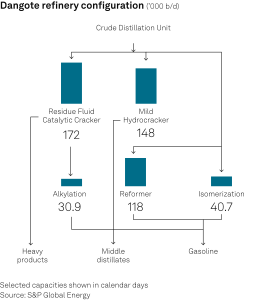
Without the RFCC running, the refinery can still make gasoline from its reformer, albeit in lower volumes. Other secondary units, including the hydrocracker, can also run independently, leaving supplies of diesel and jet fuel largely unaffected.
Over the past year, Dangote's import activity suggests that roughly 30% of its crude has been US WTI Midland supply, a grade known for yielding high volumes of reformate that can be blended with naphtha to maximize gasoline output.
In November, the refinery ended an eight-month streak of importing US crude, boosting its Nigerian imports by more than 50% to 370,000 b/d, S&P Global Commodities at Sea data showed. However, the site also appears to have boosted its imports of naphtha/ gasoline blendstocks in recent months, according to the shiptracking data.
Anticipation of the Dangote turnaround has triggered an influx of gasoline into West Africa from the European market, which has sent clean tanker rates soaring. Platts assessed the Clean UKC-West Africa 37kt freight at $45.36/mt Nov. 24 -- a 20-month high. Activity was supported by traders aiming to preempt a Nigerian fuel tariff expected in January, which was later abandoned in November.
Expansion roadmap
The latest maintenance work comes as Dangote works to advance its next expansion, which it says will more than double its capacity and help stabilize its operations.
By 2028, the company plans to commission a second crude distillation unit, minimizing downtime risks and mirroring the configuration of other refineries operating at its scale. Plans are in early stages, but an engineer at the site, who was not authorized to comment publicly, said a second refining train is likely to mirror the existing setup, with the potential addition of a vacuum distillation unit.
Rasool Barouni, head of refining at S&P Global Energy CERA, said the addition of VDU could add vacuum gas oil, base oils and bitumen to the refinery's portfolio, and would support its operational flexibility. "This allows for continued output of high-value products even when the RFCC is offline, instead of being limited to fuel oil production," he said.

Editor: