


Refined Products, Crude Oil, LPG, Gasoline
May 13, 2025
Nigeria's Dangote refinery blames 'design issues' for RFCC outage
By Kelly Norways and Matthew Tracey-Cook
HIGHLIGHTS
Refinery restarting RFCC after four-week outage due to 'design issues'
June maintenance plans under evaluation subject to performance
Refinery resumes LPG truck loadings, drops gasoline retail price
Nigeria's major Dangote refinery is restarting its main gasoline unit, the residue fluid catalytic cracker, and is evaluating the need for a second turnaround, a company executive said.
Speaking to Platts, part of S&P Global Energy, on May 13, a Dangote executive said that the company is in the process of returning refining units from a four-week turnaround to address 'design issues'.
The refinery is ramping up its RFCC, alkylation and polypropylene units, the source said, but the company is yet to determine whether a second maintenance will be necessary later this year.
"The real picture can be seen only when we open the equipment," said the source, sharing that next steps remain subject to observed performance at the site.
Output from the Lagos refinery has become a key barometer for global gasoline cracks since production began last year, and unplanned April maintenance supported a Eurobob price rally when roughly 100,000 b/d of supply was suddenly taken offline.
According to the refinery executive, the plant's crude distillation unit was last running at 550,000 b/d, roughly 85% of its nameplate capacity.
After starting test runs in Q3 2024, roughly nine months after the refinery was inaugurated, the RFCC had reached 70% of its capacity before the outage, the executive said.
The company now plans to ramp up the unit to its full capacity, allowing the site to finally scale crude throughput at the refinery to the site's full 650,000 b/d potential, he said.
With the RFCC offline, the refiner was forced to rely solely on its 120,000 b/d reformer to serve local gasoline demand in April. Market sources reported restricted access to gasoline cargoes and LPG during the outage, but said May 12 that more supplies had been made available.
Other secondary units continued to operate uninterrupted during the works, and the refinery has maintained steady exports of gasoil, jet fuel, and residual fuel that would typically be processed in the RFCC.
On May 12, Nigerian media reported that the Dangote Group had dropped its ex-gantry gasoline prices by naira 10/liter to N825 ($0.52/l), hinting at a potential production boost.
Future turnaround plans
Resumed RFCC activity at the Nigerian refinery has left market watchers uncertain over future maintenance plans that many traders had priced into future forecasts.
Before the unit was taken offline, Dangote officials were preparing for a month-long turnaround in June, though speculators said that the April turnaround may have pre-empted planned works.
The Dangote Group beat most analyst expectations by commissioning the RFCC and bringing its first gasoline to market in September 2024, but the unit has since suffered repeated outages in 2025, delaying expectations for its operations to stabilize.
"People expect June maintenance. If they don't go down, it will be very bearish EBOB," said one market source.
A second market participant warned that the refinery faces long lead times sourcing necessary parts for maintenance, such as fresh FCC catalysts, making careful planning imperative to maintain stable output.
According to forecasts by S&P Global Energy, a June RFCC turnaround at the refinery would support global gasoline cracks by roughly $3/b.
Expected downtime has added support to a bullish run for gasoline benchmarks on the back of strong US summer driving season forecasts and ample Mediterranean demand, which lifted front-month Eurobob FOB ARA barge cracks to a nine-month high of $16.9/b on May 9, according to Platts assessments.
Import surge
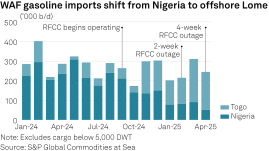
Reduced output from Dangote has supported a bounce in West African import demand as the market has reverted to European supplies to serve regional demand.
According to S&P Global Commodities at Sea data, gasoline imports to Nigeria and Togo surged from around 200,000 b/d in January to over 300,000 b/d in March and roughly 250,000 b/d in April, close to Nigeria's total of around 300,000 b/d of national demand.
CAS data captures cargoes with a tonnage of over 5000 dwt.
According to market sources, Togo has become an increasingly important channel for Nigerian imports as traders have drawn growing volumes to the offshore Lome market, where supplies are then loaded from large cargoes onto smaller vessels.
The trend to import supplies to Lome and breakbulk has been motivated by financial incentives to reduce tax exposure and continue purchases in US dollars, sources said, as the Nigerian government has made a push for companies to transact in naira.
Strong flows to WAF have been aided by soft freight costs. Platts assessed the Clean Long-range UKC-West Africa rate at $22.68/mt on May 12, down from $28.25/mt the previous year.

Editor: