Natural Gas, Refined Products, LNG, Electric Power, Crude Oil, LPG, Diesel-Gasoil
November 25, 2026
INTERVIEW: KEO CEO sees up to 14,000 b/d of crude at Venezuela's PetroUrdaneta in 2027

By Sheky Espejo
Editor:
HIGHLIGHTS
Company budgets $75 mil-$85 mil for 2027: Tomassoni
First crude sales could generate $12 million
Three to five financing proposals under consideration
Natural gas exports to Colombia among long-term opportunities
KEO Energy expects to increase crude production at Venezuela's PetroUrdaneta project to between 12,000 and 14,000 barrels/day within six to 12 months, from just below 2,000 b/d currently, as the US company accelerates well reactivations and prepares to begin commercializing its production, CEO Davide Tomassoni said in an interview with Platts, part of S&P Global Energy.
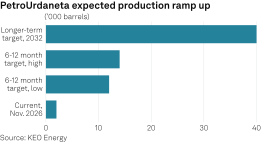
The company has budgeted between $75 million and $85 million for capital, operating and administrative expenditures in 2027, when it expects to generate gross revenue of between $150 million and $160 million, potentially allowing it to finance development through crude sales while reducing its dependence on external capital, Tomassoni said.
The company, which took possession of the asset in September after signing a joint venture contract with state-owned PDVSA Aug. 28, has selected an additional 20 wells for reactivation, which would bring its producing well count to 36.
"We are increasing production every week," Tomassoni said.
PetroUrdaneta comprises five oilfields, including La Paz and La Paz Sur, which historically produced more than 250,000 b/d. The fields produce crude ranging from 29 to 34 degrees API, allowing for relatively low extraction costs compared with Venezuela's heavier crude deposits.
Of the 280 inactive wells at PetroUrdaneta, management estimates between 35 and 45 could be reactivated without substantial investment, while the remainder require further technical assessments and potentially more extensive intervention.
Well P201, reopened Nov. 20 after a prolonged period of inactivity, delivered initial production of 600 b/d, compared with expectations of 50-100 b/d.
The reactivation cost is about $200,000, well below the $750,000-$1 million the company typically budgets for such interventions.
"The pressure is amazing," Tomassoni said. "The first initial result was astonishing to us."
Crude commercialization
KEO Energy hopes to conclude negotiations with PDVSA on its commercialization agreement before year-end, unlocking sales of more than 200,000 barrels already accumulated in storage.
Under its contractual arrangements, the company will receive 1.2 barrels of Venezuela's flagship Merey 16 heavy crude for every barrel of lighter crude it delivers to PDVSA.
The company has identified three potential buyers for its initial cargo, which could generate approximately $12 million at an estimated realized price of $59-$61/b, reflecting a discount of around $10/b.
KEO Energy expects to commercialize crude in increments of approximately 200,000 barrels, with sales proceeds directed toward PetroUrdaneta's development and operations.
PDVSA granted KEO up to six months from the signing of the joint venture contract to negotiate the offtake agreement. Outstanding discussions include cargo volumes, loading ports and domestic commercialization rights.
"We are hoping to have that signed before the end of the year," Tomassoni said, adding that the timing remained dependent on the Venezuelan authorities.
Financing alternatives
KEO Energy is evaluating three to five financing proposals, including potential equity investments, production prepayments and loans collateralized by crude production.
Some preliminary proposals involve upfront payments in exchange for future production at preferential prices over one or two years, while production-backed loans in Venezuela typically carry interest rates of 9%-12%, reflecting country risk, Tomassoni said.
The board is also considering accepting a smaller initial investment and using production revenues to finance development before negotiating with potential equity partners at more favorable valuations.
"We have to find our best fit which will maximize the interest of our shareholders," he said. "And we don't want to rush."
The company's US registration and license from the US Treasury Department's Office of Foreign Assets Control have helped reassure potential investors, Tomassoni said.
KEO favors predominantly US investors with oil and gas expertise and an understanding of the requirements of rehabilitating mature fields.
Equipment shortages
Despite existing infrastructure and relatively attractive economics for well reactivation, equipment shortages pose a major operational challenge.
"Finding equipment is almost impossible, even if you pay upfront for everything," Tomassoni said.
The company, which has more than 122 people working on the project, is also dealing with electricity outages, damaged equipment, pipeline and storage tank rehabilitation, and administrative hurdles.
Electricity disruptions have forced KEO to address its own generation requirements, including securing diesel and using associated natural gas.
"It's not easy, you know, to rehabilitate an oil and gas field which has been sleeping dormant for a very long time," he said.
Personnel have been working seven days a week to restore operations. Management expects operating conditions to improve substantially within six months.
"It's happening. It just takes time," Tomassoni said. "But hey, we are producing."
Natural gas opportunities
Beyond crude, KEO sees opportunities to monetize PetroUrdaneta's natural gas resources through potential exports to Colombia, LPG and LNG production, and electricity generation.
"I do believe personally natural gas is going to be probably far the longest play," Tomassoni said.
PetroUrdaneta already has gas infrastructure that management believes could eventually support dry gas exports to Colombia through the pipeline connection to Ballena.
The investment outlook remains conditional on continued stability and security.
"Obviously, all this happens if peace is being maintained and we can work," Tomassoni said.
