Natural Gas, Crude Oil
November 24, 2026
Venezuela expects to increase oil production to 2.9 million b/d over the next decade

Editor:
HIGHLIGHTS
Output is expected to come mainly from the Orinoco Oil Belt
Rehabilitation of infrastructure could add up to 1 million b/d
Average upstream operating expenditures: $18.4 per barrel
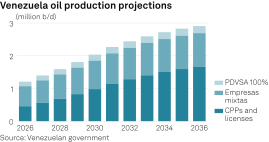
The Venezuelan government expects to increase oil production to 2.9 million b/d over the next decade, according to the "Plan Venezuela Renace," published by the Ministry of Economy and Finance on Nov. 24.
"Output is expected to come mainly from the Orinoco Oil Belt, which is projected to account for more than half of production, followed by Lake Maracaibo with about one-third, and other regions accounting for the remainder," states the 89-page document.
In October, Venezuela reported average OPEC production of 1.224 million b/d, while secondary sources estimated production at 1.158 million b/d, according to the Monthly Oil Market Report.
PDVSA estimated Venezuela will reach a production level of 1.3 million b/d as of Dec. 31, according to previous reports.
In October, the average production by Venezuelan state oil company PDVSA and its foreign partners, including Productive Production Contracts (CPPHs), rose to 1.230 million b/d, up from 1.218 million b/d recorded in September, according to preliminary data from the Ministry of Hydrocarbons, reviewed by Platts, part of S&P Global Energy.
According to the Ministry of Economy and Finance, "in the near term, Venezuela could increase production by up to 1 million additional barrels per day through the rehabilitation of existing infrastructure, without requiring immediate greenfield developments. This upside reflects the scope to restore idle or underutilized capacity."
"Average upstream operating expenditures across all fields stand at around $18.4 per barrel, suggesting that a recovery in output could be achieved at reasonable cost. Over the medium term, further production increases would depend on the availability of foreign investment to support the development of additional capacity," the document added.
Venezuela holds recoverable crude oil reserves of 300 billion barrels, of which more than 85% are located in the Orinoco Oil Belt.
Investment requirements
Getting to roughly 2.9 million b/d will require enormous investments, according to the report, which assumes $160 billion of oil-sector capex over 2026-36, with $85 billion supplied by partners and $75 billion by PDVSA.
An additional $15 billion of gas investment is expected entirely from international partners.
The ownership/operating structure is expected to change. By 2036, the plan expects CPPs and licenses to produce 1.66 million b/d, from 457,00 b/d in 2026; empresas mixtas 1.03 million b/d, up from 611,000 b/d in 2026; and wholly PDVSA-operated fields only 217,000 b/d, up from 139,000 b/d in 2026.
"Beyond the headline production target, the expansion scenario rests on a selective and capital- intensive development strategy," according to the document." Capital expenditures will be allocated to the most promising fields, based on their expected growth potential and yields for the government, with the 20 fields with the greatest potential projected to account for around 60% of total production", the document added.
The government acknowledged significant downside risks to the plan, including a slower oil production recovery, volatile crude prices, financing shortfalls, delays to debt restructuring, persistent inflation and continued sanctions.
Delayed debt restructuring and sanctions are among the most consequential risks, with the government's assessment showing they could have a high impact across several pillars of the recovery program. Despite the scale of the challenges, the government rated the likelihood of every risk identified in its matrix as medium.
Hydrocarbons law reforms
The Hydrocarbons Law was amended in late January to attract foreign investment that would help increase oil production. The Hydrocarbon Production Sharing Agreements (CPPH) were incorporated as a business model in the reform.
According to PDVSA CEO Héctor Obregón "of the 105 contracts, agreements, and CPPHs that PDVSA expects to sign in 2006, 80 are definitive agreements through which Venezuela expects to increase its oil production to 2 million b/d within five years".
Among the CPPH agreements is the one signed between the US Departments of State and Defense and North American Blue Energy Partners (NABEP) covering 17 oil fields. Under the agreement, NABEP will exercise operational control of the business, while the US government is entitled to a 35% stake in the company and preferential access to 20% of its production at cost.
On Jan. 3, a US military task force captured Nicolás Maduro in Caracas; he is currently awaiting trial in a New York prison on several charges of money laundering, drug trafficking and human rights violations, among others, with his trial set for June 1, 2027, according to international media reports.
PDVSA did not immediately respond to a request for comment.
