Maritime & Shipping, Crude Oil, Refined Products, Chemicals, Agriculture, Wet Freight, Gasoline, Aromatics, Jet Fuel, Fuel Oil, Biofuels
November 24, 2026
Trump administration's case-by-case Jones Act review slows waiver shipments: analysis
Editor:
HIGHLIGHTS
Case-by-case review cuts shipments threefold
Gulf Coast originates 76% of waiver moves
356 completed movements total 94 million barrels
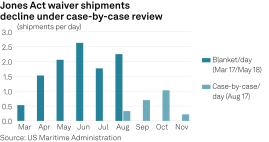
The pace of Jones Act waiver shipments has fallen about threefold since the Trump administration shifted in August from a blanket waiver to case-by-case review of each request, a Platts analysis of US Maritime Administration data showed, as the administration extended the program Nov. 16 for another 90 days, through Feb. 14.
Cargoes moving under the original March 17 waiver and its May 18 extension loaded at an average of about 1.9 per day, peaking near 2.6 per day in June, according to the analysis. Under the Aug. 17 extension, which replaced the blanket suspension with individual review, shipments have averaged about 0.6 per day, as measured through the Nov. 23 report.
The slowdown tracks what industry sources have described as a marked drop in waiver activity since the August change. The monthly pace did climb as the review process took hold — from a partial-month rate in August to about 0.7 a day in September and 1.0 a day in October — but remained below the average throughout the first two implementations of the waiver program.
The first iteration of the waivers led to a dramatic redirection of US flows, with tanker-and-barge shipments of crude oil and petroleum products from the US Gulf Coast to the US West Coast reaching 4.43 million barrels in July, up from 1.26 million barrels in July 2025, an increase of roughly 252% year over year.
The US saw a "remarkable uptick" in domestically sourced fuel shipments in the summer months, one industry trade group analyst said during an October policy briefing. That pace slowed in August due to "added regulatory uncertainty and burden."
"That doesn't mean they have stopped flowing," the analyst said. "It just means we have seen a remarkable reduction compared to the previous version of the process."
Political balance
The American Maritime Partnership, which represents the US domestic maritime industry and has long criticized any Jones Act waivers as a threat to national security and US jobs, has characterized the case-by-case approach as "an improvement over the previous blanket Jones Act waiver," while continuing to urge an end to the program.
On Nov. 13, after the administration announced its latest extension, AMP issued a statement calling for a "prompt end" to the waiver and said the US should "continue scrutinizing all waiver requests under the case-by-case process to ensure that any approved waivers meet the statutory standard of military necessity and are not used to displace American vessels and American workers for routine commercial moves."
The Cato Institute, a Washington-based libertarian think tank, has tracked all 56 Jones Act-compliant US vessels and noted they have remained fully employed throughout the waiver period.
"Foreign vessels have supplemented, not replaced, the Jones Act fleet," Cato wrote. "With the Jones Act tanker fleet fully employed, each foreign-flagged voyage represents demand that would otherwise have gone unmet."
In all, MARAD has recorded 356 completed waiver movements since March 17 — 293 under the March/May waivers and 63 under the Aug. 17 extension.
Gulf-origin trade still dominates
The Gulf Coast remains the engine of the waivered trade, originating 271 of the 356 movements, or about 76%, reinforcing the region's role as the primary seaborne supplier of US crude and refined products, the Platts analysis showed. The two largest lanes both run outbound from the Gulf, with 82 cargoes discharged on the Atlantic Coast and 78 on the West Coast.
Cargo mix splits by destination. Gulf-to-West Coast movements skew toward light products, with 45 of 78 carrying gasoline or blendstock and seven more moving jet fuel, consistent with the West Coast's shift toward a refined-product import model. Gulf-to-Atlantic flows run heavier on crude, with 32 of 82 cargoes carrying domestic grades bound for East Coast refineries.
Shipments within a single region accounted for 101 movements, led by 56 within the Gulf — where crude, ammonia and fuel oil cluster — and 35 within the West Coast, concentrated in vacuum gas oil, renewable diesel and gasoline. Movement into the Gulf from other coasts remained limited, at 15.
Puerto Rico and the US Virgin Islands drew 72 waivered voyages, 55 of them from the Gulf Coast — a destination that has grown as a share of the trade since the summer.
The waivered voyages have together moved about 94.1 million barrels of crude and products, plus roughly 396,000 mt of cargoes quoted by weight, such as anhydrous ammonia and bitumen. The median parcel was near 300,000 barrels; the largest single cargo was 974,000 barrels of crude shipped from Louisiana to California via ship-to-ship lightering.
Each movement cites a national defense interest justification, the standard statutory basis for suspending the Jones Act's US-built, US-flag, US-owned and US-crewed requirements on domestic ocean shipping. The Trump administration first announced the waiver on March 17, as the US-Israel war on Iran led to the effective closure of the Strait of Hormuz and has extended it three times since — May 18, Aug. 17 and Nov. 16.
