Natural Gas, LNG, Refined Products, Electric Power, Maritime & Shipping, Crude Oil, Gasoline, Diesel-Gasoil
November 24, 2026
Côte d’Ivoire targets 500,000 b/d of oil output by 2040
Editor:
HIGHLIGHTS
Plans to triple output by 2030: minister
Murphy discovery may exceed Baleine
Country is key regional fuel, electricity hub
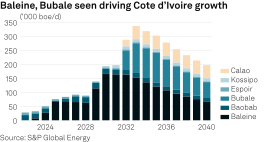
Côte d'Ivoire hopes to triple its crude production to 300,000 barrels/day by 2030 and raise it to 500,000 b/d by 2040, placing it among the top five African producers, its energy minister said, with investment-friendly policies attracting international oil companies to the country's emerging upstream sector.
In a briefing with journalists in the capital Abidjan, Mamadou Sangafowa-Coulibaly, Minister of Mines, Petroleum and Energy, said interest from companies including Eni, Murphy, Vaalco, Petrobras, ExxonMobil and others is starting to yield results for the country, which became a significant oil exporter in late 2023.
With changing peak oil and energy transition narratives and wars in Ukraine and Iran prompting an uptick in African exploration, Côte d'Ivoire, which took Eni's Baleine project from discovery to first oil in just two years, is fast becoming an investor darling.
In wide-ranging comments, Sangafowa-Coulibaly said the West African country is producing under 100,000 b/d of oil but expects to see a 150,000 b/d boost with the third phase of Baleine, following Eni's May final investment decision.
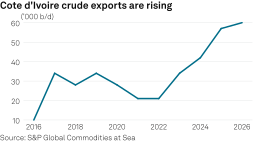
According to ship tracking data from S&P Global Commodities at Sea, Côte d'Ivoire has shipped about 60,000 b/d of crude on average this year, 87% of it from Baleine, with the remainder from state-run Petroci's Espoir field and Canadian Natural Resources' Baobab project.
Baleine crude has an API of 40, making it lighter than Ghana's Jubilee grade, which Platts, part of S&P Global Energy, assessed at a $9.70/b discount to Dated Brent Nov. 23, weighed by high freight costs.
"By 2030, we will be around 300,000 b/d approximately," the minister said. "Hopefully it will be above 500,000 b/d by 2040. This is my forecast, based on data, facts and our policy."
Eni's other key discovery, Calao, will help drive that growth, Sangafowa-Coulibaly said, with the "overwhelming discovery" estimated at 5 trillion cubic feet of natural gas, big enough to meet domestic demand with leftovers for the wider region and international markets through LNG.
US company Murphy Oil has made a commercial discovery in the CI-709 block with its Bubale-1X exploration well, which Sangafowa-Coulibaly said could "maybe be bigger than Baleine." Eni estimates Baleine at as much as 2.5 billion barrels of potential oil in place.
When it comes to frontier exploration, Brazilian state-backed Petrobras agreed in September to take over eight blocks that "demand a lot of investment," Sangafowa-Coulibaly said, stressing that Côte d'Ivoire's offshore geology closely mirrors Brazil's.
Abidjan is also locked in negotiations with ExxonMobil on three deepwater blocks, the minister added, with the parties "not far from a conclusion." Sangafowa-Coulibaly said he recently sat down with representatives from BP in Houston.
In all, 75% of Côte d'Ivoire's blocks are either under exploration or exploitation, the official said. The focus up to now has been on the largely derisked eastern side of its offshore basin, close to the Ghana border, meaning there is plenty left to explore in the west.
"Côte d'Ivoire isn't the only country occupying the Atlantic Margin," Sangafowa-Coulibaly said. "Where Côte d'Ivoire has a difference, it's the stable, predictable regulations," he added, pointing to political stability, security, modern infrastructure – including power access – competent administration and an attractive business climate as the foundation of its recent success.
"Côte d'Ivoire's flexible approach to foreign investors has boosted interest in the country's offshore acreage over the past few years," said Ida Hockerfelt, a senior analyst with S&P Global Energy CERA. "This flexibility has supported licensing now that investors are looking at the Atlantic Margin."
According to data from S&P Global Energy's Vantage, Côte d'Ivoire will rank fifth in upstream investment in 2027 at $1.2 billion, behind only Mozambique, Nigeria, Angola and Namibia.
However, Hockerfelt noted that "while pragmatic in licensing processes and project plans, the government is also tightening some terms, particularly regarding local content requirements for foreign companies, similar to other emerging producers."
Sangafowa-Coulibaly said there is "healthy competition" between African countries to attract investment, but added that dollars spent in any of its countries are a win for the continent, particularly when it comes to local processing.
"The natural resources we do have right now in terms of oil and LNG, we need to process them to meet our own demand before exporting," he said. "It makes no sense to export crude and import finished products at the higher cost."
One potential remedy, Sangafowa-Coulibaly said, is the Africa Energy Bank, a tie-up between Afreximbank and the African Petroleum Producers Organization, which aims to marshal regional and international capital for African projects across the energy value chain.
New refinery
On the downstream side, the minister said rapid economic growth in Côte d'Ivoire and the wider region has overwhelmed the country's 80,000 b/d SIR refinery outside Abidjan, increasing reliance on volatile international markets.
Platts assessed gasoline to West Africa on a CIF basis at $809.50/metric ton Nov. 23, down from a late September peak of $1,324/mt, driven by soaring product cracks amid the Middle East war.
SIR's refinery was built to process heavier crude from Nigeria rather than local barrels, meaning yields are poor when it processes light sweet Baleine crude.
As a result, the country is constructing a second plant, Sangafowa-Coulibaly said, which "will be double the capacity of the current one and will be to process Baleine crude, to meet our demand ... but also [demand] in neighboring countries."
"We are providing a number of countries with gasoline, diesel, particularly during this tough time," he added, noting the challenges African nations – particularly in the arid Sahel – are facing in securing sufficient fuel following the closure of the Strait of Hormuz.
On the sidelines of the Sirexe energy conference in Abidjan, Tiotioho Soro, SIR's director general, told journalists that the new 170,000-200,000 b/d plant in San Pedro would be completed by around 2032.
"Based on the growth of our people and our economy, the demand, we are 100% sure that this is a viable investment," said Sangafowa-Coulibaly.
Electrification push
Beyond oil and gas, Côte d'Ivoire has made progress on electrification, with plans in place for universal electricity access by 2030. According to the World Bank, 73% of Ivorians had access to electricity in 2024, up from 56% in 2012, although government statistics put the level far higher.
In Abidjan, a fleet of Chinese electric vehicles ferries passengers around, while power cuts are rare by regional standards.
On a former coconut plantation on the outskirts of the dusty coastal town of Jacqueville – an hour by road from Abidjan – sits the 390 megawatt Atinkou gas-to-power plant, offering a relatively low-cost, quick-turnaround model for gas-rich African countries.
Opened Nov. 6, the €404 million facility is connected by a 20 km pipeline to a single offshore gas field operated by Foxtrot International and supplies power to Abidjan and beyond, taking Côte d'Ivoire's installed electricity capacity to 3.34 GW.
Among a sea of pipes, control rooms and solar panels sits the only high-efficiency F-class gas turbine operating in sub-Saharan Africa, plant workers told journalists.
"We are building facilities like Atinkou," said Sangafowa-Coulibaly. "We are sharing electricity with six countries, so we will increase production."
