NGLs, Refined Products, Crude Oil, Naphtha, LPG
November 13, 2026
World oil market set for Q4 surplus as Gulf supply rebounds: IEA

Editor:
HIGHLIGHTS
IEA cuts oil demand forecasts for 2026, 2027
China's consumption drops 1.3 mil b/d in Sept
Global production jumps 5.3 mil b/d since Aug
The world oil market is set to flip into a fourth-quarter surplus as a faster-than-expected recovery in Middle East crude flows outpaces softer global demand, the International Energy Agency said Nov. 13, reversing an earlier warning of a year-end deficit.
In its latest monthly oil market report, the Paris-based agency lowered its 2026 global oil demand projection by 90,000 barrels/day from its October assessment to 102.3 million b/d, deepening the expected annual contraction to 2.7 million b/d compared with the 2.6 million b/d drop forecast a month earlier.
Total consumption for 2027 was also revised down by 80,000 b/d month over month to 104.3 million b/d, with next year's projected 2 million b/d recovery leaving global oil use roughly 670,000 b/d below prewar 2025 levels.
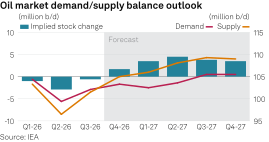
Combined with a 3.3 million b/d upward revision to fourth-quarter supply, the softer demand baseline is set to push global balances into an immediate overhang before a more substantial inventory build takes hold in 2027, the IEA said, signaling a reversal of last month's warning of a persistent year-end deficit.
"The oil market is showing tentative signs of rebalancing, with global oil supplies surpassing demand for the first time since the outbreak of the war in Iran," the IEA said in its latest report, titled "Straightening out."
Demand weakness
China accounted for the bulk of the downward demand adjustments, with the agency cutting its 2026 and 2027 Chinese consumption estimates by 80,000 b/d each to 16.43 million b/d and 16.96 million b/d, respectively, the IEA said. Chinese oil demand contracted by 1.3 million b/d year over year in September, nearly double August's pace, as a six-year property slump and rapid electric vehicle adoption continued to erode road fuel consumption.
Overall, the downgraded consumption outlook reflects ongoing disruptions to Middle Eastern exports of refined products and LPG, which remain at roughly half of prewar levels, alongside the lingering drag of elevated fuel prices, the IEA said. The agency expects the year-over-year global demand contraction to ease to 2.7 million b/d in the fourth quarter from an average drop of 4.4 million b/d in the second and third quarters.
By comparison, analysts at S&P Global Energy CERA project a full-year 2026 global oil demand contraction of 2.6 million b/d, then expect demand to rebound by 2.59 million b/d in 2027. The US Energy Information Administration's latest Short-Term Energy Outlook estimates a 2 million b/d decline in 2026 followed by a 2 million b/d rebound in 2027.
"This reflects a gradual, albeit incomplete, normalization in product supply and consumer behavior, partially tempered by the impact of elevated prices and continued weakness in Middle East demand," the IEA said.
While global oil demand is expected to return to growth around March 2027, the IEA estimates that the rebound will be heavily skewed toward petrochemical feedstocks. LPG, ethane and naphtha will account for nearly 80% of next year's 2 million b/d increase in demand as supply chains normalize, while road transport fuels will remain virtually flat.
Supply, stocks
The IEA said the shifting market outlook is being driven by a surge in Middle Eastern crude flows that have defied escalating maritime attacks and strikes on regional infrastructure.
Global oil production jumped by 2.3 million b/d month over month to 105.4 million b/d in October, building on an upwardly revised 3 million b/d gain in September.
Total output has now climbed by 5.3 million b/d since August, the IEA said, narrowing the year-over-year annual supply contraction for 2026 to 4.8 million b/d, compared with the 5.8 million b/d annual drop projected in last month's report.
The 5.3 million b/d surge since August prompted the IEA to lift its full-year 2026 global supply forecast by 920,000 b/d to 101.6 million b/d. For 2027, the IEA forecasts global oil supply to rise by 6.6 million b/d to 108.1 million b/d, down 200,000 b/d from October's projection after the agency cut its 2027 Iranian crude forecast by 680,000 b/d to 1.9 million b/d amid the continued US naval blockade.
That projected 3.8 million b/d global supply overhang in 2027 is expected to weigh on crude benchmarks. CERA analysts currently forecast Dated Brent will fall over the coming year, ending 2027 in the low $80s/b. Platts Dated Brent had already retreated to $92.06/b as of Nov. 12 from a peak above $135/b in early October.
On stocks, the IEA said global oil inventories rebounded by 52 million barrels, or 1.7 million b/d, in October, marking the first stock increase since June and coming after a 10 million barrel draw in September.
However, the build occurred entirely at sea, where oil on water rose by 86 million barrels to 2.03 billion barrels. On-land inventories remained at their lowest level since at least 2016, as OECD industry stocks fell by 41 million barrels in October.
