Refined Products, Crude Oil, Chemicals, Jet Fuel, Gasoline, Diesel-Gasoil
November 04, 2026
South Korea’s exports on track to top $1 trillion as oil product values surge
HIGHLIGHTS
Jan-Oct exports climb 93.7% to reach $930 billion
Refining margins drive 80% oil product gain
Seoul raises diesel export ceiling to 110%
South Korea's cumulative exports exceeded $900 billion for the first time in January-October, putting the country on course to surpass $1 trillion in exports for 2026, as refined oil product sales contribute to the milestone amid robust refining margins, according to the trade ministry and industry sources over Nov. 2-4.
The country would become only the fourth nation in the world to achieve annual exports of $1 trillion, with the threshold expected to be crossed in November, the Ministry of Trade, Industry and Resources said in a statement Nov. 2.
South Korea's exports rose 93.7% year on year to $115.28 billion in October, the second-highest monthly total on record after September's $121.05 billion. Exports for January-October reached $930 billion, leaving $70 billion needed in November to reach the annual milestone, according to MOTIR.
Semiconductors remained the leading export item and the main driver of growth. Semiconductor exports surged 259.4% year over year to $56.44 billion, supported by strong global demand for memory chips used in artificial-intelligence applications and elevated prices as major technology companies expanded data-center and other AI-related capital spending, MOTIR said.
Refined oil product exports also made a significant contribution. Export value rose 80.0% year over year to $6.92 billion, even though shipment volume declined 7.5%, according to MOTIR.
"The increase was driven by a 94.5% rise in export prices, highlighting the ability of South Korean refiners to capture strong product margins in international markets," the trade ministry said.
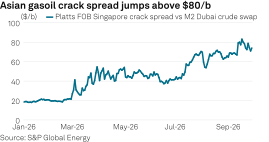
The gains came as regional middle-distillate markets remained highly profitable, product managers at two major South Korean refiners based in Ulsan and Seosan told Platts, part of S&P Global Energy, during market discussions over Nov. 2-4.
Platts assessed the second-month Singapore gasoil swap crack against Dubai crude at a record high of $83.02/b on Sept. 16. The crack spread averaged $72.97/b in September, compared with $64.71/b in August and the 2025 average of $18.16/b. Platts assessed the crack spread at $60.6/b on Nov. 3.
Platts also assessed the FOB Singapore second-month jet fuel/kerosene crack spread against Dubai swaps at an average of $50.14/b in 2026 to date, more than double the 2025 average of $17.32/b.
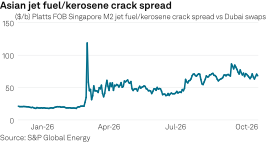
Strong demand for diesel, jet fuel, kerosene and gasoline from markets including Australia, Japan, Europe, the US West Coast and other parts of Asia has supported South Korean refiners' export earnings, the Ulsan- and Seosan-based refinery product managers said.
Meanwhile, South Korea's petrochemical exports increased 27.5% to $4 billion in October despite a 6.8% decline in volume, as export prices rose 36.9%, according to MOTIR.
Seoul allows more diesel exports
Seoul recently raised the ceiling on diesel exports to 110% of the corresponding month a year earlier, from 100%, provided refiners maintain domestic supplies and adequate inventories, Platts reported previously.
South Korea—Asia's top middle-distillate supplier—exported 14.9 million barrels of diesel in November 2025, meaning refiners could seek to sell close to 16.4 million barrels to overseas customers this month, according to the product managers at the Ulsan- and Seosan-based refiners and a sales trader at the Singapore-based trading office of another South Korean refiner, citing the latest data from state-run Korea National Oil Corp. issued Oct. 30.
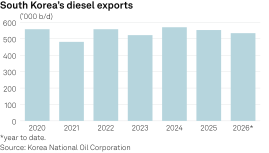
South Korea has about 3.4 million b/d of refining capacity, well above domestic petroleum demand of around 2.3 million b/d, leaving substantial capacity for exports when local supply conditions permit.
"The key is for refiners, and the government is to make sure adequate feedstock crude procurement continues to keep up the essential fuel production to meet both domestic and global customer demand," the middle distillate product manager at the Ulsan-based refiner told Platts Nov. 4.
The Dubai market structure has eased sharply in recent days, potentially signaling an improvement in sour-crude flows through the Strait of Hormuz. Meanwhile, South Korea's efforts to diversify its crude imports have succeeded in keeping feedstock inventories high and comfortable, the Seosan-based refinery product manager said.
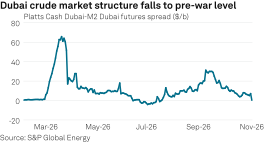
Platts assessed the spread between Cash Dubai and the same-month Dubai futures at 30 cents/b on Nov. 2, marking the lowest level since minus 30 cents/b on July 17 and lower than the prewar February monthly average of 92 cents/b. Platts last assessed the spread at 92 cents/b on Nov. 3.
The spread — widely known as the Dubai M1-M3 market structure — is a key component of the monthly official selling price calculations used by major Middle Eastern producers.
