Crude Oil, Maritime & Shipping, Refined Products, Wet Freight, Fuel Oil
November 02, 2026
Sanctioned tankers lift Russia’s NSR oil exports to new record: CAS

By Max Lin
Editor:
HIGHLIGHTS
Arctic oil shipments exceed 13 million barrels
Trade lane can save bunker and charter costs
Sanctioned fleet raises environmental worries
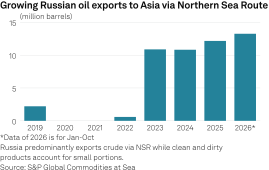
Russia has lifted its oil exports via the Northern Sea Route to a new high this year, with sanctioned tankers continuing to play a dominant role in the emerging Arctic trade.
During the NSR's navigational season in 2026, 13.2 million barrels of crude and petroleum products were loaded from Russian ports for shipments to Asia, compared with the previous record of 12.2 million barrels in 2025, and 10.8 million barrels in 2024, according to data from S&P Global Commodities at Sea.
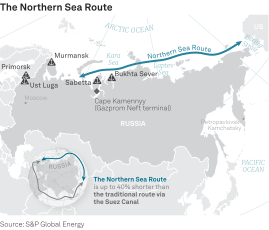
This year's volumes include the first crude cargoes from Vostok, Rosneft's flagship Arctic oil project at Bukhta Sever Port on the Kara Sea, as well as the first fuel oil shipment since commercial ships started to utilize the NSR in 2019, according to CAS data.
Russia could reduce freight costs when delivering to Asian buyers via the trade lane compared with the usual Middle Eastern route, where security risks have increased due to the US-Israeli war with Iran, some analysts said.
"Major conflicts are pushing shipping northward," Mikhail Korostikov of the Carnegie Russia Eurasia Center said in a web note. "It's not the innate qualities of the Northern Sea Route that explain its current growing popularity, but the unusual extent of global conflict."
Tanker transit time from Russia's western oil hubs to East Asia via the Suez Canal typically takes six weeks or more, whereas the NSR route can theoretically cut the transit time by up to 40%.
"Bunker prices are higher, delivery times are shorter," Gibson Shipbrokers' research director Richard Matthews told Platts, part of S&P Global Energy. "It's another route where you can trade more efficiently into the North Asian market."
Platts Bunkerworld Marine Fuel 0.5%S Index averaged $773.95/metric ton during the third quarter of 2026, up from $522.41/mt in the same period of last year.
Russia generally exports crude on Aframaxes and Suezmaxes. An Aframax could consume 40 metric tons/day of bunker fuel when sailing at 13-14 knots.
Shorter distances also point to lower tanker requirements, and tankers' daily earnings have been around all-time highs. Platts Global Suezmax Index for non-eco, non-scrubber ships averaged $212,466.29/day in the third quarter, much higher than $34,724.88/day in Q3 2025.
Sanctioned fleet
All of the 28 ships transporting Russian crude via the NSR to overseas customers during 2025-26 were sanctioned by at least one Western government during their voyages, and seven of them were without ice-class notation, according to S&P Global Maritime Intelligence Risk Suite data.
Ksenia Vakhrusheva, Arctic project advisor for nonprofit Bellona, said the use of sanctioned tankers with no or low ice class has resulted in additional risks for operating in already-harsh Arctic environments.
"The biggest environmental concern now is the growing number of old, no ice-class oil tankers from the Russian shadow fleet which sail via NSR during summer-autumn navigation. The risk of meeting floating ice resulting in an oil spill is very high for such vessels," Vakhrusheva told Platts.
Sanctioned ships tend to be old and lack classification services and insurance coverage, and some environmentalist groups have voiced strong concerns over potential incidents in the far-flung area.
Dave Walsh, advisor to the Clean Arctic Alliance, said the impact on the ecosystem would be lasting in any Arctic spill because oil dissipates more slowly in cold water, and that rescue and response infrastructure is sparse and could be far from the location of an incident.
"Oil spills in Arctic marine ecosystems pose long-term threats to biodiversity and Indigenous communities who rely on marine resources for their food security and traditional ways of life," said Elena Tracy of World Wild Fund for Nature's Global Arctic Programme.
"Moreover, the combination of ecological vulnerability of Arctic ecosystems and low local response capacity to oil spills creates a condition for ruining ecosystems and local economies for decades."
State-run Rosatom, which manages the NSR and Arctic logistics, did not respond to emails seeking comments.