Crude Oil
October 30, 2026
Democratic Congress could cool some oil investment in Venezuela: analysts

By Kate Winston
Editor:
HIGHLIGHTS
NABEP agreement faces Democratic pressure
Oversight may chase some small players away
Democratic control of one or both houses of Congress after the midterm elections is expected to boost oversight of US involvement in Venezuela's oil sector, which could cool some oil investment there, energy analysts say.
"Congressional scrutiny could have a significant impact on investment in Venezuela," David Goldwyn, chair of the Atlantic Council Global Energy Center's Energy Advisory Group, told Platts, part of S&P Global Energy.
Traditional investors like Chevron will be fine, and projects that align with Venezuela's new hydrocarbons law and regulations should be secure, Goldwyn said. Both Democrats and Republicans want Venezuela to be self-sustaining, and foreign investment is essential for that, he said.
But a Democratic Congress would likely scrutinize idiosyncratic arrangements like the US deal with North America Blue Energy Partners (NABEP), focusing on why and how the company was chosen, Goldwyn said.
A Democratic Congress would also have an interest in much greater transparency about where Venezuela oil revenues are going, how they are spent, and whether the US licensing policy is equitable, Goldwyn said.
Rachel Ziemba, a senior adviser with Horizon Engage, also said the biggest risk from oversight is for the NABEP deal. Congress is likely to push for more clarity on what the deal allows and increase oversight over the US government stake, she said.
In August 2026, the US Departments of State and Defense signed an agreement with NABEP, giving the US a 35% interest in the company and preferential access to purchase 20% production at cost.
NABEP, which retains operational control, has the rights to commercialize more than 65 billion barrels of proven oil reserves in Venezuela and plans to invest nearly $100 billion to increase production capacity and improve oil and gas infrastructure, the company says. The company has increased its crude oil output to more than 200,000 barrels per day, compared with 18,000 b/d two years ago with an investment of some $1 billion, NABEP said Oct. 13.
NABEP deal faces scrutiny
Lawmakers have already begun seeking more information about the deal.
On Sept. 15, Representative Joaquin Castro (Democrat-Texas), the ranking member of the House Foreign Affairs Subcommittee on the Western Hemisphere, motioned to subpoena federal agencies and private companies for records on the NABEP deal. The motion failed 6-6 along party lines.
On Sept. 30, Democratic Senators Jeanne Shaheen, Jack Reed, Martin Heinrich, and Elizabeth Warren, wrote to the Trump administration demanding information about the deal. Among other details, they sought the complete agreement between the US and NABEP, the legal authority for US involvement, and whether any member of the Trump administration stands to benefit financially from the arrangement.
The senators raised concern that NABEP has only two years of experience in the oil industry, with no evidence that it has the operational and financial capacity to provide the investment needed to bring the deal to fruition. They also argued that the statute creating the Department of Defense's Office of Strategic Capital does not explicitly provide the authority to take an equity stake in a private oil company, according to the letter.
When asked about congressional oversight and the senators' letter, a NABEP spokesperson said that the company is not a political entity and is instead focused on boosting oil production.
Output growth is driven by a team of Venezuelan engineers who bring 30+ years of experience in the country's oil fields, and by the hundreds of millions of dollars the company reinvests in output every month, the spokesperson said."
"NABEP increased production tenfold in our first two years, backed by $1 billion in company-funded investment," the spokesperson said. "In just the few weeks since the deal between the US government and NABEP was signed on August 31st, we've already grown production by another 10%, an additional 20,000 barrels per day."
Secretary of State Marco Rubio said that the fact that NABEP is partnered with the US gives the company the certainty needed to make massive investments.
"It's created the market confidence that they can now go out and raise the money to bring in the capital investment to increase the productive capacity of Venezuela," Rubio told reporters during an Oct. 26 teleconference.
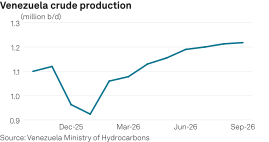
Venezuela state oil company PDVSA and its foreign partners produced 1.218 million b/d of crude in September, according to preliminary data from the Ministry of Hydrocarbons reviewed by Platts, part of S&P Global Energy.
PDVSA estimates that Venezuela will reach 1.3 million b/d of production by the end of 2026, and 1.5 million b/d by the end of 2027, according to Hector Obregón, the company's president.
Other oversight risks remain
Congress is unlikely to do much to change the administration's direction of travel on Venezuela, but increased scrutiny could still lead to headline risk for oil firms, Ziemba said
Companies may be worried about disclosures that could affect shareholders and other stakeholders, or about making other investment terms public, she said. Congressional inquiries could also eat up legal fees and time, and information disclosures could increase the risk of civil cases, she said.
Kenneth Medlock, senior director of the Center for Energy Studies at Rice University, said congressional scrutiny could affect investment by some of the smaller players in Venezuela.
Smaller producers, who are primarily wealthy individuals seeking to grow their production, may come under scrutiny, Medlock said. Congressional hearings and investigations could chase some of those players away, he said.
But larger companies are making decisions based on expected 10-, 20-, and 30-year commercial outcomes and will make their decisions based on risk and profitability, Medlock said. There is hope that true democracy will emerge in Venezuela, along with the rule of law and contract sanctity, Medlock said. If that happens, the larger companies will likely look to expand their footprint, he said.
"In terms of elections having an outcome in Venezuela, if one happens in Venezuela that results in the re-establishment of true democracy, it will have a much larger impact than anything that happens in November in the US," Medlock said.
Speaking after a fourth round of talks on the political transition process in Venezuela, a senior State Department official said that reforms of Venezuelan institutions will be completed in the coming months to enable a credible presidential election.
A new slate of magistrates for Venezuela's Supreme Justice Tribunal will be selected by the end of the year, and reforms and membership selection for Venezuela's National Electoral Council will be completed shortly thereafter, the official said during a separate Oct. 26 briefing.
Once those reforms are in place, Interim President Delcy Rodríguez will declare a vacancy in the presidency, triggering a six-month period for new elections, the official said. "You have to create the architecture for a credible election before you can actually call for one or have one," the official said.
