Natural Gas, Crude Oil
October 30, 2026
ASEAN targets full ratification of petroleum-security pact before Nov summit: ACE

By Mia Pei
Editor:
HIGHLIGHTS
Six of 11 members ratify energy security pact
Oil bill projected to reach about $369B after 2045
Emergency aid requires 10% supply shortfall
ASEAN aims to complete ratification of its renewed petroleum-security agreement before the bloc's November summit, paving the way for coordinated regional emergency responses during an energy crisis, ASEAN Centre for Energy Executive Director Razib Dawood said.
Six of ASEAN's 11 members have ratified the ASEAN Framework Agreement on Petroleum Security (APSA), with the remaining countries working through domestic approval procedures, according to the ASEAN Centre for Energy.
"The target is to fully ratify," Dawood told Platts, part of S&P Global Energy, in an interview during Singapore International Energy Week 2026, held Oct. 26-30. He noted that member states aim to announce completion at the November summit.
APSA will take effect 90 days after ratification is formally deposited with the ASEAN secretary-general. The ASEAN Centre for Energy, the agreement's secretariat, would then finalize emergency-response protocols and drills to test how assistance would work during a supply disruption, Dawood said.
Signed in October 2025, the renewed pact will replace the 2009 agreement when it enters into force. It covers crude oil, petroleum products, and natural gas, establishing a framework for members to assist countries facing supply shortages.
Under the framework, members are to endeavor collectively to supply the equivalent of 10% of a distressed country's normal requirements on negotiated terms. Assistance remains voluntary and commercial, limiting the assurance of emergency cargoes.
The affected country must implement demand-reduction measures before requesting assistance in the event of a critical shortage. A critical shortage is defined as a shortfall of at least 10% of normal domestic requirements lasting at least 30 consecutive days.
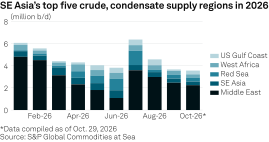
Dawood said simultaneous supply pressures across ASEAN in 2026 highlighted this constraint, leaving countries with little spare fuel to offer their neighbors.
The arrangement would be better suited to responding when one or two countries face shortages and other members have surplus supplies, he said.
"We have to have some kind of immediate mechanism to cushion the disruption," Dawood said. "You have to secure the molecule."
The ASEAN Centre for Energy's ninth ASEAN Energy Outlook, launched Oct. 8, underscores the longer-term exposure. Under its baseline scenario, final energy consumption more than quadruples between 2025 and 2060, while the annual oil bill rises to about $369 billion after 2045 from about $165 billion in the late 2020s, in 2020 prices.
Strategic stockpiling
Dawood said the bloc could explore shared strategic stockpiling under APSA, although a regional initiative remains at the feasibility-study stage. Various models would need to be considered, and individual countries could pursue their own arrangements.
The APSA framework allows voluntary, commercial stockpiling, including joint arrangements among members, without establishing a pooled reserve.
Beyond emergency buffers, Dawood pointed to efficiency, fuel switching, alternative energy and regional cooperation as ways to reduce import dependence while supporting economic growth.
The ASEAN Centre for Energy's coordinated-transition scenario projects 2060 transport oil consumption at about 8 million b/d below the baseline, highlighting the potential for electrification and other measures to reduce fuel exposure.
With an expanding consumer market, manufacturing potential and opportunities for investment in energy infrastructure, the bloc has strong growth prospects, Dawood said, highlighting the region's pragmatism in realizing that potential. "We are ... a very predictable region," he said. "You can depend on long-term investment, long-term return."
Dawood said strengthening energy security would support economic expansion and the energy transition, while increased infrastructure investment would create jobs and contribute to growth. "It is not either-or. We can do all," he said.
