Maritime & Shipping, Crude Oil, Wet Freight
October 27, 2026
Asian refiners view US crude premium as cost of stable supply, logistics security
HIGHLIGHTS
Some refiners pay premiums above $20/b for WTI Midland
Japan's US crude imports surge 352% YOY
WTI Midland at discount to Murban on CFR Asia basis
East Asia continues to rely heavily on US crude as a leading non-Middle Eastern supply source amid efforts to diversify procurement, with double-digit premiums for WTI Midland and West Texas Light delivered into Asia potentially reflecting the value of enhanced supply reliability and logistical security, according to industry sources and government ministries during Oct. 22-27.
For Thailand, Japan, South Korea and Taiwan, US crude has been the leading and most reliable non-Middle Eastern supply option, feedstock managers at Japanese, South Korean, Taiwanese and Thai refiners in Negishi, Ulsan, Xiaogang and Rayong, as well as Singapore-based traders, told Platts, part of S&P Global Energy, during Oct. 22-27.
Refiners' trading teams have struggled to secure better spot-market offers, with WTI Midland premiums consistently exceeding $10/b since the start of the second quarter; however, given the irregular availability of medium and heavy sour crude from the Middle East, elevated Persian Gulf-Far East freight and insurance costs, and heightened shipping security risks, the premium for US crude may reflect the value of more reliable delivery and supply, the Japanese, South Korean, Taiwanese and Thai refinery feedstock managers said.
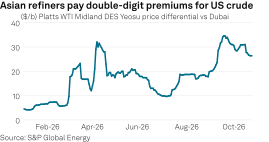
Platts assessed WTI Midland on a DES Yeosu basis at a premium of $34.60/b to front-month Dubai on Sept. 18, marking a record-high price differential for the light, sweet US crude delivered to the Far East. The premium was last assessed at $26.30/b on Oct. 26.
Among recent spot market activities, Taiwan's CPC purchased six Aframax cargoes of WTI Midland crude scheduled for January arrival via its monthly import tender, with initial trade levels heard at premiums in the mid-$20s/b against Dated Brent, CFR Taiwan, Singapore-based traders with close knowledge of the deal said.
Japan's top refiner ENEOS purchased WTI Midland crude for December arrival at premiums of around $20/b against Dubai, DES Japan.
In South Asia, India's HPCL purchased November-arrival barrels of the light sweet grade at premiums in the mid-$12s/b against Dated Brent, DAP India, while Pakistan's Cnergyico is expecting to receive 1 million barrels of WTI Midland within the next few days, Vice Chairman Usama Qureshi told Platts in an exclusive interview Oct. 26.
"In times of high uncertainty regarding supply and logistics security, a premium is warranted for cargoes that are nearly certain to be delivered on time," a feedstock manager at a major Japanese refiner based in Negishi said.
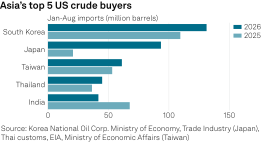
Japan posted the biggest increase in US crude shipment volumes so far this year as Asia's fourth-biggest crude buyer took 384,330 b/d from North American suppliers in the first eight months, up 352% year over year, or more than fourfold, from 85,017 b/d a year earlier, the latest data from the Ministry of Economy, Trade and Industry showed.
Diversification cost
For Asia's top US crude buyer, South Korea, diversifying crude supplies is essential amid a fragile global geopolitical landscape, even if longer shipping routes can make it costly, according to ; however, arbitrage economics often favor non-Middle Eastern crude, a feedstock manager at a Ulsan-based refinery, the South Korean trade ministry and a trading manager at another major South Korean refiner's trading office in Singapore told Platts Oct. 26-27.
The South Korean government plans to reduce the share of crude oil sourced from any single region to no more than 50% by 2035, the Ministry of Trade, Industry and Resources said in its second-half 2026 industry briefing report. The share of Middle Eastern crude in South Korea's total refinery feedstock imports in the first nine months was 62%, compared with 69% in 2025, the latest data issued Oct. 27 by state-run Korea National Oil Corp. showed.
"The objective is to reduce vulnerability to geopolitical conflicts and disruptions affecting concentrated supply routes. To achieve this, the government will diversify crude suppliers, import routes, transportation methods and crude grades," MOTIR said.
South Korea received 144.22 million barrels of US crude during January-September, up 19.1% from the same period last year, KNOC data showed. South Korean refiners paid an average of $95.03/b for US crude during the first nine months, compared with an average of $91.59/b for the country's total crude imports of 732.9 million barrels over the same period.
Still, refiners across Asia find WTI Midland more economical than some light sour Middle Eastern grades due to expensive Persian Gulf-Asia shipping and insurance costs, Singapore-based traders said.
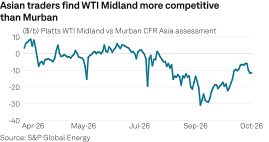
Platts assessed the spread between WTI Midland and Murban on a CFR North Asia basis at an average discount of $6.45/b so far this year, compared with the 2025 average discount of 18 cents/b.
For Pakistan, while alternative non-Middle Eastern grades offer greater flexibility, their commercial viability will depend on crude premiums, freight rates, refinery compatibility, and the duration of disruptions affecting established supply channels, according to a statement from the Ministry of Petroleum Oct. 26.
