Maritime & Shipping, Refined Products, Crude Oil, Wet Freight, LPG
October 26, 2026
VLCC transits climb at Hormuz; steady at Bab al-Mandab for second day
By Claudia Carpenter and Max Lin
Editor:
HIGHLIGHTS
Hormuz sees six VLCCs, most since Oct 17
Bab al-Mandab records one VLCC for two days
US marks 1.5 billion barrels through Hormuz
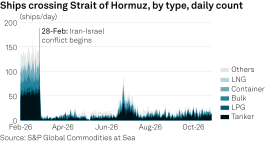
The Strait of Hormuz had six VLCC transits on Oct. 25, the most since Oct. 17, while the Bab al-Mandab Strait recorded one VLCC on both Oct. 24 and Oct. 25, S&P Global Commodities at Sea said in an Oct. 26 report.
Hormuz traffic in total was steady at 17 ships on Oct. 24 and Oct. 25, while Bab al-Mandab transits jumped to 42 ships from 27 ships over the same period, according to the CAS report. The VLCC total for Hormuz on Oct. 25 was up from five on Oct. 24, CAS data showed.
The outbound VLCC from the Persian Gulf was Monaco Prosperity, while inbound VLCCs were Bangladesh Prosperity, Ennie, Thailand Prosperity, West Loyalty and Bulgaria Prosperity, CAS said. The VLCCs that transited Bab al-Mandab were Della, heading northbound, on Oct. 25 and Karina, also moving northbound, on Oct. 24, according to CAS.
US forces on Oct. 25 marked the export of at least 1.5 billion barrels of crude oil since the summer through Hormuz, with US Central Command commander Admiral Brad Cooper flying over the chokepoint in a US Army CH-47 Chinook, Central Command said on X. It noted that more than 3,000 commercial ships had successfully transited Hormuz with support from CENTCOM forces over the last six months.
"Today, primary transit routes in the Strait of Hormuz remain free and clear of Iranian sea mines thanks to incredible efforts by our people," Cooper said. "We remain intensely focused on keeping commercial traffic flowing as we work with our teammates in the US interagency, Gulf Cooperation Council, and shipping industry."
The comment came despite Iran launching its heaviest wave of attacks on merchant ships around Hormuz and in the wider region this month, with the International Maritime Organization recording 29 attacks during Oct. 1-22, exceeding all monthly tallies since March.
On Oct. 26, the UK Maritime Trade Operations Centre reported a tanker exiting Hormuz was disabled after being struck by an unknown projectile Oct. 23. No crew casualties or oil spills have been reported.
Of the 16 VLCC crossings identified over Oct. 23-25, 10 were assessed as inbound and six outbound, CAS said. Inbound VLCC movements included five of South Korea's Sinokor-operated ships, and the Saudi-linked Majra and Qasba. The VLCC Ennie moved into the Persian Gulf after last loading a cargo of Basrah Heavy crude in early October, and China-owned VLCC Indigo Ray also moved inbound, CAS said.
Outbound transits included Sinokor-operated Romania Prosperity, UAE-linked Das and Al Faya, and Saudi-linked Kahla and Emerald Shine, CAS said.
LPG tankers
Over Oct. 23-25, five LPG tankers were observed crossing the Strait of Hormuz, including one outbound and four inbound transits, CAS said.
The outbound ship was the Marshall Islands-flagged Very Large Gas Carrier Sheng Hai Long, which had been in the Persian Gulf since Aug. 21, CAS said. During its stay, the ship loaded LPG at Ras Laffan, Qatar, while operating without AIS visibility, then exited the strait in a dark transit before reappearing in the Arabian Sea on Oct. 24, CAS said.
On Oct. 24, two LPG tankers entered the Gulf. One was UAE-linked Sweihan, which previously transferred cargo at Vadinar, India, and was last seen heading for Ruwais, UAE, for its next loading, CAS said. On Oct. 25, UAE-linked LPG tanker Delma was last seen berthed at Ras Laffan for loading, CAS said.
Activity across the US naval blockade line came to 57 transits on Oct. 25, up from 51 on Oct. 24, according to CAS.