Natural Gas, Chemicals, Electric Power, Refined Products, Crude Oil
October 22, 2026
India's Reliance says open to partnering with US companies in oil, new energy
HIGHLIGHTS
Rubio visits Jamnagar refinery to view scale, operations
Reliance discusses mutual commercial interests with Rubio
Mukesh Ambani outlines Jamnagar complex's long-term vision
India's Reliance Industries Ltd. is open to collaborating with US companies across oil and gas and new energy, as the country's largest private refiner aims to provide affordable energy amid a changing landscape and growing demand, the company said in a statement Oct. 21.
The comments came after Reliance Chairman and Managing Director Mukesh Ambani and Executive Director Anant Ambani held discussions with US Secretary of State Marco Rubio during his visit to the Jamnagar complex, which houses Reliance's refinery and new energy gigafactories.
Rubio was given a tour of the refinery complex and offered a firsthand view of its scale, advanced technology and integrated operations, according to the statement.
"The visit included wide-ranging discussions on the global energy landscape and opportunities for commercial partnerships across conventional and new energy. The exchange covered reliable and affordable energy supplies, technological advances, resilient supply chains and the investment required to meet growing demand," Reliance said in the statement.
Jamnagar refinery's Nelson Complexity Index of 21.1 — the highest in the world — gives the asset the flexibility to process almost all crude oil grades and meet the increasingly differentiated and demanding product specifications of global markets, Debangsu Ray, cluster president and head of the Jamnagar Refinery and Petrochemical Supersite, told Platts, part of S&P Global Energy, on Sept. 8.
The refining complex, with crude processing capacity of 1.4 million barrels/day, has so far processed more than 240 different crude oil grades, Ray said.
"The interaction provided a constructive opportunity to exchange industry perspectives and explore areas of mutual commercial interest," Reliance said.
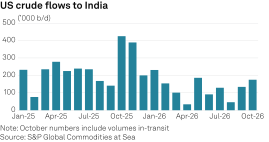
US crude oil flows to India averaged about 149,000 b/d in 2024, marked by a strong midyear surge followed by a second-half pullback. Flows were generally higher but more uneven in 2025, averaging about 238,000 b/d, according S&P Global Commodities at Sea data.
However, US crude oil flows to India weakened in 2026, averaging 128,000 b/d over January-October — roughly 43% below the 2025 average for the same period, CAS data showed.
Footprint in Venezuela
Ahead of his visit to Jamnagar, Rubio said discussions with Reliance would focus on understanding the company's current position and assessing potential opportunities for crude oil production in Venezuela.
Mansi Anand, principal analyst for research on national oil companies at S&P Global Energy CERA, said Venezuela's challenge has never been its resource potential, as the country possesses one of the world's largest heavy-oil resource bases. The difficulty has been converting those reserves into reliable production, cash flow and shareholder returns.
"Reliance, however, could approach Venezuela from a very different position. Jamnagar is one of the world's premier heavy-crude refining systems and Reliance is already a significant Venezuelan crude buyer," Anand said.
"However, moving from crude purchases to new upstream investment is a much bigger step. Any material upstream commitment would likely require durable sanctions clarity, secure export channels, contractual stability and an investment structure that limits country-risk exposure," she added.
Long-term vision
Mukesh Ambani and Anant Ambani outlined Reliance's long-term vision for the Jamnagar complex, including its development into a centre for deep tech, innovation and advanced manufacturing, according to the statement.
"Discussions also explored the increasing intersection of energy and digital infrastructure, including the role of dependable power in supporting data centres and the expansion of the digital economy," the statement said.
Ray said the future of the Jamnagar complex would involve transforming it from a traditional fuel refinery into an integrated energy and materials complex, as Reliance seeks to balance capital allocation between maintaining its core refining strength and scaling up its new energy gigafactories.
Primary capital allocation will follow two megatrends: deep petrochemicals expansion and world-scale green energy manufacturing, Ray said. By placing solar, bioenergy and advanced energy storage ecosystems in close proximity to its refining footprint, Reliance aims to create a symbiotic loop where clean energy powers low-carbon refining, which in turn yields the high-tech materials needed for the transition.
