Refined Products, Maritime & Shipping, Crude Oil, Jet Fuel, Gasoline, Fuel Oil, Diesel-Gasoil
October 21, 2026
Japan to introduce kerosene import subsidies from Oct. 21 until March 20, 2027
By Akihiro Gotoda and Gawoon Vahn
Editor:
HIGHLIGHTS
Japan subsidizes kerosene import-wholesale gap
Hokkaido retail kerosene hits record ¥155.70/l
Kerosene imports drop 42.9% YOY
Japan will provide financial subsidies for the difference between kerosene import prices, including surcharge/freight, and domestic wholesale prices, to refiners and oil product importers from Oct. 21, 2026, to March 20, 2027, according to a document distributed by the Ministry of Economy, Trade and Industry during an Oct. 20 briefing seen by Platts, part of S&P Global Energy.
A METI official confirmed the document Oct. 21.
Refiners and oil product importers are required to keep supplying kerosene by the same amount in the same month of the previous year to receive the subsidies, the document showed. They are also required to apply to METI for subsidies and provide import and domestic wholesale prices. The definition of imports, such as the time of unloading or customs clearance, will be determined later, the official told Platts.
METI will calculate a monthly average of import and domestic wholesale prices for the subsidies, the official added.
Ryosei Akazawa, the minister of Economy, Trade and Industry, said Oct. 16 that the government will set up three new policies to ensure a stable kerosene supply amid higher domestic prices. First, the government will request refiners, importers and wholesalers to supply kerosene cargoes by the same amount as the same month of the previous year to consumers or business partners.
The second policy intends to help refiners sell kerosene cargoes directly to consumers, and the third is a subsidy for the difference between import and domestic wholesale prices.
"METI will likely work out details later on a case-by-case basis, while discussing with refiners or oil product importers," a trader familiar with the matter said.
Record prices
The average weekly retail kerosene price in Hokkaido, Japan's northernmost region, rose 24.5% year over year to ¥155.70/liter (98 cents/l) Oct. 19, hitting a record for the second consecutive week, while the national average was ¥142.90/l, according to METI data published Oct. 21.
"The announcement of the policy package has taken effect in Hokkaido as a rise in the kerosene price was reduced to ¥0.20/l week over week in comparison to ¥3/l for the previous week, though we will keep a close eye on the situation," Takehiko Nagai, director of Industrial Safety Policy Division in METI, said at a press briefing in Tokyo Oct. 21.
The average assessment price of kerosene rose 46.3% year over year to ¥119,500/kiloliter Oct. 19 across the Chiba, Kanagawa, Chukyo and Hanshin regions, according to Platts calculations.
The Japanese Consumers' Cooperative Union in Hokkaido issued a statement Oct. 13 asking the national and Hokkaido governments for an emergency policy to tackle the disruption in kerosene distribution and higher spot market prices, according to the union website.
The statement said record-high wholesale prices raised the regional retail price above ¥190/l, higher than retail gasoline at about ¥170/l, due to a lack of imports, refiners' control of kerosene supply and a restriction of kerosene supply from other prefectures.
Japan's largest refiner ENEOS Corp. responded to Platts request for comment on the union's statement, saying "ENEOS prioritizes a stable supply of kerosene as a lifeline in domestic markets, though ENEOS couldn't meet excess demand while doing our best to accumulate kerosene inventories for stable supply in the winter amid the current situation in the Middle East."
Idemitsu Kosan Co. Ltd, the second-largest refiner, was immediately unable to be reached for comment, while a spokesperson for Cosmo Oil Co. Ltd., the third-largest refiner, declined to comment on the union's statement.
Kerosene consumption in Hokkaido was 2.19 million kiloliters in fiscal year 2025-26 (April to March), the largest among all 47 prefectures in the country, according to the Petroleum Association of Japan.
Japan's accumulated imports of kerosene declined 42.9% year over year to 177,312 kiloliters from April to August, the latest month available, and inventories in the country and Hokkaido fell 16.7% and 17.4% year over year to 2.12 million kiloliters and 699,300 kiloliters, respectively, at the end of August, according to METI.
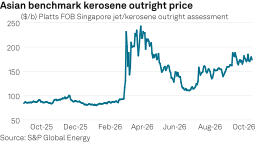
The Platts FOB Singapore jet fuel/kerosene front-month crack spread against front-month cash Dubai averaged $61.39/barrel from April to September, indicating an increase in kerosene import costs in comparison to an average of $15.16/b in the same period of the previous year.
Platts assessed the FOB Singapore jet fuel/kerosene cargo at an average of $174.90/b to date in October, compared with September's average of $169.50/b and the 2025 average of $86.42/b.
