Crude Oil, NGLs
October 21, 2026
Canadian pipelines see higher apportionment, heavy oil price discounts widen
By Ashok Dutta and Riley Tran
Editor:
HIGHLIGHTS
Mainline apportionment set at 16% for November
TMX sets record 7% apportionment
Growing Asian demand for Canadian crude
Operators, Enbridge and Trans Mountain Corp., have unveiled higher apportionment for their crude oil pipelines from the Western Canadian Sedimentary Basin to the US Gulf Coast and the Pacific Coast, primarily driven by rising demand, even as price differentials for heavy barrels continue to widen, they said separately.
For the Mainline system, the first point of apportionment for heavy crude is 16% at Superior (covering Lines 6 and 61) and 7% at Kerrobert (for Lines 4, 67 and 93) as the second point of apportionment, Enbridge spokesperson Gina Sutherland told Platts in an email Oct. 21.
For light crude, the first point of apportionment is 19% at Kerrobert (for Lines 2 and 93) and 13% at Cromer for Lines 2, 93 and 65 as the second point of apportionment, Sutherland said.
In October, lights and heavies have been apportioned at 8% and 4%, respectively, both at Kerrobert, she said, indicating a single point of entry to the pipeline for the month.
Enbridge had fully removed apportionment on the Mainline for September, marking it the first time in 2026 that the Calgary-based operator had made such a move, Sutherland said then, adding a reason for that was the seasonal industry maintenance by Alberta's heavy oil and oil sands producers.
The over 3 million barrels/day, 8,600-mile Mainline is the single-largest oil pipeline connecting the WCSB to markets in the US and ships both heavy and light crude directly and indirectly from Alberta to refineries and storage hubs in the US Midwest, Eastern Canada, and the USGC through multiple pipelines that are part of the overall system.
Heavy oil apportionment on the pipeline system has been high since January, when it was 13% for both light and heavy barrels, rising to 18% for light and 19% for heavy crude in June, Enbridge data showed.
Despite the high levels of apportionment, producers have been nominating incremental barrels for shipment on the Mainline, with throughput volumes averaging 3.1 million b/d in the second quarter of 2026, Sutherland said.
TMX seen moving more barrels to Asia
Meanwhile, apportionment for the 890,000-b/d Trans Mountain Pipeline system for October stands at 7%, TMC said on its website.
The apportionment is the third time this year, with levels at 0.2% in June and an unspecified percentage in July, TMC said at the time.
The pipeline system that runs from Edmonton, Alberta, to the Westridge Marine Terminal at Burnaby in coastal British Columbia comprises the legacy 300,000 b/d Trans Mountain pipeline and the 590,000 b/d Trans Mountain Expansion, which was started up in May 2024, has since loaded 691 vessels at the terminal, with more than 65% (or 455 vessels) headed to Asia, TMC said on its website, noting the pipeline was 90% full in September.
"China has been at the forefront of sourcing WCS, AWB and Canadian dilbit being delivered by TMX," Greg Stringham, a former vice president for markets with the Canadian Association of Petroleum Producers, said separately. "But of late the [South] Koreans have significantly stepped up, followed by the Japanese. This will result in higher apportionment levels in the coming months as WCSB producers are set to increase output, particularly in the winter season."
Western Canadian Select and Access Western Blend are two primary grades of heavy barrels in the WCSB.
Canadian crude oil production (including pentanes and condensate) is anticipated to reach 5.5 million b/d in 2026, 5.8 million b/d in 2027 and 6 million b/d in 2028, which is a growth of nearly 450,000 b/d in three years, S&P Global Energy CERA said in its latest monthly report.
WCS prices remain weak
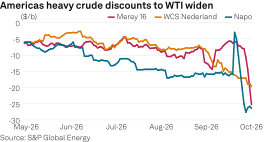
WCS at Hardisty, Alberta, and at Nederland, Texas, has declined significantly since Sept. 24, with WCS Hardisty falling by $7.50/b and WCS Nederland by $8.00/b.
Platts, part of S&P Global Energy, assessed WCS Hardisty and WCS Nederland at discounts of $28.00/b and $19.50/b Oct. 21, respectively, to the WTI CMA, both strengthening by 15 cents/b from the day before. Despite narrowing differentials on the day, WCS Hardisty and WCS Nederland are hovering at their lowest levels since Nov. 2023 and Dec. 2022, respectively.
Market sources told Platts that oversupply and increased competition from other heavy crudes into the US Gulf Coast, such as Venezuela's Merey 16, have put pressure on WCS's differentials.
"I think people are starting to realize how bad WCS could be going forward," one Canadian crude oil trader said, "[There's] lots of competition in the Gulf, and I think up in Alberta, lots of supply around too."
On the West Coast, Pacific Cold Lake and Pacific Dilbit, two crudes transported on the TMX pipeline, hit a fresh all-time low every day the grades were assessed from Sept. 16 to Oct. 15. Pacific Cold Lake and Pacific Dilbit recorded their weakest differentials, at discounts of $24.40/b and $25.40/b, respectively.
Platts assessed Pacific Cold Lake and Pacific Dilbit at discounts of $23.15/b and $24.55/b, respectively, to the ICE Brent CMA, on Oct. 21, unchanged from the previous day.