Refined Products, Crude Oil, Jet Fuel, Diesel-Gasoil
October 19, 2026
Diesel market remains under pressure as jet fuel crack widens in Europe
Editor:
HIGHLIGHTS
Jet fuel crack surpasses diesel in Europe
Stock release unlikely to significantly ease tightness
IEA plans 20 million barrel release soon
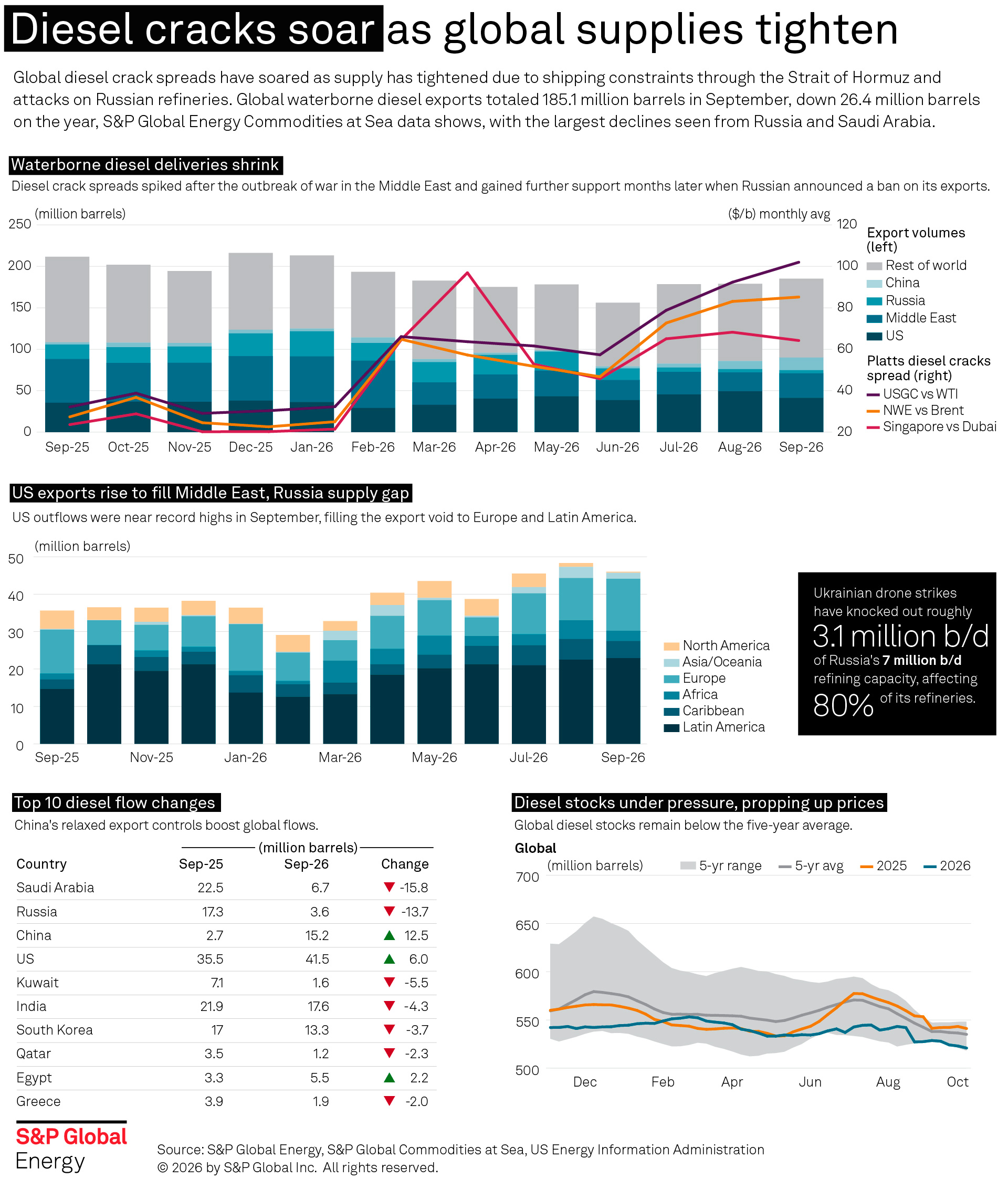
Europe's diesel market remains extremely tight despite jet fuel cracks outstripping gains in the motor fuel market for the first time in months, signaling a new and potentially more complex phase for European fuel markets.
After hovering around $60/barrel on average between Oct. 1 and Oct. 12, the European benchmark physical FOB ARA 10ppm diesel barge crack rose above $74/barrel on Oct. 16, for the first time since Sept. 30.
And while the European physical diesel crack stayed above the jet fuel crack since mid-June until mid-September, it now trades well below its counterpart.
The spread between the European jet fuel FOB FARAG barge-to-Brent crude crack and the ULSD FOB barge-to-Brent crude crack was as wide as $11.75/b on Oct.16.
"Everyone in Europe is so focused on diesel, even anticipating a potential diesel crisis, and as a result refineries have not produced enough jet fuel," said James Simpson, head of aviation research at S&P Global Energy CERA. He added that in North America, it is a "very different story," with diesel prices trading around 5%-8% above jet fuel in recent weeks.
While the European benchmark diesel crack has rebounded in recent days since the beginning of October, it is still well below the peak of $98.01/b reached on Sept. 1.
But a higher jet fuel crack does not automatically mean that all refineries will maximize this fuel, with most of them potentially staying cautious, according to market participants.
"Gasoil cracks have pulled backed but are still very elevated, people continue to max out runs on diesel," a market source told Platts, part of S&P Global Energy.
The International Energy Agency said Oct.15 that it has specific plans in place to release more than 20 million barrels of diesel "as soon as possible." No details on the dates for release were provided. Only 8 million barrels of emergency oil stocks were released in September, marking a significant decline in inventories releases in recent months, according to IEA.
"Weaker [diesel] margins come from reinforcement on the crude side. With strong structure on the inputs, [we] automatically see weaker cracks. But nothing has changed on the products side," a European diesel producer told Platts.
New stock release announcements are not something which can support fuel market significantly, according to another market source. "Europe is releasing from an already announced quota and presenting that as news," the source said.
"Even if headlines are dictating price now, the structural and logistical problems should maintain tightness," according to the source, who asked for anonymity because of no authorization to speak publicly.
No lasting price relief in sight
The diesel market situation is influenced by several factors, including efforts to influence prices from the US, according to William O'Neil, principal analyst at S&P Global Energy CERA.
"On the federal level, this includes the dyed diesel waiver, supporting the G7 diesel inventory release, and the Russia diesel deal. Additionally, many US states have cut diesel taxes and loosened dyed diesel restrictions, echoing the federal waiver," O'Neil said.
S&P Global Energy assessed that half of US states have partially or fully waived dyed diesel rules, as of Oct. 16. The more important factor for the global diesel market is the perception that a US diesel export ban is becoming increasingly unlikely, according to O'Neil.
"But the levers of softening (with the exception of tax cuts in the US) probably aren't significant enough to deliver lasting price relief. We don't think the Russia deal, for example, is likely to substantially and durably lower global diesel prices unless Ukraine is on board," he said.
It is still unclear how much extra diesel supply Russia can add to the market in the coming months. Russian Deputy Prime Minister Alexander Novak said Oct. 9 that Russia is ready to export 300,000 metric tons of diesel in October, 500,000 mt in November and 1 million mt in December. He then said that Russian diesel deliveries can reach as much as 3.5 million mt/month by the end of 2026, without clarifying the discrepancy between these figures.
Donald Trump has been pressuring Ukraine's President Volodymyr Zelenskyy to stop the country's attacks on Russian refineries. Zelenskyy said Oct. 15 that Ukrainian military officials were told by US counterparts that if they did not stop the energy strikes, the US would block intelligence sharing with Ukraine. But Ukraine is only ready to stop its attacks on Russian refineries if Russia stops attacking its energy facilities and killing Ukrainians, Zelenskyy said.
"We assess that Ukraine and Russia remain unlikely to adhere to a US-proposed ceasefire agreement that includes halting strikes on Russia's oil refineries," said Sascha Ostanina, Europe/CIS Country Risk principal analyst at S&P Global Market Intelligence.
"Previous US attempts to leverage limited aid to Ukraine—including the suspension of intelligence sharing—as a means to compel Ukraine to halt strikes on Russia have not proven largely effective, and US intelligence had not been used in Russian refinery strikes either," Ostanina said, adding that Ukrainian authorities may anticipate a decrease in pressure from the US administration following the US midterm elections.
The 2026 US midterm elections is scheduled to take place on Nov. 3.
Around 45% of Russian primary refining capacity was offline as of the end of September, according to CERA.