Crude Oil
October 01, 2026
Canada’s 1 million b/d Pacific Coast oil pipeline crosses major hurdle
By Ashok Dutta and James Jones
Editor:
HIGHLIGHTS
Pipeline to be called now Pacific Link
Construction to start in Q3 of 2027
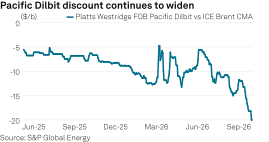
Pacific Dilbit discount continues to widen
A 1 million-barrel/day crude oil pipeline to the Canadian Pacific Coast, from the prime oil sands producing region of Alberta, has received a major boost, with the federal government listing the proposed infrastructure as a "project of national importance" and kickstarting an environmental and regulatory process, along with engineering works and stakeholder consultations, top government officials said Oct. 1.
A project of national importance would signify that the federal government-backed Major Projects Office now has sole authority to handle regulatory permits and grant approvals within a specified timeline.
"We didn't get here overnight, and the announcement today comes after an MoU we signed last November," Alberta Premier Danielle Smith told reporters on a webcast from Fort McMurray, the heart of the oil sands producing areas of Athabasca, Cold Lake and Peace River. "In July, we submitted a project application for the West Coast pipeline for being listed as a project of national interest, and our aim now is to start construction on Sept. 1, 2027."
The pipeline is now formally to be called Pacific Link (compared with West Coast earlier) and will sustain over 3.5 million b/d of crude oil production from the oil sands region, Canadian Prime Minister Mark Carney said on the same webcast, adding the new pipeline will primarily target Asia and also provide an opportunity for Western Canadian Sedimentary Basin to wean away from its traditional market of the US and find new customers.
"This will be a tremendous opportunity for oil sands producers to narrow the price differentials and reach out to a new market," Carney said. "There's a structural challenge of energy security and the existential challenge of climate change. And these challenges are forcing countries to think differently of where their energy comes from and on who they can rely to supply."
Clear path forward
A year ago, the planned pipeline was a vision, but today "we have a clear path forward," Smith said, adding the construction of Pacific Link will result in the province's oil sands producers utilizing the latest technology to add incremental barrels through what would likely be brownfield expansions.
The West Coast pipeline will originate in Bruderheim, Alberta, and terminate at the Roberts Bank terminal in the southwest coast of British Columbia, the Alberta government said separately in a release, adding the proposed infrastructure will be "largely" following the existing 890,000-b/d Trans Mountain pipeline corridor to a deep-water, VLCC-capable port terminal at Roberts Bank.
Leveraging this existing corridor will significantly reduce regulatory and logistical barriers, while minimizing land disturbances, it said.
The West Coast pipeline will be a private-public partnership, with participants including the Alberta Petroleum Marketing Commission (representing the provincial government), Trans Mountain Corp. (representing the federal government) and Calgary-based midstream player Pembina Pipeline Corp., Smith said.
"The PONI listing provides greater certainty through a clearer, more efficient and predictable federal review process that will maintain environmental standards and Indigenous consultation, which will be led by the Major Projects Office and supported by the Canada Energy Regulator," Pembina Pipeline Corp. said in a statement on Oct. 1.
As domestic and global demand for secure and responsibly produced energy continues to grow, Canada has a tremendous opportunity to strengthen its role as a trusted supplier to allies and trading partners around the world, while helping Canadians capture greater value from our abundant natural resources, Lisa Baiton, president and CEO of the Canadian Association of Petroleum Producers, said in a statement.
West Coast crude faces headwinds
September saw steeper discounts for US West Coast crude grades, as geopolitical supply risk remained high.
Pacific refiners compare Alaska North Slope and Canadian barrel prices with other grades — particularly Venezuelan barrels in the current climate — so the market is susceptible to changes in regional demand, tanker freight rates, sanctions, and competing crude prices.
Platts assessed Pacific Cold Lake at an $11.71/b discount to the NYMEX crude CMA on Oct. 1, up 20 cents day on day. Pacific Dilbit was also assessed $1/b lower at minus $12.71/b, up 20 cents from the previous session. Platts is part of S&P Global Energy.
Platts last heard ANS at a plus-$10.75/b premium to the NYMEX crude CMA on Sept. 21 and has assessed it unchanged at that level since then.
The Westridge/Cold Lake Edmonton spread has hovered around plus $10/b since mid-September, as well.
Recent wider Pacific Cold Lake and Pacific Dilbit discounts could also be impacted by weak regional refinery demand due to fall maintenance schedules. Unplanned outages or reduced runs can leave more prompt crude competing for fewer refinery slots.