Electric Power, Crude Oil, Natural Gas
September 30, 2026
Oil firms push to fast-track Venezuela operations after signing deals: executives

Editor:
HIGHLIGHTS
At least 58 oil contracts signed, half undisclosed
UCC wants to move quickly to expand its portfolio
GeoPark commits $7 billion through 2045
Private companies have signed more than 50 contracts to develop Venezuela's oil sector, and their goal now is to quickly start operations in the fields they have secured, company officials said at the Venezuela International Oil Gas Summit.
"At least 58 CPPHs have been signed so far; the key issue now is implementation, not just signing contracts," Daniel Fernandez, CEO of UCC Oil and Gas in Venezuela, said at the summit, which is taking place in Caracas from Sept. 28-30.
Less than half of these Hydrocarbon Participation Contracts, or CPPHs, and MOUs have been disclosed by the Venezuelan government since the reform of the Hydrocarbons Law was enacted in late January and the regulations for that law were issued in August.
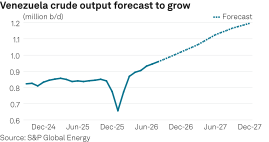
PDVSA and its foreign partners produced an average of 1.213 million barrels per day in August, up 3,000 b/d from July, according to preliminary data from the Ministry of Hydrocarbons reviewed by Platts, part of S&P Global Energy.
In August, Venezuela granted a consortium of Britain's BP, the United Arab Emirates-based firm XRG (a subsidiary of the state-owned ADNOC), and Qatar's UCC Oil and Gas, a license to develop Phase 2 of the Loran offshore gas field on the Deltana Platform.
"The important thing is to identify, quantify, and manage risk," Fernández said. "I believe that in the reform of the law and contracts, the economic feasibility clause helps manage those risks."
UCC wants to take the fast track in its business dealings with Venezuela and even participate in other projects, Erik Keskula, upstream CEO at UCC Oil, said during one of the event's plenary sessions.
"UCC has a saying: 'Success loves speed; do it now.' We tend not to want to wait. We want to move very, very quickly," Keskula said.
Operational plans
But others, like Spanish company Repsol, prefer to take the time to ensure operational conditions are ripe for development.
The company is working on how to handle associated gas and fluids, which could delay production if not managed properly, said Ludwing Mercado Hurtado, operations manager for Venezuela at Repsol.
"If we produce just for the sake of producing without the capacity to collect, treat, and dispose of these fluids, we will miss out on marketing opportunities," Mercado said.
Repsol is a minority partner of the state-owned PDVSA in the joint venture Petroquiriquire, whose production averaged 37,000 b/d in September, according to the preliminary report from the Ministry of Hydrocarbons.
For Repsol, 85% of its operations in Venezuela involve gas production. "This experience allows us to unify our approach to both crude oil and gas within a single roadmap, preventing growth constraints in one area from limiting the other," Mercado said.
In the short term, Repsol has set a goal of achieving at least 50% more production than current levels in the West, with the hope of tripling that figure in the near future, Mercado said.
The political instability that began on Jan. 3, when former president Nicolás Maduro was captured in Caracas in a US operation, as well as high inflation, electricity shortages and other problems, do not seem to be dampening demand for Venezuela's crude oil and natural gas.
"Sometimes people worry a lot about the business environment," Fernandez said. "The business environment is what it is, and if things get worse, there will be solutions within a legal framework."
Service company opportunity
SLB representative William Antonio said he sees a great opportunity in Venezuela for service companies.
"In Venezuela, we have a total of 30,700 wells, of which only 30% are active. Any operator that wants to invest, and, obviously, recoup its investment as quickly as possible, starts with what will deliver quick barrels, barrels right now," Antonio said.
The challenge is that there are not enough service teams in Venezuela to meet existing demand. But there has been an increase in the number of companies interested in investing, and the priority is to focus on existing wells to quickly increase production, Antonio said.
In June 2026, SLB and PDVSA signed an MOU focused on the digital transformation of the hydrocarbons sector. The agreement includes the use of artificial intelligence, predictive models, and data management to optimize mature fields and heavy crude operations.
Electricity shortages also an issue for the sector, but Hunter Hunt, co-CEO of Hunt Consolidated and president of Hunt Energy Holdings, said he doesn't know the answer to that problem. Peak electricity demand in Venezuela is around 16 GW, compared to up to 92 GW in Texas, he said.
"When we look at the country's potential and what can be achieved from an industrial perspective, in addition to continuing to expand commercial and residential consumption, it's clear that there is enormous room for growth," Hunt said.
In August, Hunt Oil Company signed a CCPH in Houston for the Carisito and Caro fields in Monagas state, in eastern Venezuela.
Colombian firm GeoPark Limited on Sept. 4 signed a CPPH with PDVSA to extract and market crude oil from the Bare block, located in the Orinoco Oil Belt, one of the world's largest oil fields.
According to Felipe Bayón, CEO of Geopark, the company plans to invest $7 billion in a four-phase plan from 2026 to 2045, covering both capital expenditures and operating expenditures.
According to Carlos Bellorin, EVP of Energy Trends & Advisory at Welligence Energy Analytics, the oil business in Venezuela is moving quickly.
"In Brazil, it took 35.5 months from the passage of the Pre-Salt Law to the signing of the first contract (Libra), and then it took three years for just one additional contract. In Mexico, following the 2014 energy reform, it took 11 months to sign the first contract. In Venezuela, it took 7 months from the enactment of the reform to the signing of the first CPPH," Bellorin said, comparing Venezuela to other countries in the region.
The Venezuela International Oil and Gas Summit, which brought together 680 participants, is the first high-level international event in Venezuela's energy sector in many years.
