Refined Products, Crude Oil, Gasoline, Diesel-Gasoil
September 22, 2026
Iran war, energy trade, sanctions could be key topics at Trump-Xi summit: analysts
Editor:
HIGHLIGHTS
Trump could ask Xi's help in ending Iran conflict
Beijing may reduce tariffs on US crude imports
US President Donald Trump may raise key energy issues with Chinese President Xi Jinping at their summit on Sept. 24, including asking Beijing to help end the conflict in Iran, help open Middle East shipping routes and boost US oil purchases, energy analysts say.
However, other possible US requests that could rein in energy prices—such as asking China to increase its exports of refined products or to continue dampening its oil purchases, as it has since the war started— are not expected to sway Xi, they say.
"I doubt China would adjust its oil imports and exports simply because Trump asks Xi to do so," Erica Downs, a senior research scholar at Columbia University, told Platts, part of S&P Global Energy.
"The actions taken by Beijing that have resulted in the decline of China's oil imports were taken to ensure China's oil supply security, and this is not something Xi will negotiate away." Downs said.
Rory Johnston, oil market researcher and founder of Commodity Context, says one reason that China reduced its oil imports after the closure of the Strait of Hormuz was to limit the economic impact of high crude prices on other countries in Asia that buy Chinese goods.
Beijing may increase refined product exports this winter for the same reason, Johnston said. While Xi, not Trump, is driving this strategy, Xi may still take credit for it with Trump, he said. And Trump will likely do the same. "I almost guarantee that whatever happens, Trump is going to play it as a win before the election."
High gasoline prices and diesel prices are a top concern for the Trump administration ahead of the November midterm US election, when voters could express their unhappiness with high costs at the ballot box.
Trump could also ask China for help in reopening the Strait of Hormuz and the Bab al-Mandab Strait, given that China is the biggest buyer of Iranian oil and imported about half of its oil from the Middle East before the start of the conflict, Downs said.
Trump could also ask China to buy more oil from the US to reduce its dependence on Hormuz, as he did during his meeting with Xi in May, Downs said.
China is expected to reduce tariffs on US crude imports during Xi's visit, according to refining sources, traders and analysts at Chinese oil companies. Beijing imposes a 20% tariff on US crude imports, and China has not imported any US crude since June 2025.
Removing the tariff could pave the way for China to resume US crude imports into China, creating a quick win for both countries, a Beijing-based senior official at a state-run refiner said.
Iran war
Even though China is buying less Iranian oil than before the US first blockaded the Strait of Hormuz in April, Trump could also ask China to further reduce imports from Tehran or risk additional US sanctions, Downs said.
"That said, the Trump administration, like previous administrations, has shied away from targeting large Chinese entities with global footprints because of the risks to the US-China relationship and/or the global economy," Downs said.
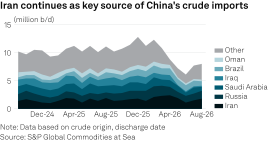
China imported 1.8 million b/d of Iranian-origin crude in August, according to S&P Global Commodities at Sea data. In the same month, China imported 1.4 million b/d from Russia, 800,000 b/d from Brazil, and 700,000 b/d from Saudi Arabia, CAS data shows.
China's crude imports from all origins totaled around 8 million b/d in August, down from 11.1 million b/d a year ago, CAS data shows.
Since the announcement of the new US sanctions campaign against Iran, the Trump administration has been quiet concerning China's commercial relationship with Iran, Scott Kennedy, a senior adviser at the Center for Strategic and International Studies, said during a Sept. 17 virtual CSIS briefing.
"I think that's an indication that maintaining a stable relationship with China is trumping, pardon the pun, US policies on Iran in this regard, and I don't see an increase in willingness to assume more risk vis-à-vis China on this," Kennedy said.
The US Treasury Department launched a new sanctions campaign on Aug. 24, aiming to isolate Iran from the global trade and financial system, and has issued a regular cadence of sanctions since then.
There is always the possibility of going after smaller Chinese entities with sanctions, Edgard Kagan, a senior adviser at CSIS, said during the briefing.
Rachel Ziemba, a senior advisor at Horizon Engage, says energy will likely not be the primary focus of talks but will be an indirect topic as the two leaders worry about the conflicts in the Middle East and Eurasia.
"The most significant risks continue to come from the conflicts, so clear guidance that the US and China were working together would be an upside, but that seems unlikely," Ziemba said.
Dan Kritenbrink, a former US ambassador and partner at The Asia Group, also said Iran is expected to feature prominently in talks, given the conflict's growing impact on the global economy and energy markets. He said Washington would likely seek Beijing's help in encouraging a resolution to the conflict.
"I would expect that President Trump and the US side would be looking for China to play some kind of responsible role ... and perhaps asking Beijing to use its connections with Tehran to encourage some kind of resolution to the conflict," he said.
China appears to be increasing its oil purchases on the global market, which will have an impact on prices, Kagan said.
"I think the president will be very focused on figuring out how China's concerns about its supplies can lead to China being willing to use some of its leverage with Iran to push for a settlement," Kagan said.
China is increasingly worried about the ramifications of the continued closure of Hormuz, both on its own economy and on the global economy, on which it depends as a destination for exports, Kagan said.
"So, I think what you will see is an avoidance of direct major confrontation on high-profile issues, but there will be a lot of maneuvering in the trenches," Kagan said.
