Crude Oil, NGLs, Refined Products
September 21, 2026
WCS crude discounts widen on major refinery works, reduced pipeline capacity
By Ashok Dutta and Riley Tran
Editor:
HIGHLIGHTS
Canadian oil discount hits $21.35/barrel
Refinery maintenance cuts demand 750,000 b/d
Trans Mountain pipeline reaches full capacity
Western Canadian Select crude differentials to West Texas Intermediate remained at over two-year lows on Sept. 21, marking their seventh consecutive day of declines, amid major planned refinery work, maxed-out pipeline capacity, and rising production, according to comments from industry officials and Platts assessments from S&P Global Energy.
Platts assessed WCS at Hardisty, Alberta, down 35 cents/barrel day over day to a $21.35/b discount to the WTI CMA, remaining at its widest differential since Dec. 4, 2023.
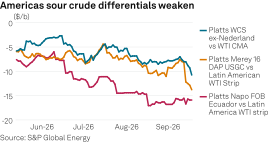
Also, WCS differentials at Cushing, Oklahoma, and at Nederland, Texas, weakened even further, falling by an additional $1.25/b each from their previous assessments. Platts assessed WCS Cushing and WCS Nederland at discounts of $13/b and $12/b, respectively, moving to their weakest differentials since Feb. 8, 2023.
"The fall [refinery] maintenance season is now upon us, and this year multiple work is planned in both the West and East," Greg Stringham, a former vice president of markets with the Canadian Association of Petroleum Producers, said from Calgary Sept. 21, adding that maintenance work at the 267,000 barrel/day Joliet refinery in Illinois was also impacting WCS pricing.
Canadian refinery outages are expected to rise to about 750,000 b/d in the week ending Sept. 25, as recently started maintenance reaches full-week impact, Platts reported on Sept. 19.
The current outage comes on the back of 700,000 b/d of capacity that was expected to be impacted the week ended Sept. 19 as turnarounds continued at Imperial Oil's Sarnia, Irving Oil's Saint John, and Suncor's Edmonton and Montreal refineries, while a brief maintenance period at Shell's Scotford upgrader in Alberta adds to this week's offline volumes.
Refineries in the US Midwest and US Gulf Coast are running at 100% and 96.7% of capacity, Platts reported.
"On previous occasions, the Trans Mountain Pipeline acted as a buffer that kept WCS/WTI differentials in a narrow range of $12/b to $14/b," Stringham said. "But that has changed with that system now running at full capacity."
The 890,000 b/d Trans Mountain System comprises the legacy 300,000 b/d Trans Mountain line and the 590,000 b/d Trans Mountain Expansion that transports heavy and light barrels from Edmonton, Alberta, to the Westridge Marine Terminal in coastal British Columbia.
No comments were immediately available from the operator, Trans Mountain Corp. However, it said in late August that the system delivered a record throughput of 840,000 b/d, or 94%, in the second quarter of 2026.
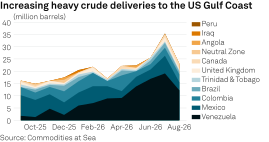
The US Gulf Coast is another destination for WCS barrels, but increasing volumes of heavy crude are being delivered to the refineries there from other producers. Venezuela exported 12.2 million barrels of heavy crude to the USGC in August, up from 1.5 million barrels in August 2025, S&P Global Commodities at Sea data showed.
As a result, discounts for other heavy crudes have also widened, with Platts assessing Venezuela's Merey 16 at a $14.40/b discount to WTI on Sept. 21, down from a $9.19/b discount on Sept. 1.
Producers to add 255,000 b/d
For their part, producers in the Western Canadian Sedimentary Basin are also forecast to add some 255,000 b/d of new output in the current year, compared with 2025, S&P Global Energy CERA analysts said in their September analysis.
Output in 2026 is forecast to reach 5.553 million b/d, compared with 5.298 million b/d in 2025, CERA analysts said, noting Western Canadian export supply is anticipated to continue growing as new production comes online, particularly in the oil sands.
Excess pipeline capacity will be reduced through the winter periods when oil sands production is at its highest, the analysis said.
Incremental oil sands production in the winter will also increase demand for diluents such as condensates and natural gasoline as the crude and raw bitumen gets more viscous, CERA analyst Jordan Woloschuk said.
In addition to in-basin supplies, producers also depend on imports from the US to meet their demand for diluents, Woloschuk said, noting that at present, some 290,000 b/d is sourced through the Cochin and Southern Lights pipelines.
Meanwhile, crude exports from the Vancouver Fraser Port in British Columbia rose 3% to a new mid-year record of 12 million metric tons/year, or 240,916 b/d, as Alberta producers continued to grow exports to the Indo-Pacific region, the port authority said Sept. 21.
Almost 80% of crude moving through the port was destined for Indo-Pacific markets led by China and South Korea, with Indonesia receiving its first shipment of crude from the TMX line in April, the Vancouver Fraser Port Authority said.
