Refined Products, Crude Oil, LPG, Naphtha
September 15, 2026
Asia faces dual hit of $100/b oil, supply crunch that threaten demand, energy security
HIGHLIGHTS
Oil above $100/b starts to dent Asian demand
Cost pressures hit freight, manufacturing, households
Inflation fears grow as costs rise
Crude oil prices above $100/barrel are creating a dual challenge for Asia by combining higher costs with tighter physical supplies, threatening to curb fuel demand while exacerbating inflationary pressures and economic growth risks in a region heavily reliant on imported energy, industry sources and analysts said Sept. 14.
Recent market developments have prompted Asian countries to pursue varied energy-resilience strategies -- ranging from tapping strategic reserves to capping domestic fuel prices. Analysts said early signs of demand curtailment were already visible and could intensify unless conflicts in the Middle East and Ukraine subside and prices decrease. This could hinder Asian countries' efforts to secure additional cargoes and build energy-security buffers.
"Asia is facing a dual shock of higher prices and lower physical availability of supply," said Premasish Das, executive director for oil analytics at S&P Global Energy CERA. "In the past, demand adjusted mainly because consumers and businesses responded to rising costs. This time, the region is dealing not only with a price shock, but also a supply shock."
Discussions at APPEC 2026, hosted by S&P Global Energy over Sept. 7-10, echoed similar themes. Speakers -- including oil traders, refiners, shipowners, and technology companies -- described an industry grappling with disrupted routes, tighter availability, heightened operating risks and costs, and volatile shifts in energy-demand patterns.
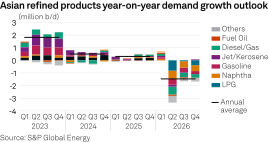
"What we are seeing today is primarily demand curtailment rather than outright demand destruction. Consumers are driving less, industries are reducing operating rates and refiners are cutting throughput because costs are higher and feedstocks are tighter," Das said. "If supplies recover and prices ease, some of that demand will return. The more important question is what happens if elevated prices persist."
Crude oil futures settled higher Sept. 14 as the global supply outlook tightened following the temporary shutdown of Saudi Arabia's 7 million b/d East-West pipeline. ICE November Brent climbed $1.07/b to $105.68/b, while NYMEX October WTI settled $1.34/b higher at $101.39/b.
Lower production
Middle Eastern crude oil production has fallen from about 24.8 million b/d in the fourth quarter of 2025 to roughly 18.2 million b/d in Q3 2026, tightening supplies of crude oil, LPG and naphtha, according to CERA.
As a result, refiners, petrochemical producers and consumers have been compelled to adjust simultaneously, with much of the global demand adjustment occurring in Asia.
Global oil demand is expected to decline by about 2.4 million b/d in 2026 from 2025 levels, with Asia accounting for roughly 1.5 million b/d of the contraction, according to CERA.
"While we expect some recovery in demand during 2027, the pace and extent of that recovery will depend heavily on the restoration of Middle Eastern production and the normalization of flows through the Strait of Hormuz," Das said.
About 75% of Asia's crude imports from the Middle East transited the Strait of Hormuz in 2025, CERA data showed. By the third quarter of 2026, that share had fallen sharply, fluctuating between 10% and 20%, according to ship-tracking data from S&P Global Commodities at Sea.
The impact of $100/b oil has extended far beyond direct fuel consumption. Elevated energy costs have driven up freight, manufacturing and household expenses, putting pressure on corporate margins and posing a risk of broader inflation, according to analysts, economists and industry sources.
"Asia is a large energy consumer and a net energy-importing region. As such, elevated energy prices are placing a strain on Asia's economies," said Vishrut Rana, Asia-Pacific senior economist at S&P Global Ratings.
Producer prices have risen sharply, leaving small and medium-sized enterprises particularly vulnerable due to their limited pricing power and smaller financial buffers. Energy-importing economies have experienced a deterioration in current account balances, while households confronted with higher energy bills have reduced other expenditures, Rana said.
Despite these challenges, Asia continues to demonstrate resilience.
In the first half of 2026, growth held up in several economies, supported by strong global trade and manufacturing, particularly in technology-related goods, while domestic demand remained broadly steady, Rana said.
"Overall, elevated energy prices are cutting some wind from the sails for Asia's growth outlook," Rana said.
High retail prices
Dharmakirti Joshi, chief economist at CRISIL, part of S&P Global, said depleted global oil inventories and geopolitical risks in the Middle East were likely to continue exerting upward pressure on retail fuel prices.
"Under strong demand conditions, rising fuel costs and other input pressures, higher costs are gradually being passed through to consumers in India, raising core inflation," Joshi said. This could complicate monetary policy by pushing inflation beyond energy and transport into a wider range of goods and services, according to Joshi.
The economic impact could be particularly severe for countries that import most of their oil, said Rajat Kapoor, managing director for oil and gas at Synergy Consulting.
"High oil prices are a direct hit to any oil-importing economy, and Asia is particularly exposed," Kapoor said, adding that the roughly $50/b increase in crude prices since the beginning of 2026 has had a significant impact on the economic health of individual Asian economies.
Kapoor identified three main channels of pressure: First, a higher oil import bill could widen current account deficits and weaken currencies, making subsequent shipments more expensive in local currency terms. Second, higher fuel prices raise inflation directly at the pump and indirectly through freight and other production costs. Finally, government efforts to shield consumers may simply shift the financial burden elsewhere.
"A brief spike above $100/b is manageable. Prices staying there for a few more quarters become a material drag on Asian growth," Kapoor said.
Prolonged high oil prices could prompt companies to improve efficiency, encourage consumers to alter their spending and travel habits and make alternatives such as electric vehicles more attractive, according to CERA. As a result, temporary reductions in oil consumption could evolve into lasting demand destruction, it said.
