Crude Oil, Natural Gas, Maritime & Shipping, Wet Freight
September 09, 2026
FACTBOX: Platts Dated Brent rallies to $114.26/b as US-Iran war heats up

By Jeff Mower
Editor:
HIGHLIGHTS
Hormuz traffic drops; sour exports fall 65%
VLCC rates hit record $161.93/mt on risk
Platts Dated Brent rallied to $114.26/b on Sept. 9, up $5.58 on the day and surging from $89.64/b on Aug. 28, as US military strikes on five Iranian tankers between Sept. 5-9 compounded months of Middle East supply disruptions. The sharp move higher in the physical benchmark signals that markets are now pricing in a structurally tighter crude supply environment, with VLCC freight rates rising and physical premiums across competing grades widening as refiners race to secure alternative barrels.
In a web statement Sept. 8, the US Central Command said its forces "destroyed" the Iranian Horizon 1, Kaviz, Charminar and Riesco in the Gulf of Oman, as well as Derya near Kharg Island, after directing the crews to abandon the ships. This followed attacks on three Iranian tankers on Sept. 5.
The following are key facts about the US strikes on Iranian tankers and their oil market impact:
Trade flows
The Strait of Hormuz, which prior to the war had daily transits of about 20 million barrels of oil, has seen flows severely restricted since March.
- Fifteen ships transited the Strait of Hormuz on Sept. 8, down from a revised 24 ships on Sept. 7, with Bab al-Mandab traffic also falling to 38 ships from 41 ships over the same period, according to a Sept. 9 S&P Global Commodities at Sea report.
- Most traffic through Hormuz was Iran-linked, with four of the vessels flagged under the country, CAS said.
- Sour crude exports from the Middle East Gulf averaged 5.88 million b/d in Q2, down from 16.88 million b/d a year earlier, a 65% year-over-year decline.
- Alternative producers have moved to fill the gap, lifting exports to record levels, though the supply shortfall remains significant.
- Sour crude exports from Canada, the US, Russia, Norway, Brazil, and Venezuela hit a combined record above 5.5 million b/d in Q2, up 1.3 million b/d year over year, CAS data shows.
- Shadow-trade networks have obscured the true origin of crude exiting the region since the US resumed its blockade in July.
- The share of unknown-origin crude exiting the Middle East surged to 50% of total flows in August, up from just 4% in July, CAS data shows.
- There were no recorded exits of Iranian crude from the Middle East in August, down from 968,605 b/d in July, according to CAS.
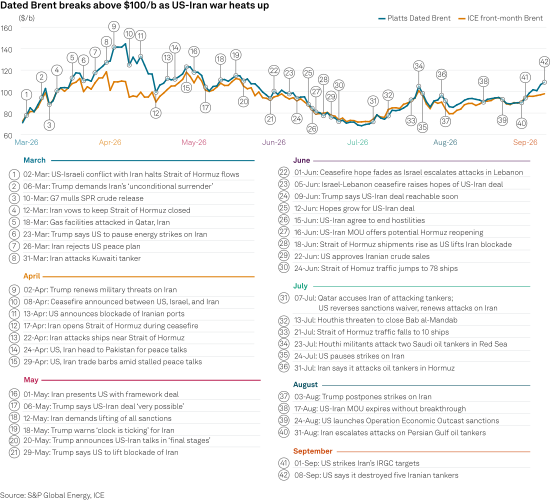
Prices
Tanker freight rates surged to record highs following the Sept. 5-9 strikes, reflecting escalating physical risk and acute route uncertainty in the Gulf of Oman.
- Platts assessed the Arab Gulf-Far East VLCC rate at an all-time high of $161.93/mt on Sept. 9, up 6.39% day over day.
- The Gulf of Oman-Far East VLCC rate hit $73.41/mt Sept. 9, up 13.85% day over day, the highest since the assessment began last month.
- Physical crude premiums have widened sharply as sour barrel scarcity pushes buyers to bid aggressively for non-sanctioned medium sour grades.
- The Murban physical crude premium to Dubai rallied to $31.14/b on Sept. 9, jumping from a $10/b premium just one week earlier on Sept. 2.
- Angolan Cabinda crude was assessed by Platts at a $2.70/b premium to the Angolan Dated Brent Strip on Sept. 9, reversing a $6.75/b discount in mid-July.
- WTI Midland basis Rotterdam was assessed by Platts at an $8.80/b premium to Dated Brent on Sept. 9, up from a $3.40/b premium on Aug. 31.
- The EIA on Sept. 9 raised its 2026 Brent crude oil price outlook to $91/b, up from $87/b a month ago, citing the ongoing Iran war's drag on Middle East exports.
Infrastructure
Western sanctions are systematically closing off financial and logistical channels that underpin Iran's ability to export and monetize its oil.
- The US Treasury on Sept. 4 sanctioned Turkish bank Golden Global Yatirim Bankasi and two subsidiaries for allegedly facilitating tens of millions of dollars in Iranian oil revenue transactions.
- The UK is expanding sanctions on Iran's energy sector and related trade as part of sweeping new legislation targeting Tehran's nuclear program, with a carefully crafted exemption designed to protect a critical gas supply route to Europe from disruption.
- Iran is attempting to offset disruptions by ramping domestic output, even as export routes and financial infrastructure face mounting pressure.
- Iran raised output at its South Azadegan oilfield to over 183,000 b/d, developer PEDCO said Sept. 5, according to oil ministry news service Shana.
- Iranian crude in Southeast Asian floating storage fell to roughly 17.4 million barrels at the end of August, down sharply from 38.1 million barrels at the end of July, per CAS data.
