Crude Oil, Agriculture, Refined Products, NGLs, Biofuels, Vegetable Oils, Sugar, Diesel-Gasoil
September 09, 2026
APPEC: Bangchak widens crude basket, lengthens planning after Hormuz disruption

By Mia Pei
Editor:
HIGHLIGHTS
Bangchak increases American, Australian crudes sourcing
Thailand cuts Middle East imports to 35%
HVO exports banned under export control
Thailand's Bangchak has broadened crude sourcing for its two refineries to span North America, South America, and Australia and is selecting far-haul supplies further in advance, Bundit Hansapaiboon, president of refinery and marketing business group at Bangchak said Sept. 9.
"We try to diversify our crude sourcing," Hansapaiboon, said during a keynote presentation at APPEC 2026. "We expand our crude basket throughout the world."
Bangchak operates the 120,000 barrels/day Phra Khanong refinery in Bangkok and the 174,000 b/d Sriracha refinery in Chonburi. The company uses a single linear-programming model to optimize crude selection and production across the two refineries as an integrated system of 294,000 b/d, Hansapaiboon noted.
Its trading business, established in Singapore about a decade ago and since expanded to Dubai, supports the refineries' crude sourcing and broader value-chain optimization, he said.
The wider geographical reach has required Bangchak to change how early it evaluates and secures crude. "We change our working procedure a lot," Hansapaiboon said. "In the past, we may run ahead about two or two and a half months, but now we have to work in advance longer than that."
Hansapaiboon cited US, Argentine, and Ecuadorian crude as examples of far-haul supplies that would require Bangchak to prepare about three to three-and-a-half months in advance.
Reduced Middle East reliance
Bangchak's strategy comes amid a broader diversification of Thailand's crude supply following the outbreak of the Middle East war and disruption of shipping through the Strait of Hormuz.
Middle Eastern crude accounted for 35% of Thailand's supply portfolio in Q2, down from 55% in Q1, according to government data shown in Bangchak's presentation.
The US share increased to 34% from 24%, while West Africa's share rose to 11% from 3%, and domestic crude increased to 10% from 8% during the same period. Far East supply remained at 10%. The combined share of crude sourced outside the Middle East consequently rose to 65% from 45%, according to the data.
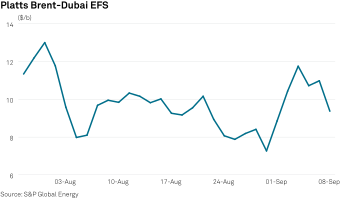
Platts, part of S&P Global Energy, assessed the November Brent-Dubai exchange of futures for swaps contract at $9.37/barrel at the London close on Sep. 8.
Hansapaiboon said panic buying briefly caused product shortages at Thai service stations at the start of the Hormuz crisis in March. Supplies subsequently stabilized after the government and domestic refiners reassured consumers that sufficient fuel remained available.
"We put more focus on energy security," he said, adding that Bangchak could not allow customers and its nationwide network of about 2,200 service stations to run short of fuel.
Biofuels support supply security
Bangchak is integrating conventional refining with domestically produced ethanol and palm-based biodiesel to reduce reliance on imported fossil fuels, said Hansapaiboon.
The group operates biodiesel, bioethanol and sustainable aviation fuel plants, drawing on domestic feedstocks including palm oil, cassava, and molasses. Hansapaiboon highlighted E20 and E85 gasoline and B7 and B20 diesel as part of Thailand's fuel diversification efforts.
Thailand's average ethanol blending rate rose to 12% in the first half of 2026 from 11% in January-February, according to the government data cited by Hansapaiboon, while the average biodiesel blending rate increased from 5% to 8%.
Hansapaiboon highlighted the flexible product split of Bangchak's 7,000 b/d SAF plant at the Phra Khanong refinery, which processes used cooking oil and can supply European customers with both SAF and hydrotreated vegetable oil. "We can do both, and we can do 100% of each mode," the executive said of the plant's SAF and HVO capabilities.
Thailand's fuel export controls continue to prevent Bangchak from exporting HVO because it is classified as gasoil. SAF does not fall under the restriction, said Hansapaiboon at the sidelines of the conference.
"We cannot export HVO because HVO is considered gas oil," Hansapaiboon said. "So right now we can only export SAF."
The restrictions were introduced in March as Thailand sought to safeguard domestic fuel supplies during the Middle East conflict. Thailand has yet to introduce a domestic SAF blending mandate, leaving European exports as Bangchak's current outlet for the plant's SAF production, he noted.
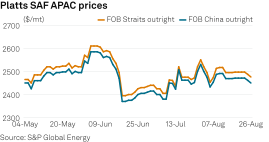
Platts assessed SAF (HEFA-SPK) FOB Straits at $2,540/mt on Sep. 9 Asian close, unchanged day over day.