Natural Gas, Electric Power, Crude Oil
September 08, 2026
GeoPark says Venezuela investment does not depend on political normalization

By Sheky Espejo
Editor:
HIGHLIGHTS
GeoPark targets 56,000 b/d by 2030
Bare field holds 15.7 billion barrels
Capex to rise from $10M to $130M annually
GeoPark on Sept. 8 laid out a five-year redevelopment plan centered on reactivating hundreds of wells to raise production from its Bare heavy oil asset in Venezuela to around 56,000 b/d by 2030, noting its investment case does not depend on a broader normalization of the political environment in the country.
"Our investment case does not depend on broader normalization of Venezuela," GeoPark said during a Sept. 8 presentation. "We have evaluated the opportunity based on the assets, the contractual framework, and the operating environment that exists today."
CEO Felipe Bayón said entering Venezuela early could give GeoPark a first-mover advantage and make it one of the few independent regional producers offering exposure to Venezuela alongside operations in Colombia and Argentina's Vaca Muerta.
The comments come amid renewed foreign investment in Venezuela's upstream sector. Eni recently secured operatorship of the Junín 5 heavy oil field under a new production participation agreement, while Chevron outlined plans to invest $7 billion and increase its Venezuelan production to nearly 600,000 b/d by 2031.
S&P Global Energy said Sept. 8 that Venezuela, which began 2026 ranked last among 113 jurisdictions in its oil and gas risk assessment, is now the most improved globally. S&P also sees considerably more upside to Venezuela's production outlook than it did only weeks ago.
Crude output could approach 1.5 million b/d over the next 12 to 18 months under its higher-case scenario, according to the analysts.
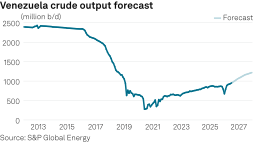
The recovery still faces execution risks, including infrastructure and electricity constraints as well as Venezuela's unresolved debt burden, according to S&P.
Redevelopment plan
GeoPark's 2026-2030 plan for Bare calls for between 400 and 450 well reactivations, around 100 workovers and approximately 30 horizontal wells, alongside artificial-lift optimization and rehabilitation of critical infrastructure, management said during a call with analysts.
The asset produces 10,000-11,000 b/d from more than 100 active wells, compared with historical peak production above 120,000 b/d, management said. It has about 1,160 wells and 15.7 billion barrels of original oil in place, with a recovery factor of between 4% and 5%.
GeoPark plans to target lower-cost production from the existing well stock before moving into more capital-intensive drilling. Venezuela capex is expected to rise from about $10 million in 2026 to around $130 million in 2030, with spending accelerating as new drilling increases in 2029 and 2030.
Management said the spending profile reflects the development sequence rather than an expectation that Venezuela's political or regulatory risks will diminish. From 2031, additional horizontal drilling, workovers and thermal recovery could eventually lift production toward 90,000 b/d.
Existing facilities can handle around 30,000 b/d, allowing GeoPark to begin well reactivations without an immediate major expansion. Power demand is expected to rise to around 10 GW, with associated gas used to generate electricity.
Diluent requirements could increase from roughly 4,000 b/d currently to as much as 30,000 b/d as oil production approaches 50,000 b/d. PDVSA is expected to supply the diluent, but GeoPark said it could procure volumes independently and deliver them through the José terminal if required.
Project economics
GeoPark expects operating costs and working capital requirements to initially run in the high teens per barrel before declining to around $8/b to $10/b by 2030. Venezuela-specific general and administrative expenses are expected to add $1/b to $2/b, management said.
Management estimated a Merey crude commercial and quality discount of between $14/b and $15/b, including transportation to the export port, and a volumetric compensation for taxes, royalties and PDVSA's interest equivalent to approximately $5/b to $6/b during the initial phase.
The company expects operating cash flow of between $42/b and $47/b and estimated capital expenditure of between $10/b and $12/b, resulting in a free cash flow breakeven of between $32/b and $35/b once production reaches a more mature stage, management said.
GeoPark cautioned that the first 18 to 24 months would carry higher costs as operations ramp up. It declined to disclose the discount rate applied to the project but said the rate included a Venezuela risk premium above the company's usual 15% investment-return threshold.
Under the fiscal structure described by GeoPark, 35% of gross production is allocated to Venezuela as government take, comprising a 25% integrated tax-and-royalty component and a 10% PDVSA interest.
Over the contract's life, GeoPark expects Bare to add approximately 400 million barrels of cumulative net production
The comments come amid renewed foreign investment in Venezuela's upstream sector.
