Agriculture, Refined Products, Energy Transition, Biofuels, Jet Fuel, Diesel-Gasoil, Oilseeds, Hydrogen
September 07, 2026
INTERVIEW: Australia can become regional SAF hub with onshore feedstocks: Boeing

By Mia Pei
Editor:
HIGHLIGHTS
Distributed supply chain model emerges
Policy must balance production, demand: exec
Boeing-CSIRO high case sees SAF at 90% of 2050 demand
Policy settings will determine whether Australia emerges as a sustainable aviation fuel production and export hub or remains principally a supplier of raw materials to overseas refiners, Boeing's head of sustainability for Asia-Pacific and India, Kimberly Camrass, told Platts, part of S&P Global Energy, Aug. 27. This comes as the Asia-Pacific region's low-carbon fuel supply chain develops under a more distributed model.
The question has gained immediacy after the Australian government opened consultation on a potential demand mechanism for low-carbon liquid fuels, including those used in aviation, with feedback closing Sept. 15.
The consultation forms part of Australia's wider A$14.8 billion Fuel Security and Resilience Package, which also includes A$3.2 billion for a government-owned reserve of 1 billion liters of diesel and jet fuel.
Unlike conventional jet fuel, which is generally supplied by fewer, larger refineries and trading hubs, SAF could be produced closer to the region's varied feedstock pools, Camrass told Platts in an interview.
"We're actually seeing the potential for a more distributed supply chain," she said, adding that this could spread the economic benefits of fuel production among countries while reducing exposure to disruptions in existing fossil-fuel supply chains.
Production would depend on where feedstocks and processing capabilities overlap. Some markets have feedstocks but limited processing capacity, while Singapore and South Korea have substantial refining or blending infrastructure but fewer domestic feedstock options. A regional market would need to connect producers, processors and consuming countries, Camrass said.
"Asia-Pacific has a high level of readiness and potential for SAF production to service its own needs and even to provide export opportunities to the rest of the world," she said. "The challenge is turning that potential into production in the short to medium term."
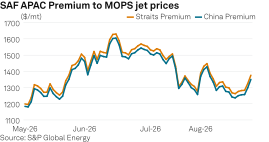
Platts assessed SAF (HEFA-SPK) FOB Straits at $2,560/mt on Sept. 4, up $56/mt day over day.
Australia's high-case potential
A 2023 roadmap by Boeing and Australia's Commonwealth Scientific and Industrial Research Organisation found that local resources could theoretically support SAF output equivalent to almost 90% of projected Australian jet fuel demand by 2050.
The high case assumes greater feedstock availability, higher biorefinery yields and growing hydrogen production. Potential output reached 89.72% of demand, compared with 7.57% in the low case. Boeing said both scenarios remain applicable.
Australia exports up to A$6 billion of feedstocks annually, including canola and tallow, according to the government.
"If Australia is to receive the economic and industrial development benefits of a SAF industry, it would be preferable for that SAF to be produced here and exported, as opposed to the feedstock being exported directly," Camrass said.
The policy framework would ultimately determine which trade model prevailed, she added.
Australia and New Zealand could eventually supply Pacific island countries lacking the resources for domestic SAF production, Camrass said.
Balancing supply and demand
"A demand-side policy that has not considered the supply-side requirements is poor economic policy and can result in less affordable aviation, less accessible aviation," Camrass said.
Boeing supports a package of supply-and-demand measures rather than a single instrument. Camrass cited alignment with CORSIA, transparent obligations, compatible federal and state incentives and a policy duration of at least 10 years. Guaranteed strike prices and production tax incentives could lower costs and improve project bankability, she said.
Through 2030, Boeing supports coprocessing and other transitional options at existing Australian refineries, Camrass said.
Corporate demand could provide additional support through book-and-claim systems, under which buyers purchase SAF's environmental attributes without receiving the physical fuel.
"Book and claim at a domestic level in Australia will be absolutely critical," Camrass said.
The systems could help companies address Scope 3 business-travel emissions, attract corporate capital and help airlines absorb part of SAF's price premium, Camrass said.
Certification pathway
Camrass said Boeing was working to enable higher SAF blend rates. Current ASTM International specifications allow fuel produced through approved SAF pathways to be blended with conventional jet fuel at rates of up to 50%.
"Over the past five years, we worked with ASTM to enable SAF within existing fuel specifications, proving that adoption requires no changes to engines, fuel systems, or airport infrastructure," Camrass said. Boeing is also working to expand fuel specifications to ensure compatibility with existing and future fleets.
The company aims to ensure that all new commercial airplanes delivered from 2030 are compatible with 100% SAF and is procuring blended SAF for its US operations.
Scaling production, however, will require action by stakeholders beyond aircraft manufacturers, Camrass added.
