Refined Products, Crude Oil, Diesel-Gasoil, Gasoline
September 03, 2026
Why the Americas are not prepared for peak diesel demand season

Editor:
HIGHLIGHTS
Global diesel inventories drop 28.5 million barrels
US diesel stocks fall below five-year range
Brazil loses Russian supply, relies on US imports
The Americas are heading into their most diesel-intensive stretch of the year with the thinnest buffers seen in recent memory, and the numbers explain why.
Three forces are converging at once: a structural global supply deficit that has removed half the world's net diesel length from the market, a US inventory position that is already drawing down ahead of schedule, and a South American market — Brazil in particular — that may be even more exposed than the US.
And seasonal diesel demand is peaking. Agricultural demand for diesel is rising in South America, where planting is beginning, and in North America, where harvesting is underway, right ahead of peak heating demand season.
A global deficit with no slack
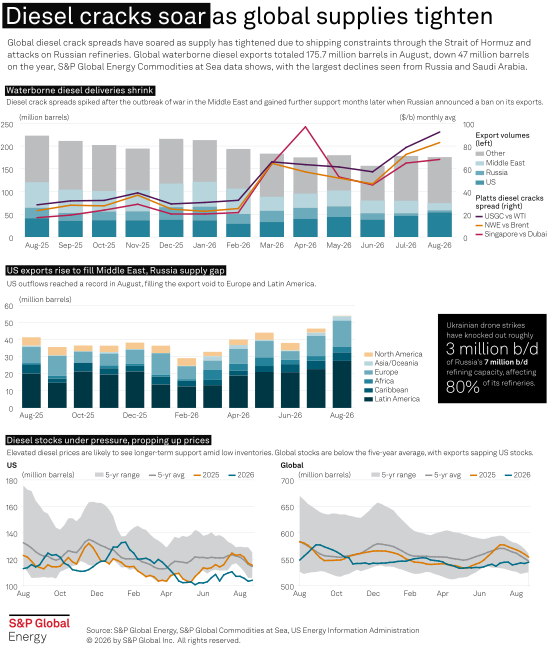
Global diesel inventories stood at 542 million barrels, or roughly 73.2 million metric tons, as of Aug. 21, down 28.5 million barrels, or about 3.8 million mt, year over year, according to S&P Global Energy CERA.
Russia and the Middle East, which together account for roughly half of global net diesel length, have both been effectively sidelined, CERA's analysts said.
Although Russia has asked refiners to run harder, there is no way to compensate for the scale of the losses of those impacted refineries, said Dan Evans, CERA's head of fuels and refining research, on a Sept. 2 webinar.
"We're seeing the tightness in the domestic market in Russia, and we're also seeing a massive decline in export flows," he said.
Russia's diesel export ban has been extended through Sept. 30, and August shipments fell to just 504,600 mt, or roughly 3.7 million barrels, from 743,000 mt, or about 5.5 million barrels, in July, according to S&P Global Commodities at Sea (CAS) data.
Ukrainian drone strikes have knocked out roughly 3 million b/d, or about 405,000 mt/d, of Russia's 7 million b/d, or about 945,000 mt/d, of refining capacity, affecting 80% of its refineries.
Middle Eastern impasse
Meanwhile, Strait of Hormuz disruptions have cut Middle East refined product exports by3 million-4 million b/d, or roughly 405,000-540,000 mt/d, with no equivalent bypass route for products the way crude has found alternative corridors, according to CERA estimates
This has pushed the entire Atlantic Basin refining system — covering North America, Europe, Africa and Latin America — to run flat out, with US refinery utilization hitting a record 98%, an eight-year high, according to weekly US Energy Information Administration data.
According to CERA data, between 2 million and 3 million b/d of products, or roughly 270,000-405,000 mt/d, are effectively "missing" from global supply.
And the price signal is unmistakable: diesel in New York hit the equivalent of nearly $200/b, or about $1,480/mt, on Sept. 1, roughly double Dated Brent, while the USGC ULSD crack spread hit an all-time high of $98.15/b, or about $726/mt, the same day, according to price data from Platts, part of S&P Global Energy.
US cushion erodes
The US occupies a dual role as both the Western Hemisphere's swing supplier and the market most vulnerable to a domestic shortfall.
According to most recent weekly EIA data, ULSD stocks rose slightly to 94.18 million barrels, or roughly 12.7 million mt, for the week ended Aug. 28.
However, overall ULSD stocks are down about 12.2 million barrels, or roughly 1.6 million mt, year over year and below the bottom of the five-year range — sitting 7.4 million barrels beneath the prior five-year comparable-week minimum of 101.62 million barrels, the EIA data shows.
Forecasts from CERA and other analysts show stocks bottoming near 100 million barrels, or about 13.5 million mt, in October — exactly when harvest and pre-heating demand peaks.
Compounding the constraints, US diesel exports hit a record 54.2 million barrels, or roughly 7.3 million mt, in August, as the country tries to plug the global gap left by Russia and the Middle East while its own seasonal needs accelerate, according to CAS and EIA data.
The widening export discount has done nothing to slow the flow of barrels abroad.
US ULSD exports averaged 1.77 million b/d since Aug. 22, well above the 12-month average of 1.3 million b/d, and August as a whole set an all-time monthly export record of 54.2 million barrels, according to CAS data.
The USGC-Northwest Europe arbitrage averaged open at $3.91/b in August, peaking at $7.63/b on Aug. 10, incentivizing transatlantic flows even as the domestic pipeline price commanded a premium, according to Platts prices.
Export ULSD traded at a persistent and deepening discount to domestic pipeline ULSD on every single observed day.
The spread widened by nearly 10 cents/gal from its narrowest point on Aug. 27 to the latest assessment Sept. 1, reflecting the pull of record-high domestic crack spreads — the prompt pipeline ULSD WTI front-month crack hit an all-time high of $96.793/b on Aug. 31 — which elevated domestic pipeline values faster than export netbacks, according to Platts data.
Three demand drivers are converging in a narrow October-November window: fall harvest across PADD 2 and PADD 4, early winter heating demand already prompting diesel shipments to New York, and refinery turnaround season, which will cut output at precisely the moment every other demand category is peaking.
Globally, diesel demand typically rises by 2 million b/d, or roughly 270,000 mt/d, between August and October, a seasonal surge this constrained system has no clear capacity to absorb, according to CERA estimates.
South America may be worse positioned
South America enters its spring planting season with regional diesel inventories at their lowest seasonal point of the year, around 21,500-22,800 thousand barrels, or roughly 2.9 million-3.1 million mt, according to CAS.
Brazil, the region's largest consumer at roughly 1.2 million b/d, or about 167,000 mt/d, has lost Russian diesel entirely and is now sourcing about 74% of its August imports from the US Gulf Coast, CAS data shows.
According to the CAS data, Brazil's surge to 208,000 b/d of US ULSD imports is consistent with the broader picture: with Russia's diesel export ban extended through Sept. 30 and no Russian tankers en route to Brazil as of Aug. 28.
The US Gulf Coast captured 74% of Brazil's August diesel arrivals (1.015 million cubic meters), the highest US market share of the year, CAS data showed.
Platts assessed DAP Santos cargoes of US-origin ULSD at a 3-cent/gal discount to NYMEX October ULSD futures for MRs on Aug. 28, making USGC barrels competitive despite the elevated domestic pipeline price.
Port congestion at Paranaguá, Santos and Itaqui created a 21% gap between berthed and discharged cargoes in August, and Brazil's diesel import window has been closed for 227 days as of Aug. 28, according to Platts market data.
Bolivia's government took emergency control of state oil company YPFB on Sept. 2 after diesel and gasoline sales fell 21% in the first half of the year — a systemic failure carrying contagion risk for neighboring markets, according to S&P Global Latin America Refined Products Short-Term Report.
With hurricane season active through Nov. 30, a likely extension of Russia's export ban, continued Hormuz restrictions, and worsening Brazilian port congestion, the region has essentially no reserve capacity and no historic-scale inventory cushion left to absorb a disruption.
