Refined Products, Natural Gas, Chemicals, Maritime & Shipping, Crude Oil, Electric Power, Energy Transition, Coal, Agriculture, Polymers, Wet Freight, Dry Freight, Renewables, LPG, Naphtha, Biofuels
September 03, 2026
APPEC: Energy security takes center stage as Asia confronts shifting oil, shipping flows
HIGHLIGHTS
APPEC to be held over Sept. 7-10 in Singapore
Hormuz crisis is market's 'ultimate theoretical risk'
Storage, access to ships, new routes in focus
Asia's push for energy security amid evolving oil flows, shipping disruptions and high prices is expected to be a central theme at APPEC 2026, where discussions are poised to focus on how the region is preparing to overcome supply challenges caused by heightened market crises driven by geopolitical conflicts.
While the conference, hosted by S&P Global Energy over Sept. 7-10 in Singapore, would spotlight critical themes ranging from market stability to Asia's transitioning role in the global energy landscape, experts are expected to explore how geopolitical tensions, including the Strait of Hormuz crisis, have exposed vulnerabilities in Asia's supply chains and prompted refiners and traders to reassess their strategic priorities.
Delegates are anticipated to debate whether recent trade rerouting represents a lasting structural shift or a temporary response to disruptions, and what factors could trigger further changes in trade flows.
"APPEC, over the past years, has guided the market through the rise of China, the US shale revolution and a global pandemic," S&P Global Energy President Dave Ernsberger told Platts on Sept. 2. "But 2026 is different. This year, the market's ultimate theoretical risk, closure of the Strait of Hormuz, has become a very physical reality. With trade flows shifting and geopolitics reshaping the landscape all around us, this is a pivotal moment for global energy."
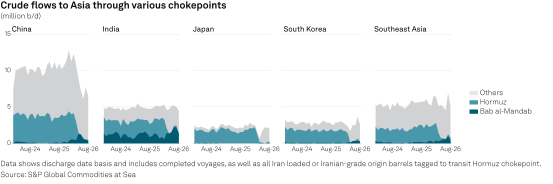
About 75% of Asia's Middle Eastern crude imports transited the Strait of Hormuz in 2025, according to S&P Global Energy CERA. By the third quarter of 2026, that share had fallen sharply, fluctuating between 10% and 20%, ship-tracking data from S&P Global Commodities at Sea showed.
Another key focus at the conference would be energy storage and strategic reserves, as industry participants examine what current inventory levels and reserve policies reveal about underlying market stress versus short-term volatility.
"For most Asian economies, particularly those still industrializing and urbanizing, energy security remains the overriding priority," said Atul Arya, chief energy strategist at S&P Global Energy. "The impact of the crisis has highlighted the need for diversifying supply sources, which may come at a cost, as well as creating strategic reserves for crude oil, refined products and where feasible, for gas."
Trade transformation
Asian refiners are navigating economic, reliability and compliance risks in crude selection, while producer strategies and evolving customer partnerships amid shifting trade dynamics are expected to be key topics at APPEC.
As Asia's refining sector transforms, delegates are anticipated to explore how refining capacity, competition and margins impact crude buying, particularly the balance between sweet and sour grades and between light and heavy grades.
"The global refining sector is not a static industry waiting to be phased out; it is an active engine of evolution," said Debangsu Ray, cluster president and head of Reliance Industries Ltd.'s Jamnagar refinery.
"Highly complex, deeply integrated coastal assets are uniquely capable of transforming their operations to produce clean fuels, advanced polymers, and transition materials that the modern world requires," Ray said. "Scale, complexity, and adaptability will distinguish the winners in this changing landscape."
Related podcast: APPEC to focus on Asia's energy resilience and vulnerability in a fragmented market
APPEC comes as the global shipping sector faces scrutiny, with industry leaders assessing how oil trade, security and regulatory changes are reshaping freight markets and supply chains. The spotlight will be on the shipping industry's adaptability in this rapidly evolving landscape.
"Geopolitical conflicts, sanctions, attacks on ships and maritime infrastructure, and changing trade relationships have fundamentally altered how barrels move around the world," said Rahul Kapoor, head of shipping and metal analytics at S&P Global Energy. "Today, freight is no longer simply a transactional cost. Access to shipping assets has become a strategic variable influencing trade flows, reshaping arbitrage opportunities and determining who can successfully compete in global markets."
Managing freight, insurance and the economics of arbitrage would be another key theme, as industry participants grapple with rising costs. The conference is also expected to examine the factors shaping tanker and dry bulk shipping demand.
Navigating volatility
Oil futures settled slightly higher Sept. 2 as renewed US-Iran military strikes near the Strait of Hormuz heightened concerns over potential disruptions to Persian Gulf crude flows. NYMEX October WTI settled 79 cents/barrel higher at $91.01/b, its highest level since July, and ICE October Brent rose 98 cents/b to $95.63/b.
At APPEC, attention is likely to focus on how market participants are managing price volatility. With both term contracts and spot exposure under scrutiny, experts are expected to discuss how price benchmarks are evolving to reflect the realities of increasingly uncertain markets.
Trading desks, facing frequent price swings and the impact of sanctions, are recalibrating risk management strategies as long-held assumptions about trade flows and counterparties are tested, with panelists set to explore evolving approaches to hedging and exposure management in a rapidly changing market environment.
Jenny Yang, head of power and renewables research at S&P Global Energy CERA, said geopolitical conflicts are no longer only disrupting commodity trade flows but are also affecting power system operations, underscoring the growing interdependence of energy security, fuel availability and electricity reliability.
"Investments in electrification, renewables with storage, nuclear, geothermal, domestic coal and other indigenous resources are increasingly driven by energy security objectives, with significant implications for future energy markets and commodity trade flows," Yang said.
APPEC will also spotlight rapidly changing chemical markets, as delegates assess how the conflict in the Middle East could reshape LPG and naphtha trade flows.
Biofuels, sustainable aviation fuel and digital transformation are anticipated to feature in discussions at the conference, as delegates review Asia's role in the transitioning global market.
With growth propelled by evolving policy frameworks and cross-sector collaboration, participants are expected to deliberate on how refiners, traders and technology providers are joining forces to scale up biofuels production despite complex supply and demand dynamics and adoption challenges.
The conference will highlight the impact of digital transformation and artificial intelligence on energy companies, as they pursue innovative strategies to optimize supply chains, enhance operational efficiency and manage risk.
