Maritime & Shipping, Crude Oil, Natural Gas, Chemicals, Electric Power, Refined Products, Wet Freight, Fuel Oil
August 25, 2026
Indonesia, Malaysia, Singapore reaffirm open Malacca-Singapore straits amid risks

By Mia Pei
Editor:
HIGHLIGHTS
Three nations commit to safe, free strait passage
Over 100,000 ships transit straits of Malacca, Singapore
New fuels and tech could create safety challenges
Indonesia, Malaysia, and Singapore reaffirmed their commitment to ensuring the straits of Malacca and Singapore remain free, open and secure for international shipping, as disruptions in the Strait of Hormuz have intensified attention on global maritime chokepoints.
The three littoral states affirmed that the status of the straits of Malacca and Singapore are international navigation waterways where the right of transit passage applies under the UN Convention on the Law of the Sea, emphasizing that navigational rights and freedoms must be respected "both in principle and practice," according to a joint statement issued at the 17th Co-operation Forum in Singapore on Aug. 25.
"Events in the Middle East this year reminded the world that open sea lanes can never be taken for granted," Singapore Transport Minister Jeffrey Siow said at the opening of the forum. "In our part of the world, we will endeavor to keep the Straits of Malacca and Singapore free, open, and safe for international shipping."
More than 100,000 vessels transit the straits of Malacca and Singapore each year, carrying almost a quarter of global seaborne trade and nearly a third of the world's oil and gas supplies, Siow said.
In contrast, total crossings through the Strait of Hormuz averaged 23 vessels/day over Aug. 21-23, compared with a daily average of more than 110 vessels prior to the war in the Middle East, according to S&P Global Commodities at Sea.
At the two-day event held from Aug. 25 to 26 the three littoral states, user states and industry stakeholders are expected to discuss the safe introduction of new technologies and alternative fuels in the straits of Malacca and Singapore, while also reviewing technical projects to improve navigational safety, the joint statement said.
The forum is part of the Co-operative Mechanism on Safety of Navigation and Environmental Protection in the straits of Malacca and Singapore that was established in 2007 by the three littoral states.
The mechanism is regarded as the first and only practical implementation of Article 43 of the UN Convention on the Law of the Sea, which calls for cooperation in international straits, Siow said.
New risks, fuels in focus
Singapore is seeking stronger trilateral responses to emerging marine incidents as traffic volumes increase, vessels become larger, and cargo profiles change.
The three littoral states are expected to finalize regional guidelines in 2026 to strengthen coordination for vessels in distress requiring a place of refuge, while Singapore aims to propose trilateral measures and procedures to address the growing incidence of cargo fires on container ships, Siow said.
The Maritime and Port Authority of Singapore Chief Executive, Ang Wee Keong, said at the forum that increasing traffic, larger vessels, and changing cargo profiles were making the operating environment in the straits of Malacca and Singapore increasingly complex.
Discussions at the forum will cover marine incident trends, cargo safety and a review of the under-keel clearance limit, as well as technologies including very high frequency data exchange systems, satellite-based augmentation systems, near-miss detection tools and simulation technologies, Ang said.
The under-keel clearance requirement is relevant for deep-draft vessels, such as VLCCs, transiting the waterway; as a result, changes to navigational parameters are closely watched by crude tanker operators.
Additionally, the transition toward alternative marine fuels is introducing new operational and safety considerations for vessels transiting the straits of Malacca and Singapore.
"While the shift toward a multi-fuel future can help reduce shipping emissions and ensure energy resilience, it also introduces new operational and safety challenges," Ang said.
The forum will examine the use of ammonia and methanol as marine fuels, electric vessel operations, and the training required for seafarers as shipping moves toward a wider range of fuel options, according to Ang.
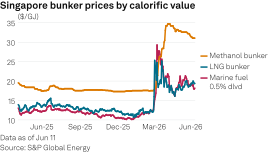
Platts, part of S&P Global Energy, assessed the methanol bunker price in Singapore by calorific value at $27.814/gig on Aug. 24, up $0.023/gig from the previous assessment.
Indonesia, Malaysia seek coordination
Indonesia called for greater coordination among maritime systems, including the straits of Malacca and Singapore ship reporting system, and proposed a dedicated project to examine future maritime technologies and regulatory preparedness.
A representative of Indonesia's director general of sea transportation said at the forum that the International Maritime Organization's non-mandatory code for autonomous surface ships, which took effect July 1, could introduce new challenges in the heavily congested straits.
Malaysia also highlighted the economic and energy security implications of maintaining the route's reliable operation.
Continued cooperation, real-time information sharing and sustained investment in navigational safety are critical "safeguards for global trade and energy security," Malaysia Marine Department Director General Datuk Haji Dickson bin Dollah said at the forum.
Maritime disruptions in the Strait of Hormuz have demonstrated how problems at a chokepoint could strain global oil and gas supplies and drive up energy prices, he said.
