Natural Gas, Crude Oil, Refined Products, Jet Fuel
August 24, 2026
INDIA CEO SERIES: BP sees India entering pivotal decade in its energy history

Editor:
HIGHLIGHTS
BP has invested more than $13B in India's energy sector
Says India successfully navigated Strait of Hormuz disruption
India's influence on global energy demand expected to rise through 2050
The India CEO Series by S&P Global Energy is a compilation of exclusive interviews by Asia Energy Editor Sambit Mohanty with some of the leaders of the biggest energy companies in India.
India's choices on energy security, domestic production, technology adoption, and infrastructure development will increasingly shape both its own growth trajectory and the future evolution of the global energy system, as its influence on global demand will continue to rise through 2050, Kartikeya Dube, Chairman of BP India, said.
"The recent Middle East crisis reinforced a lesson India has long understood -- energy security is strongest when domestic capability grows alongside global connectivity," Dube told Platts, part of S&P Global Energy, in an exclusive interview for the India CEO Series, adding that the events underscored that domestic production, resilient infrastructure and diversified supply chains are complementary pillars of long-term energy security.
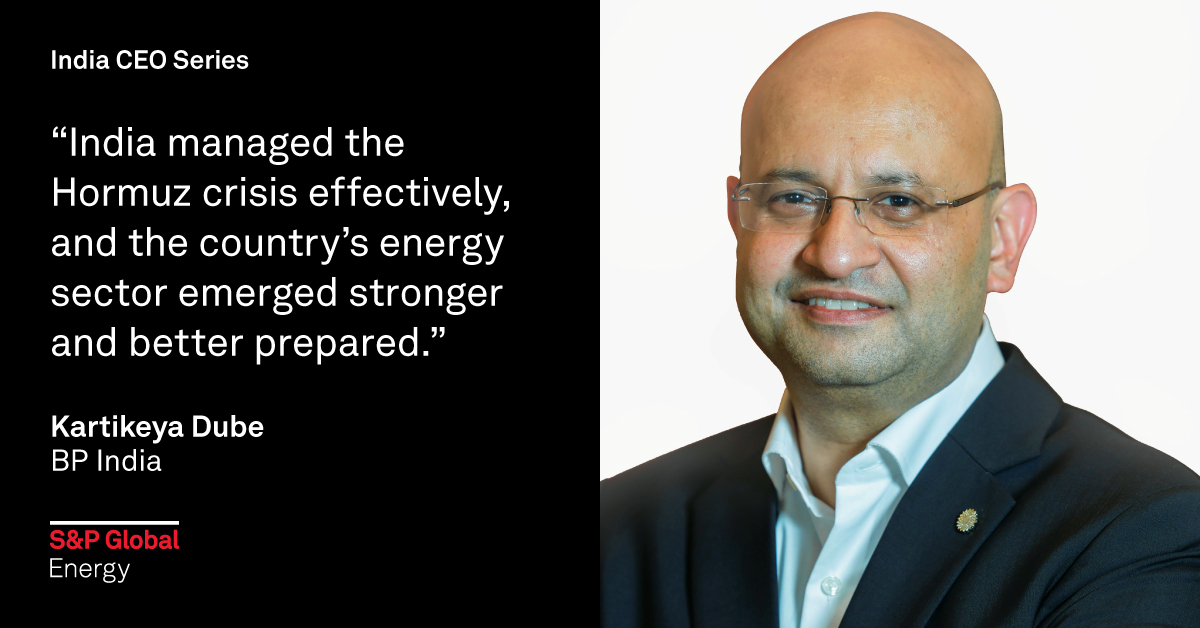
India successfully navigated the disruption in the Strait of Hormuz through coordinated action by the government and industry. Refiners adapted to alternative crude grades, supply chains remained intact and major fuel shortages were avoided despite the country's significant dependence on imported energy, he said.
"In my view, India managed the crisis effectively, and the sector emerged stronger and better prepared. The experience reinforced that there is ultimately no substitute for strengthening domestic production capability while maintaining the flexibility and resilience that come from global connectivity," Dube added.
BP has invested more than $13 billion in India and, through its partnership with Reliance Industries, is helping deliver approximately one-third of the country's domestic gas production from the Krishna Godavari Basin, Dube said.
"India's energy story is increasingly becoming a story of capability creation. The opportunity is not only to meet growing demand, but to strengthen the foundations of long-term energy security while supporting economic growth and development," Dube said.
Deepwater opportunity
Few opportunities have the potential to reshape India's energy future as significantly as successful deepwater exploration, Dube said.
The launch of the National Offshore Exploration Scheme -- called Samudra Manthan -- reflects a growing recognition that India's long-term energy security will increasingly depend on its ability to unlock domestic resources at scale. It signals a willingness to pursue opportunities that require long-term vision, advanced technology and patient capital.
The Indian cabinet recently approved investments of up to 840 billion Indian rupees ($8.78 billion) over five years to accelerate offshore oil and gas exploration. The initiative is expected to catalyze reserve accretion of more than 600 million metric tons of oil equivalent by fiscal year 2030-31 (April-March).
"Samudra Manthan recognizes a simple reality -- India's deepwater resources represent one of the largest remaining opportunities to strengthen domestic energy capability," Dube said. "Its significance lies not only in the resources that may be discovered, but in the technology, skills and ecosystem that can be developed around them."
India's sedimentary basins -- particularly in deepwater and ultra-deepwater regions -- remain significantly underexplored relative to their geological promise. Basins including the Andamans, Krishna Godavari, Mahanadi, and Kutch offer meaningful potential, although development involves complex technical challenges, significant capital requirements and long investment horizons.
What is particularly encouraging, according to Dube, is that India today possesses many of the ingredients required for success -- policy ambition, strong national institutions, capable industry partners and one of the world's deepest pools of engineering, scientific and digital talent.
"As technologies such as AI, advanced analytics and high-performance computing become increasingly important in exploration and production, India has an opportunity not only to develop resources, but to build capabilities that strengthen its long-term competitiveness and influence within the global energy system," Dube said.
As the initiative gathers momentum, BP believes its global deepwater experience can contribute through advanced technologies, digital capabilities and project execution expertise, he said.
Partnerships strengthen domestic capability
India's offshore ambitions are built on foundations established over decades by institutions, such as ONGC. As the sector enters a new phase focused on recovery enhancement, technology deployment and deepwater development, collaboration between domestic and global partners has the potential to unlock significant additional value from India's resource base, Dube said.
BP has been selected as the technical services provider for both Mumbai High and ONGC's 43-block Western Offshore area. The collaboration brings expertise in reservoir management, enhanced recovery, and offshore operations to some of India's most significant producing assets, Dube said.
"Our work alongside ONGC demonstrates what can be achieved when a deep understanding of Indian reservoirs is combined with global technical and operational expertise. The shared objective is clear: improve recovery, enhance efficiency and support sustained production from strategic national assets," Dube said.
The collaboration seeks to moderate natural production decline, improve hydrocarbon recovery and operational efficiency, and support sustained production growth.
At the same time, BP continues to strengthen its deep partnership with Reliance Industries across fuel retailing, mobility solutions, and upstream oil and gas production. Its gas marketing joint venture, India Gas Solutions, serves key gas-consuming sectors and continues to expand across the downstream gas value chain.
Natural gas is expected to play an increasingly important role in India's energy transition, driven by its cost competitiveness, reliability, and lower-emission profile compared with other fossil fuels, alongside robust demand growth from the industry, infrastructure, transport, and residential sectors.
The participation of BP, Reliance and ONGC in recent offshore licensing rounds demonstrates a shared commitment to supporting the next phase of India's upstream growth and resource development, Dube said.
Disciplined capital seeks competitive opportunities
The current global energy landscape presents India with a significant opportunity to accelerate exploration and development of its hydrocarbon resources. However, global E&P capital remains highly disciplined, and opportunities must compete for investment based on their ability to deliver attractive returns and long-term value.
"Capital is increasingly selective. Investment flows towards jurisdictions that combine resource potential with regulatory certainty, competitive fiscal frameworks and efficient operating environments," he added.
India has made substantial progress in strengthening its investment framework and improving the attractiveness of its upstream sector. Continued reforms can further reinforce the country's competitiveness and ability to attract long-term capital, technology and expertise.
Measures such as further gas market deregulation, reduction of integrated goods and services tax on petroleum operations, and inclusion of natural gas and aviation turbine fuel within the GST framework could further improve sector economics and accelerate development.
Dube said the foundations were already being laid through initiatives such as Samudra Manthan, the enduring strengths of institutions such as ONGC, continued reforms and growing collaboration across India's energy ecosystem.
"If this momentum continues, India has the opportunity not only to remain one of the world's most important energy markets, but to emerge as one of its most influential energy leaders," he said.
