Agriculture, Chemicals, Refined Products, Biofuels, Vegetable Oils, Fuel Oil
August 20, 2026
PIMD eyes Singapore biomethanol exports after 2028 scale-up: exec

By Mia Pei
Editor:
HIGHLIGHTS
Pertamina NRE's pilot plant validates fuel
Domestic demand anchors initial production
PIMD weighs Singapore methanol bunker license
Singapore-based Pertamina International Marketing and Distribution is eyeing Singapore as the first reference market for Indonesian biomethanol, with physical exports expected to begin after a commercial-scale plant, targeted for around 2028, comes online, Aditya Prabowo, managing director of PIMD, told Platts, part of S&P Global Energy, on Aug. 19.
"We want the pilot at Sei Mangkei to prove the fuel first," he said, adding that the pilot facility is scheduled to begin operations in December 2026.
Pertamina New & Renewable Energy (Pertamina NRE) and Singapore-based CRecTech plan to develop the 50 metric tons/year pilot facility at Pertamina NRE's existing biogas power plant in the Sei Mangkei Special Economic Zone in North Sumatra, as part of Pertamina NRE's three agreements inked on Aug. 14 covering the production, domestic offtake and international marketing of biomethanol.
The pilot facility will convert biogas derived from palm oil mill effluent into biomethanol using CRecTech's catalyst technology. CRecTech has said the process could reduce production costs by up to 50% by cutting the conventional four-stage conversion process to two stages.
PIMD's memorandum of understanding with Pertamina NRE to develop the international bunker market for biomethanol remains exploratory and does not include volume or offtake commitments, Prabowo said. "At this stage, the MOU is a framework to explore, not a work order."
Under the MOU, the two companies will form a joint working team to study how biomethanol could be supplied and marketed as a marine fuel, as well as how the associated environmental attributes would be managed.
Market development, logistics and certification will be among the areas examined, but any supply or offtake arrangement would require a separate definitive agreement after production has been validated, Prabowo said.
"What the MOU deliberately does not cover is offtake ... once production is validated, supply arrangements would come through definitive agreements," he added.
"We'd rather sequence it this way than sign volume commitments for a product that isn't flowing yet," said Prabowo, noting that the first commercial-scale facility is targeted around 2028, without disclosing the expected commercial facility's planned capacity, investment cost or definitive start-up date.
The companies envisage replicating the production model at other locations, with Indonesia having about 1,800 palm oil mills that generate POME, said Prabowo. "The ceiling is high."
Domestic offtake
Domestic demand will initially anchor the project because Indonesia currently imports about two-thirds of its annual methanol requirement of nearly 2 million mt, according to Pertamina.
Pertamina NRE has signed a heads of agreement with Pertamina Group's petrochemical trading arm Pertachem, which will take the output from the pilot facility and negotiate a framework for longer-term domestic supply.
PIMD's Prabowo noted that the eventual division of commercial production between domestic and export markets has yet to be determined.
"Export volumes will follow production scale-up and what the international market offers... A first physical export cargo realistically comes after the commercial plant is running," said Prabowo.
Singapore as reference market
Singapore is the leading candidate for PIMD's initial marine-fuel marketing efforts because of its position as the world's largest bunkering hub, its proximity to Indonesia, and PIMD's existing bunker operations in the city-state.
"Singapore is the obvious reference market," Prabowo said. "It's the world's biggest bunkering hub, about three days' sail from Kuala Tanjung, and PIMD already operates there as a licensed bunker supplier."
PIMD is licensed by the Maritime and Port Authority of Singapore to supply marine distillates and fuel oil, but it does not currently hold a dedicated methanol bunker-supplier license.
"Whether and when a dedicated methanol bunkering license gets pursued is one of the things the working team will work through," Prabowo said.
Singapore's three methanol bunker suppliers for the 2026-30 licensing period are Global Energy Trading, Golden Island and PetroChina International Singapore, according to the authority's latest list of licensed suppliers.
Prabowo noted that PIMD will also assess other ports where methanol demand and price benchmarks are developing, although no market beyond Singapore has been prioritized.
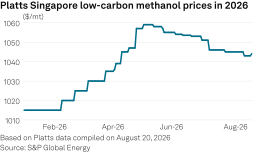
Platts assessed Singapore low-carbon methanol at $1,044/mt Aug. 19, up $1/mt day over day, in line with gains in the adjacent gray methanol bunker market.